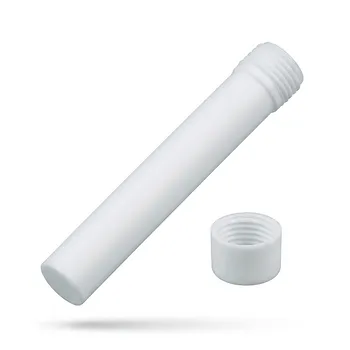
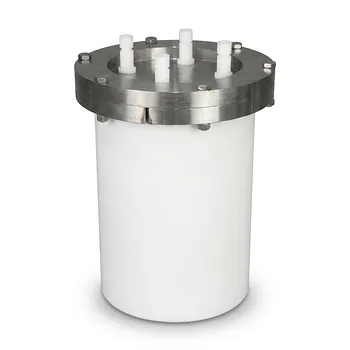
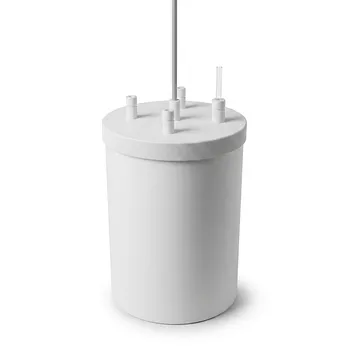
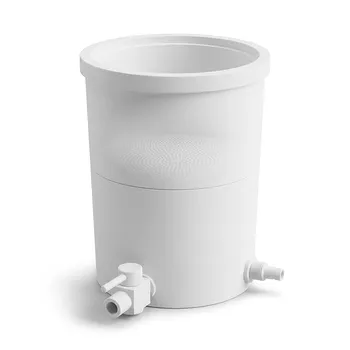
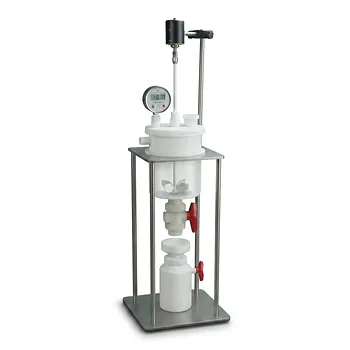
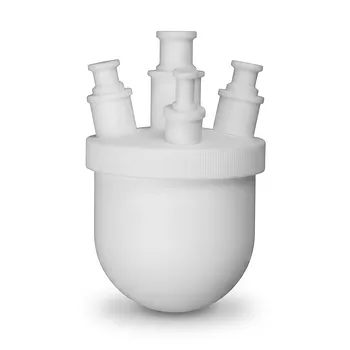
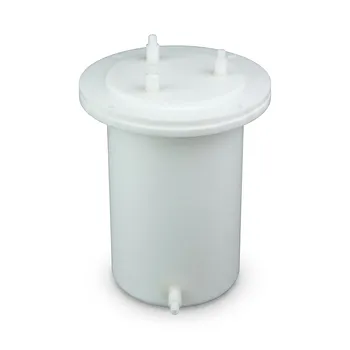
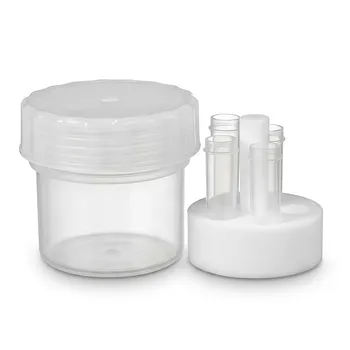
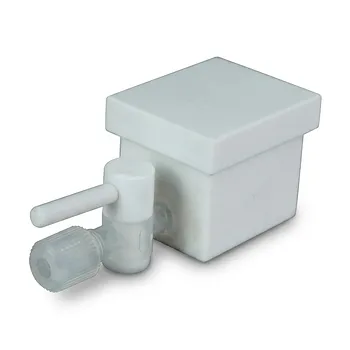
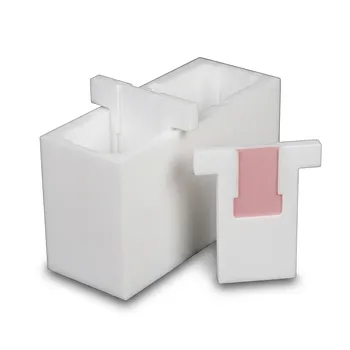
A Polytetrafluoroethylene (PTFE) liner is essential because it provides a chemically inert barrier that survives the extreme heat and pressure of hydrothermal synthesis. This liner protects the stainless steel autoclave from corrosive precursors, prevents metal ion contamination of the $VO_2@C$ nanocomposites, and ensures high product recovery due to its non-stick properties.
Core Takeaway: The PTFE liner serves as a critical interface that maintains chemical purity and reactor integrity. By isolating aggressive precursor solutions from the metal vessel, it enables the synthesis of high-quality $VO_2@C$ without compromising the autoclave’s structural life or the material’s electrochemical performance.
Protecting the Reactor Infrastructure
Preventing Chemical Corrosion
The precursors used in $VO_2@C$ synthesis can be highly aggressive, often involving acidic or basic environments that would degrade stainless steel. PTFE (Teflon) is used because its molecular structure is virtually immune to chemical attack, shielding the external autoclave body from irreversible pitting and weakening.
Maintaining Structural Integrity under Pressure
Hydrothermal reactions occur in sealed vessels where temperatures often exceed the boiling point of water, creating significant internal pressure. The PTFE liner acts as a containment cup that ensures the corrosive fluid stays away from the load-bearing metal walls, preventing stress-corrosion cracking that could lead to vessel failure.
Ensuring Nanocomposite Purity
Prevention of Metal Ion Leaching
If the reaction solution directly touched the stainless steel walls, iron, chromium, or nickel ions could leach into the mixture. In $VO_2@C$ nanocomposites, these metal impurities can disrupt the crystal structure or poison the carbon matrix, significantly degrading the material's final properties.
Preservation of Surface Chemistry
For carbon-coated materials like $VO_2@C$, maintaining the integrity of the surface functional groups is vital. By providing an inert environment, the PTFE liner ensures that the carbonization process and the vanadium oxide formation are governed strictly by the intended precursors rather than unintended side reactions with the reactor walls.
Optimizing Product Yield and Recovery
Non-Stick Surface Properties
The extremely low surface energy of PTFE prevents $VO_2@C$ nanoparticles from "scaling" or sticking to the sides of the reactor. This non-stick behavior is crucial for ensuring that the maximum amount of synthesized material can be collected after the reaction is complete.
Simplifying Post-Reaction Cleaning
Because the products do not adhere to the PTFE surface, the risk of cross-contamination between different experimental batches is minimized. This allows researchers to maintain a high degree of phase purity and consistency across multiple synthesis runs.
Understanding the Trade-offs
Temperature Limitations
While PTFE is exceptionally resistant to chemicals, it has a functional temperature ceiling, typically around 220°C to 250°C. Exceeding these temperatures can cause the liner to soften, deform, or even release toxic vapors, which limits the thermal range of the hydrothermal process.
Thermal Expansion and Sealing
PTFE has a higher coefficient of thermal expansion than the stainless steel that surrounds it. This requires careful engineering of the autoclave seal; if the liner is not properly sized or if the temperature is ramped too quickly, the expansion can cause the liner to "creep" or compromise the pressure seal.
Implementing PTFE Liners in Your Synthesis
How to Apply This to Your Project
- If your primary focus is high phase purity: Always inspect the PTFE liner for discoloration or scratches, as these can harbor contaminants from previous reactions.
- If your primary focus is equipment longevity: Ensure the liner is properly seated and never fill it beyond 70-80% capacity to allow for the expansion of the liquid phase.
- If your primary focus is maximizing yield: Use a plastic spatula or mild sonication to recover the $VO_2@C$ precipitates, taking care not to gouge the soft PTFE surface.
Selecting the right liner is not merely a convenience but a fundamental requirement for achieving the precise chemical environment necessary for advanced nanocomposite synthesis.
Summary Table:
| Key Benefit | Function in Hydrothermal Synthesis | Impact on VO2@C Nanocomposites |
|---|---|---|
| Chemical Inertness | Protects steel autoclave from corrosive precursors | Prevents reactor damage and pitting |
| High Purity | Blocks iron, chromium, and nickel ion leaching | Ensures clean crystal structure and matrix |
| Non-Stick Surface | Prevents nanoparticles from scaling on walls | Maximizes material yield and recovery |
| Thermal Isolation | Acts as a containment cup for high-pressure fluids | Maintains structural integrity under heat |
Optimize Your Synthesis with KINTEK’s Fluoropolymer Expertise
Achieve uncompromising purity and reliability in your most demanding laboratory processes with KINTEK. We specialize in high-performance fluoropolymer materials, offering everything from everyday basic labware—including beakers, crucibles, and reagent bottles—to specialized sample prep tools and fluid transfer components like tubing and valves.
Whether you need standard hydrothermal synthesis liners, microwave digestion vessels, or advanced reaction apparatus such as custom electrochemical cells and battery testing fixtures, our end-to-end custom CNC fabrication ensures a perfect fit for your specific research needs. We deliver everything from complex non-standard machined parts to high-volume orders with an absolute focus on PTFE and PFA performance.
Ready to upgrade your lab setup? Contact us today to learn how our bespoke fluoropolymer solutions can enhance your material synthesis and protect your infrastructure.
References
- Yogita Padwal, Suresh Gosavi. <i>In situ</i> synthesis of VO<sub>2</sub>@C nanocomposites for enhanced visible-light photocatalysis in wastewater remediation and sustainable hydrogen generation. DOI: 10.1039/d4ya00587b
This article is also based on technical information from Kintek Knowledge Base .
Related Products
- PTFE Lined High Pressure Digestion Vessel 50ml High Temperature Hydrothermal Synthesis Tank
- Custom TFM Reaction Vessel with Stainless Steel Jacket and PTFE Inner Cup for High Corrosion Resistance
- High Purity TFM Microwave Digestion Vessels PTFE Acid Evaporation Liners Domestic GT-400 Equivalent Laboratory Reaction Containers
- PTFE Hydrofluoric Acid Dilutor and Corrosion Resistant Reaction Vessel with Flange Sealing White PTFE Raw Material Storage Barrel
- High Purity PTFE Reaction Vessel Polyfluortetraethylene Cylindrical Tank Petrochemical Reaction Container
People Also Ask
- What are the benefits of using a PTFE-lined vessel for carbon-sulfur cathode treatment? Maximize Purity & Performance
- Why are PTFE-lined pressure digestion vessels required for the preparation of Ag/CeO2 catalysts? Purity & Performance
- What safety features are typically incorporated into high-pressure PTFE digestion vessel designs? Ensure Lab Safety
- What is the function of PTFE lined high-pressure vessels in g-C3N4 synthesis? Achieve High-Purity Material Growth
- Role of High-Pressure Digestion Tanks in Perovskite Synthesis: Achieve Superior Stability and Latent Heat