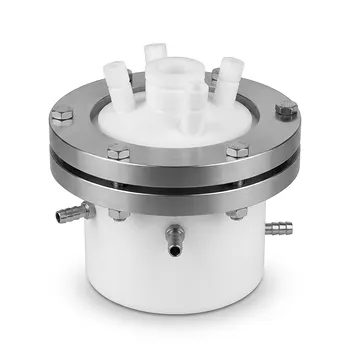
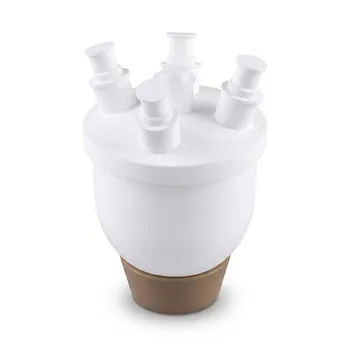
A hydrothermal synthesis reactor with a PTFE liner is the indispensable tool for creating $Cu_3P/SnS_2$ composites because it provides the controlled, high-pressure environment required for precise crystal growth. At temperatures reaching 180 °C, this setup facilitates the formation of unique flower-like $SnS_2$ structures and ensures the uniform loading of $Cu_3P$ nanoparticles, which is impossible under standard atmospheric conditions.
Core Takeaway: The reactor creates a subcritical environment that enhances solvent reactivity, while the PTFE liner acts as a chemically inert barrier to ensure the resulting composite is free from metallic impurities and structurally precise.
Driving Crystalline Morphology and Phase Formation
Achieving Subcritical Solvent Reactivity
The reactor operates as a sealed system, allowing the solvent to reach temperatures well above its boiling point while remaining liquid due to autogenous pressure. This subcritical state significantly boosts the kinetic energy and reactivity of the precursors, forcing chemical reactions that would otherwise remain dormant.
Promoting Directional Growth
The high-energy environment is critical for the directional growth of specific crystal shapes. For $Cu_3P/SnS_2$, this allows the $SnS_2$ to self-assemble into a flower-like morphology, providing a high surface area for the subsequent uniform loading of $Cu_3P$ particles.
Facilitating Uniform Loading
Without the constant pressure and heat of the hydrothermal process, $Cu_3P$ would likely aggregate into large, inefficient clumps. The reactor's environment ensures that $Cu_3P$ is uniformly distributed across the catalyst surface, which is vital for the composite's overall performance.
The Strategic Role of the PTFE Liner
Ensuring Uncompromising Material Purity
A PTFE (polytetrafluoroethylene) liner is used because it is chemically inert and resistant to aggressive precursors. It prevents the reaction solution from coming into contact with the stainless steel outer shell, ensuring no metal ion impurities contaminate the $Cu_3P/SnS_2$ composite.
Protecting Equipment Integrity
Hydrothermal reactions often involve corrosive environments that would quickly degrade metal containers. The PTFE liner provides exceptional corrosion resistance, allowing the reactor to withstand the acidic or alkaline conditions necessary for successful synthesis without damaging the structural integrity of the autoclave.
Simplifying Material Recovery
The low friction coefficient of the PTFE surface prevents the synthesized nanoparticles from sticking to the walls of the vessel. This facilitates the complete collection of the nanocomposite material and ensures that the reactor can be cleaned and maintained for repeatable results.
Understanding the Trade-offs
Temperature and Pressure Constraints
While PTFE is highly versatile, it has a thermal ceiling, typically losing structural stability above 220–250 °C. Researchers must carefully monitor the heating process to prevent the liner from deforming, which could lead to a pressure seal failure.
Thermal Expansion Discrepancies
The PTFE liner and the stainless steel shell expand at different rates when heated. If the reactor is cooled too quickly, the mismatch in contraction can cause the liner to crack or become permanently lodged inside the autoclave, potentially ruining the sample or the equipment.
How to Apply This to Your Project
Making the Right Choice for Your Goal
- If your primary focus is high-purity catalysts: Always use a high-purity PTFE liner to eliminate the risk of iron or chromium contamination from the reactor walls.
- If your primary focus is complex morphologies: Ensure your reactor is rated for at least 200 °C to allow for the subcritical conditions necessary for "flower-like" or "rod-like" crystal growth.
- If your primary focus is experimental repeatability: Maintain a strict cleaning protocol for the PTFE liner, as residual precursors can act as nucleation sites and alter the morphology of future batches.
The hydrothermal reactor transforms simple precursors into high-performance $Cu_3P/SnS_2$ composites by masterfully balancing extreme physical conditions with chemical isolation.
Summary Table:
| Feature | Function in Synthesis | Key Advantage |
|---|---|---|
| Subcritical State | Enhances solvent reactivity at 180°C+ | Facilitates complex chemical reactions |
| Pressure Control | Drives directional crystal growth | Creates "flower-like" SnS2 morphology |
| PTFE Liner | Provides a chemically inert barrier | Prevents metal contamination & ensures purity |
| Surface Properties | Low friction coefficient | Facilitates complete material recovery |
Elevate Your Material Synthesis with KINTEK’s Fluoropolymer Expertise
At KINTEK, we understand that high-performance composites like $Cu_3P/SnS_2$ demand uncompromising purity and precision. As specialists in high-performance fluoropolymers, we manufacture a comprehensive range of PTFE and PFA laboratory supplies tailored for extreme research environments.
From hydrothermal synthesis liners and microwave digestion vessels to high-purity trace analysis instruments and custom CNC-fabricated components, KINTEK provides the tools you need for repeatable, contamination-free results. Our expertise extends from everyday basic labware—including beakers, crucibles, and reagent bottles—to advanced apparatus like electrochemical cells and battery testing fixtures.
Whether you need standard consumables or complex, bespoke reaction setups, our absolute focus on high-performance materials ensures your lab stays at the cutting edge. Ready to optimize your synthesis process? Contact us today to discuss your custom requirements!
References
- Haoyan Wei, Jing Jin. Development of Cu3P/SnS2 Composite and Its High Efficiency Electrocatalytic Reduction of Carbon Dioxide. DOI: 10.3390/catal15060552
This article is also based on technical information from Kintek Knowledge Base .
Related Products
- PTFE Lined High Pressure Digestion Vessel 50ml High Temperature Hydrothermal Synthesis Tank
- High Pressure Custom TFM Reactor Stainless Steel Outer Vessel PTFE Inner Cup for Corrosive Synthesis
- High Temperature Corrosion Resistant Hydrothermal Synthesis Reactor with TFM Inner Liner and Straight Cylinder Design
- Custom TFM Reaction Vessel with Stainless Steel Jacket and PTFE Inner Cup for High Corrosion Resistance
- Custom PTFE Reaction System with Hose Barb Fittings Corrosion Resistant High Sealing 2L 4L Lab Reactor with Separatory Funnel
People Also Ask
- What are the benefits of using a PTFE-lined vessel for carbon-sulfur cathode treatment? Maximize Purity & Performance
- Why are PTFE-lined pressure digestion vessels required for the preparation of Ag/CeO2 catalysts? Purity & Performance
- What is the function of high-pressure PTFE digestion vessels in mineral analysis? Optimize Sample Mineralization
- What safety features are typically incorporated into high-pressure PTFE digestion vessel designs? Ensure Lab Safety
- What is the function of PTFE lined high-pressure vessels in g-C3N4 synthesis? Achieve High-Purity Material Growth