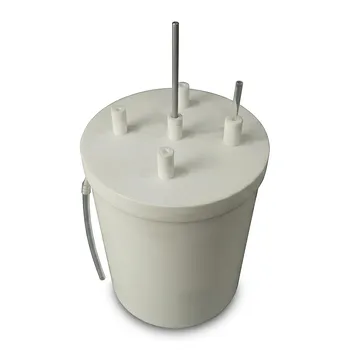
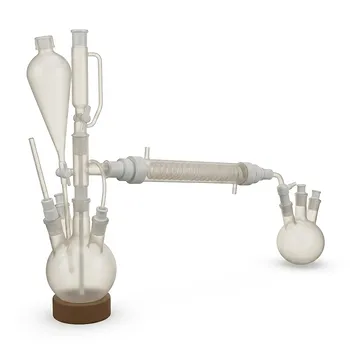
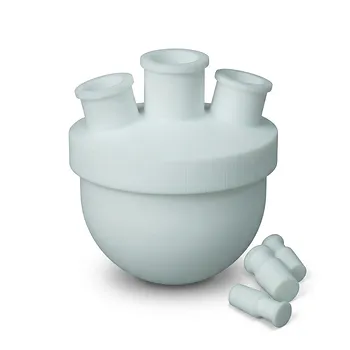
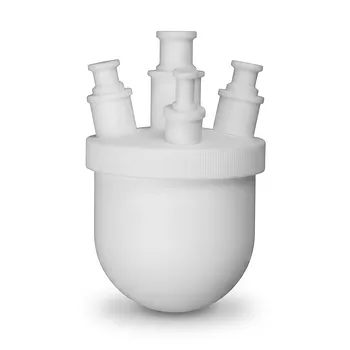
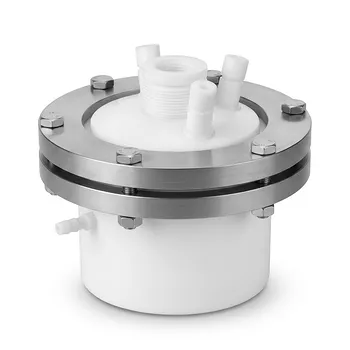
The synthesis of $(NH_4)2V{10}O_{25}·8H_2O$ requires a high-pressure hydrothermal reactor with a PTFE liner to create a controlled, high-temperature environment that exceeds the solvent's boiling point. This specialized setup ensures that precursor materials undergo complete transformation and recrystallization while the chemically inert liner prevents the introduction of metal ion impurities from the reactor walls. Without this configuration, the resulting vanadium-based nanomaterials would lack the necessary phase purity and structural integrity.
A PTFE-lined high-pressure reactor is essential because it facilitates a contamination-free, sub-critical water environment that drives the crystallization of complex oxides while protecting the equipment from corrosive chemical precursors.
Overcoming Thermodynamic Barriers
Achieving Temperatures Above Boiling Points
Hydrothermal synthesis relies on autogenous pressure generated within a sealed vessel to maintain solvents in a liquid state at temperatures far exceeding their normal boiling points. This high-energy environment provides the necessary kinetic energy for the precursors of $(NH_4)2V{10}O_{25}·8H_2O$ to react.
Facilitating Complete Recrystallization
The combination of high pressure and temperature allows for the complete transformation of precursor precipitates into highly crystalline structures. This process is vital for achieving the specific spinel or layered structures required for advanced vanadium oxide hydrates.
The Critical Role of the PTFE Liner
Chemical Inertness Against Aggressive Precursors
Vanadium precursors and the pH adjusters used in their synthesis can be highly corrosive to standard metals. Polytetrafluoroethylene (PTFE) provides exceptional chemical inertia, ensuring that the acidic or basic environment does not degrade the internal reaction chamber.
Eliminating Metal Ion Leaching
Without a liner, the stainless steel body of the autoclave would be vulnerable to corrosion, leading to the leaching of metal ions like iron, nickel, or chromium into the solution. The PTFE liner acts as an absolute barrier, ensuring the high chemical purity of the $(NH_4)2V{10}O_{25}·8H_2O$ crystals by preventing external contamination.
Thermal Stability and Safety
High-purity PTFE liners are designed to withstand temperatures typically up to 200°C to 240°C. This thermal stability, paired with the mechanical strength of the external stainless steel shell, allows the reaction to proceed safely over long durations, such as 18 hours or more.
Understanding the Trade-offs and Limitations
Temperature Ceiling of PTFE
While PTFE is highly inert, it has a strict thermal limit; exceeding 250°C can cause the liner to soften or "creep," potentially compromising the seal. For reactions requiring higher temperatures, alternative materials like PPL (Polyphenylene polymers) or quartz inserts must be considered.
Pressure Integrity and Cooling Rates
The effectiveness of the seal depends on the mechanical fit between the liner and the stainless steel cap. Rapid cooling of the reactor can cause differential contraction between the PTFE and the steel, which may lead to leaks or damage to the liner over multiple uses.
How to Apply This to Your Synthesis Project
When selecting or operating a reactor for vanadium-based nanomaterial synthesis, consider your specific experimental parameters:
- If your primary focus is Phase Purity: Ensure the PTFE liner is thoroughly cleaned with acid between runs to prevent "memory effects" or cross-contamination from previous batches.
- If your primary focus is High Crystallinity: Monitor the fill degree of the liner (typically 60-80%) to ensure sufficient autogenous pressure is generated without over-pressurizing the vessel.
- If your primary focus is Equipment Longevity: Avoid rapid quenching in cold water; allow the reactor to cool naturally to room temperature to preserve the integrity of the PTFE seal.
By strictly maintaining a sealed, inert, and high-pressure environment, you ensure that the complex crystallization of $(NH_4)2V{10}O_{25}·8H_2O$ remains consistent and free from structural defects.
Summary Table:
| Feature | Benefit | Role in (NH4)2V10O25·8H2O Synthesis |
|---|---|---|
| PTFE Liner | Chemical Inertness | Prevents metal leaching and ensures high phase purity. |
| Autogenous Pressure | High Kinetic Energy | Facilitates complete transformation and recrystallization. |
| Sealed Environment | Sub-critical Solvent State | Allows reactions to exceed normal solvent boiling points. |
| Thermal Stability | Consistent 200°C-240°C | Supports long-duration crystallization (e.g., 18+ hours). |
Elevate your material research with KINTEK’s precision-engineered fluoropolymer solutions. From high-purity PTFE and PFA liners, hydrothermal synthesis vessels, and microwave digestion containers to custom CNC-fabricated non-standard parts, we provide the ultimate contamination-free environment for advanced synthesis. Whether you require everyday consumables like beakers and centrifuge tubes or complex reaction apparatus like electrochemical cells and battery testing fixtures, KINTEK maintains an absolute focus on high-performance materials to ensure your results are never compromised by impurities. Contact us today to discuss your custom laboratory setup!
References
- Poria Gomrokchi, Masoud Salavati‐Niasari. Effect of solvent composition on a one-dimensional (NH<sub>4</sub>)<sub>2</sub>V<sub>10</sub>O<sub>25</sub>·8H<sub>2</sub>O electroactive material for electrochemical hydrogen storage application. DOI: 10.1039/d5ra03066h
This article is also based on technical information from Kintek Knowledge Base .
Related Products
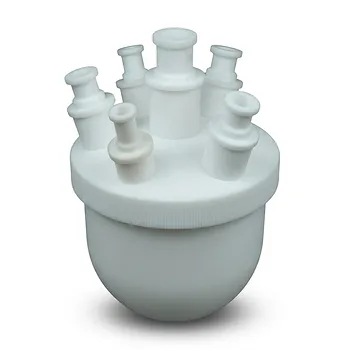
- High Pressure Custom TFM Reactor Stainless Steel Outer Vessel PTFE Inner Cup for Corrosive Synthesis
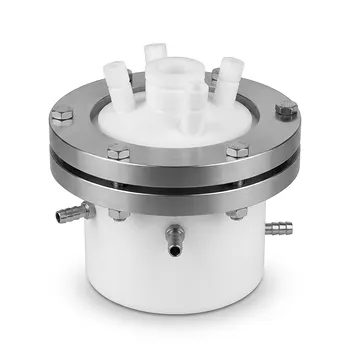
- PTFE Lined High Pressure Digestion Vessel 50ml High Temperature Hydrothermal Synthesis Tank
- High Temperature Corrosion Resistant Hydrothermal Synthesis Reactor with TFM Inner Liner and Straight Cylinder Design
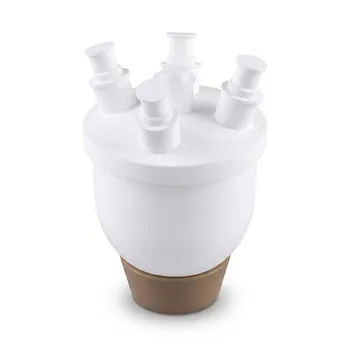
- Custom TFM Reaction Vessel with Stainless Steel Jacket and PTFE Inner Cup for High Corrosion Resistance
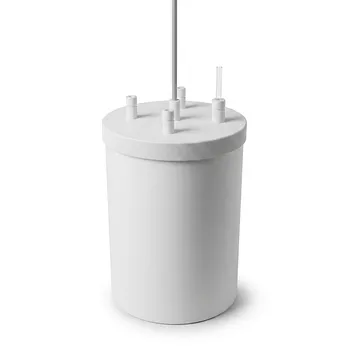
- PTFE 10L Reaction Vessel with Stirring Paddle Customizable Corrosion Resistant High Temperature Reactor for Biopharmaceutical and Chemical Processing
People Also Ask
- Why is a PTFE-lined reactor required for Mn2O3 synthesis? Achieve High Purity & Corrosion Resistance
- What is the technical value of 180 bar pressure for MgO nanostructures? Unlock Superior Crystallinity and Morphology
- What are the technical advantages of using high-pressure PTFE reaction vessels during metal digestion? Expert Insights.
- How does the regulation of initial pressure within a high-pressure reaction system affect the production of MIL-100(Fe)?
- Why is a high-pressure reactor necessary for the esterification reaction between oleic acid and methanol at 150°C? Guide