Molecular positioning matters because surface properties are determined by the atoms actually exposed at the interface, not by total fluorine content alone. In pure PTFE, closely packed, fully fluorinated –CF₂– groups form a fluorine-rich outer surface with exceptionally low surface energy. In some other fluoropolymers, fluorine atoms may be buried along a rigid backbone or shielded by aromatic rings, so the surface is less fluorine-dominated and typically shows only moderate water contact angles near 88°–90°.
The key distinction is fluorine exposure, not simply fluorine concentration. Pure PTFE and other fully perfluorinated structures maximize the presentation of fluorine at the surface, whereas molecular shielding can prevent additional fluorine from producing a proportional increase in hydrophobicity.
Why Surface Exposure Controls Hydrophobicity
Surface chemistry is an interfacial property
Water interacts primarily with the outermost molecular layer of a polymer. Fluorine buried inside the material contributes much less to the measured wetting behavior than fluorine directly facing the air–polymer interface.
This is why increasing the fluorine weight percentage does not necessarily produce a more hydrophobic surface. The fluorine must be both chemically compatible with a low-energy surface and physically accessible to water.
PTFE creates a fluorine-rich outer surface
PTFE consists of a carbon backbone surrounded by fluorine atoms. Its fully perfluorinated structure presents a dense, continuous layer of fluorinated groups at the interface.
Fluorine has a tightly held electron cloud and relatively low polarizability. As a result, fluorinated surfaces have weak intermolecular attraction and low surface energy, reducing the tendency of water and many other liquids to spread or adhere.
Molecular arrangement determines the surface composition
During film formation, fluorinated segments can migrate toward the air interface because doing so lowers interfacial energy. Side-chain fluoroalkyl groups can therefore concentrate at the outer surface even when they represent only a fraction of the total polymer composition.
The final wetting behavior depends on whether the polymer architecture allows this surface segregation. A fluorinated side chain that projects outward has a different effect from a fluorine atom positioned inside a rigid, shielded backbone.
Why Aromatic Shielding Can Reduce the Effect
Fluorine may be present but inaccessible
When fluorine atoms are located along a backbone surrounded by phenyl rings or other rigid aromatic structures, neighboring groups can physically shield them from the liquid interface. Water then interacts with a surface that is not dominated by exposed fluorinated groups.
Consequently, a polymer can contain more fluorine by weight while showing little change in water contact angle, sometimes remaining near 88°–90°.
The surrounding groups influence the measured energy
Aromatic rings and other non-perfluorinated groups can contribute more strongly to intermolecular interactions than an exposed perfluorocarbon surface. Their presence can therefore keep the effective surface energy higher than that of PTFE.
The result is a smaller reduction in wetting and less pronounced non-stick behavior, even though fluorine is present in the molecular structure.
Rigidity limits surface reorganization
A flexible fluorinated side chain can orient toward the air interface during processing. A fluorine atom embedded in a rigid backbone has fewer opportunities to reorient or become exposed.
This structural constraint explains why molecular geometry and accessibility can matter more than bulk fluorine content for surface-critical applications.
Why Pure PTFE Usually Shows Stronger Non-Wetting
Continuous perfluorination is more effective than isolated fluorination
Pure PTFE does not merely contain fluorine; its surface is built from a dense arrangement of perfluorinated groups. This produces a more uniform low-energy interface than a polymer containing isolated fluorinated units among aromatic or hydrocarbon segments.
For maximum liquid repellency and chemical inertness, fully perfluorinated materials such as PTFE and PFA are therefore generally preferred.
Surface roughness can amplify the chemistry
The molecular chemistry establishes the intrinsic low surface energy, but physical texture can increase the apparent water contact angle. For example, fluoropolymer nanofiber surfaces combine fluorocarbon chemistry with microscale roughness and can reach apparent contact angles in the 155°–160° range.
A smooth fluoropolymer film may show a much lower angle, so contact angle comparisons must consider both surface composition and surface morphology.
Contact angle is not the only performance measure
A high advancing contact angle indicates resistance to initial wetting, while the receding contact angle reflects how easily a droplet leaves the surface. Hysteresis, roughness, defects, and chemical heterogeneity can all affect practical liquid retention.
For laboratory equipment, low adsorption, complete fluid recovery, and easy cleaning may be more relevant than the advancing contact angle alone.
Understanding the Trade-offs
More fluorine does not guarantee better hydrophobicity
Bulk fluorine content is an incomplete selection criterion. If the added fluorine is buried or shielded, the surface may remain only moderately hydrophobic.
Evaluate the outermost surface chemistry, polymer architecture, and processing history rather than relying on fluorine percentage alone.
Maximum repellency can reduce controllability
PTFE and PFA provide excellent non-wetting and chemical resistance, but their very low surface energy can make bonding, coating adhesion, printing, or selective wetting difficult.
When a component requires both hydrophobic and hydrophilic regions, controlled plasma treatment or chemical modification may be necessary.
Roughness can improve repellency but complicate cleaning
Micro- and nanoscale texture can raise the apparent contact angle, but it may also introduce locations where residues or contaminants become trapped. A smooth, chemically low-energy surface may be preferable for trace-analysis equipment even if its measured contact angle is lower.
Fluorinated additives eventually reach diminishing returns
Fluorinated side chains tend to saturate the interface because the surface can accommodate only a limited amount of fluorinated material. After the outer layer is sufficiently enriched, additional fluorinated additive often produces progressively smaller gains in hydrophobicity.
This can allow surface modification without substantially changing bulk mechanical properties, but only when the additive is able to migrate and remain at the interface.
Making the Right Choice for Your Goal
The appropriate fluoropolymer depends on whether you need maximum repellency, controlled wettability, or a balance with adhesion and processability.
- If your primary focus is maximum non-wetting and chemical inertness: Choose a fully perfluorinated structure such as PTFE or PFA, where fluorine is densely exposed at the surface.
- If your primary focus is controlled or moderate hydrophobicity: Consider a partially fluorinated or copolymer structure, recognizing that backbone shielding can limit the increase in contact angle.
- If your primary focus is low sample retention and easy fluid recovery: Prioritize exposed fluorinated surface groups, low surface roughness, and low adsorption rather than fluorine content alone.
- If your primary focus is selective wetting or fluidic patterning: Use a fluoropolymer base and introduce localized chemical or plasma modification where hydrophilic regions are required.
To predict fluoropolymer hydrophobicity reliably, examine where the fluorine resides, whether it can reach the interface, and what surface morphology processing creates.
Summary Table:
| Factor | Pure PTFE | Other Fluoropolymers |
|---|---|---|
| Fluorine Exposure | Complete (maximized at surface) | Variable (often shielded) |
| Surface Energy | Extremely low | Higher than PTFE |
| Water Contact Angle | High (typically >110°) | Moderate (88°–90° or less) |
| Molecular Architecture | Fully perfluorinated, flexible | Rigid backbones, aromatic groups |
| Surface Reorganization | High | Low |
| Suitable Applications | Maximum repellency, inertness | Controlled hydrophobicity, bonding |
Looking for precision PTFE and PFA labware with optimal surface properties for your application? KINTEK offers a comprehensive range of fluorine polymers, from basic beakers to custom electrochemical cells. Our end-to-end CNC machining ensures your exact requirements are met. Contact us today to discuss your needs and get a tailored solution. Contact us
Related Products
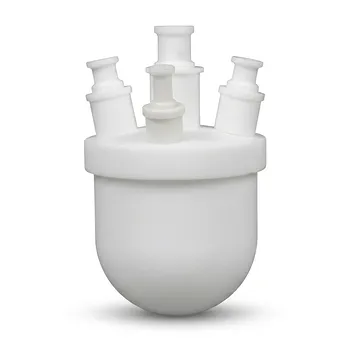
- Custom PTFE Flask 250ml High Purity Fluoropolymer Laboratory Vessel for Chemical Research
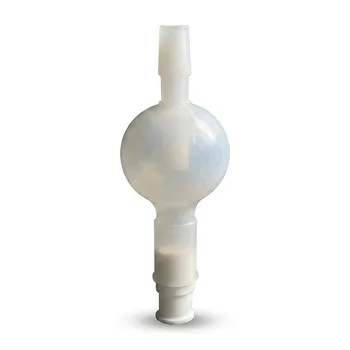
- High Purity PFA Chromatography Column with Collection Bottle Corrosion Resistant Fluoropolymer Filtration System for Trace Analysis
- Custom PTFE Reaction Tank Corrosion Resistant Fluoropolymer Chemical Processing Barrel 10L 20L 30L
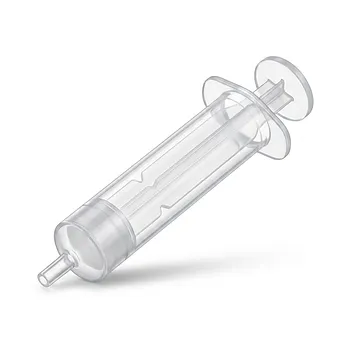
- Corrosion Resistant PFA Syringe Translucent Visual Fluoropolymer Labware 10ml Chemical Handling Tool
- Custom PFA Tubing 1/4 Inch High Purity Corrosion Resistant Fluoropolymer Tube with Welding and Machining Services
People Also Ask
- What are the key steps for structural integrity in molded PTFE lab reaction vessels? Master fine powder processing.
- When synthesizing TFVE monomers involving reactive organometallic reagents and aggressive polar solvents, what material performance characteristics are required? Ensure purity with PTFE/PFA.
- Why Are High-Purity Fluoropolymer Vessels and Tubing Critical for Trace Analysis? Prevent Contamination Reliably
- Why do PTFE fluoropolymer laboratory vessels and containers exhibit superior chemical resistance against harsh solvents and corrosive acids compared to standard plastic labware? Discover the molecular secrets
- Why are fluoropolymer reaction vessels essential for SnO2/rGO synthesis? The Key to High-Performance Composites