Smooth fluoropolymer laboratory components are hydrophobic because their fluorinated chemistry gives them exceptionally low solid surface energy, which discourages water from spreading. This effect is sufficient for water to form droplets on smooth PTFE, PFA, and related surfaces, but it does not reliably repel oils, alcohols, and many organic solvents because those liquids have much lower surface tension. Achieving superhydrophobic or superoleophobic behavior therefore requires both low-surface-energy chemistry and engineered surface texture.
Low surface energy creates the chemical basis for repellency, but texture provides the geometric barrier that prevents low-tension liquids from spreading. Superhydrophobicity and especially superoleophobicity depend on maintaining a stable, low-adhesion Cassie-Baxter state with air trapped beneath the droplet.
Why Smooth Fluoropolymers Repel Water
The role of fluorinated chemistry
Fluoropolymers contain a high density of carbon-fluorine bonds. These bonds produce a chemically inert surface with very low solid surface energy, commonly described as γSV.
A liquid tends to minimize its interfacial energy. On a low-energy fluoropolymer surface, water gains relatively little by spreading across the solid, so it forms a bead with a contact angle greater than 90 degrees.
Contact angle and wetting
The equilibrium contact angle is governed by the balance among the solid-vapor, solid-liquid, and liquid-vapor interfacial energies. Young's relation expresses this balance:
[ \cos\theta = \frac{\gamma_{SV}-\gamma_{SL}}{\gamma_{LV}} ]
A high water contact angle indicates that the liquid is not spreading readily. Smooth fluoropolymer surfaces are therefore intrinsically hydrophobic, even without added roughness.
Why smooth surfaces have a practical limit
Smooth fluoropolymer surfaces can produce high water contact angles, but their geometry limits the result. The maximum achievable angle on a smooth surface is generally around 130 degrees, with typical advancing angles for smooth PTFE near 110 degrees.
That is hydrophobic, but it is not normally superhydrophobic, which is conventionally associated with a water contact angle above 150 degrees and low contact-angle hysteresis.
Why Low-Surface-Tension Liquids Behave Differently
Water and organic liquids are not equivalent
Water has relatively high liquid surface tension, represented by γLV. Oils, alcohols, and many organic solvents have much lower γLV values, often below 30 mN/m.
Because the liquid-vapor surface tension appears in the contact-angle relationship, a low value changes the wetting balance. The liquid can spread on a smooth fluoropolymer even though the solid itself has very low surface energy.
Low energy alone is not enough
Fluorination lowers the solid's surface energy, but it does not make the solid's energy lower than every liquid's effective wetting tendency. Some oils and solvents have surface tensions close to, or lower than, the repulsive capability of the smooth fluorinated surface.
Consequently, a PTFE or PFA component may shed aqueous droplets effectively while still allowing an organic solvent to spread, adhere, or penetrate surface features.
Why superoleophobicity is harder
Superoleophobicity requires an oil or solvent contact angle above 150 degrees with low hysteresis. This is more demanding than superhydrophobicity because low-tension liquids more easily overcome the energetic barrier to spreading.
The practical implication for laboratory equipment is important: water repellency does not prove broad solvent repellency. Performance must be evaluated using the actual liquids, concentrations, temperatures, and pressures involved.
How Surface Texture Creates Extreme Repellency
Texture amplifies the fluoropolymer chemistry
Microscale and nanoscale roughness increases the apparent contact angle of a chemically hydrophobic surface. The droplet contacts only part of the solid while the remaining area consists of trapped air.
This composite solid-air interface is described by the Cassie-Baxter state. The droplet rests partly on air rather than fully wetting the polymer, which reduces adhesion and increases the apparent contact angle.
Hierarchical roughness supports the Cassie state
A single roughness scale may not be sufficient. Hierarchical texture, combining microstructures with finer nanoscale features, provides more effective support for the droplet and helps reduce the real solid-liquid contact area.
Engineered fluoropolymer surfaces with this type of texture can produce advancing water contact angles above 160 to 170 degrees, substantially beyond the limit of a smooth fluoropolymer.
Re-entrant geometry helps repel low-tension liquids
For oils and solvents, ordinary roughness can allow the liquid to penetrate the texture. Re-entrant structures address this problem by creating overhanging or undercut geometries that resist downward and lateral spreading.
These geometries make it harder for a low-surface-tension liquid to transition from a suspended Cassie state to a fully wetted state. They are therefore particularly important for superoleophobic surfaces.
Low hysteresis matters as much as high angle
A high static contact angle alone does not guarantee useful repellency. Contact-angle hysteresis measures the difference between advancing and receding contact angles and reflects how strongly a droplet is pinned.
Low hysteresis and a low roll-off angle indicate that the droplet can move, bounce, or leave the component rather than remaining attached as a residual film.
Why This Matters in Laboratory Components
Reducing liquid retention
Textured, low-energy surfaces can reduce droplet adhesion on tubing, fittings, vessels, filters, and transfer components. This supports more complete discharge and reduces sample hold-up on walls and internal surfaces.
Limiting cross-contamination
Residual droplets can carry material from one reagent or sample into the next process. Improving liquid release helps reduce cross-contamination, particularly in trace analysis and high-purity fluid handling.
Preserving porous-function performance
In porous laboratory structures, preventing unwanted wetting can help preserve gas permeability and maintain the intended transport behavior. The benefit depends on texture durability and on whether the applied pressure exceeds the pressure at which the Cassie state collapses.
Understanding the Trade-offs
Texture can be mechanically vulnerable
Micro- and nanoscale features are more susceptible to abrasion, compression, fouling, and chemical damage than a smooth bulk polymer surface. A surface that initially repels oil may lose performance after repeated cleaning or contact with particulates.
Pressure can force wetting
The trapped-air Cassie state is stable only within a defined pressure range. Applied pressure can drive a liquid into the texture, causing a transition to the Wenzel or fully wetted state.
For that reason, contact-angle data measured under static laboratory conditions should not be treated as proof of performance during pressurized filtration or fluid transfer.
Roughness can complicate cleaning
A texture that prevents liquid adhesion can also create recesses where contaminants accumulate if the surface is damaged or if the liquid chemistry changes. The design must balance repellency against cleanability and inspection requirements.
Chemistry and texture must work together
Extremely low surface energy is necessary but may still be insufficient for low-tension liquids. Conversely, roughness without compatible low-energy chemistry can increase liquid-solid contact and sometimes worsen wetting.
Coating formulations also require careful control. Polar anchoring groups can improve adhesion to a substrate, but excessive hydrophilic character can counteract fluorinated repellency.
Contact angle is not the entire specification
A complete evaluation should include advancing and receding angles, hysteresis, roll-off angle, pressure resistance, chemical compatibility, abrasion resistance, and repeated-use performance.
Testing should use representative oils, alcohols, solvents, and aqueous reagents rather than water alone.
How to Apply This to Your Project
Select the surface architecture according to the liquid and operating conditions, not just the polymer name.
- If your primary focus is water repellency: A smooth low-energy fluoropolymer may provide useful hydrophobicity, while hierarchical roughness can raise the contact angle into the superhydrophobic range and reduce droplet retention.
- If your primary focus is oil, alcohol, or solvent repellency: Combine very low surface energy with hierarchical and re-entrant texture, then verify performance using the specific low-tension liquids.
- If your primary focus is high-pressure fluid handling: Test Cassie-state stability, wetting transition pressure, hysteresis, and permeability under the actual operating pressure.
- If your primary focus is sample recovery and contamination control: Prioritize low hysteresis and low roll-off angle, because a high static contact angle is insufficient if droplets remain pinned.
- If your primary focus is long service life: Treat abrasion, fouling, cleaning, and chemical exposure as part of the surface design rather than evaluating initial contact angle alone.
The reliable path to extreme liquid repellency is the deliberate combination of fluoropolymer low surface energy, multiscale texture, and geometry that preserves a stable air-supported interface.
Summary Table:
| Aspect | Smooth Fluoropolymer | Textured Fluoropolymer (Superhydrophobic/Superoleophobic) |
|---|---|---|
| Chemistry | Low surface energy (C-F bonds) intrinsically hydrophobic | Low surface energy combined with engineered micro/nano texture |
| Water contact angle | Typically 110°–130° | >150° (superhydrophobic) |
| Oil/solvent contact angle | Low; often spreads or adheres | >150° with low hysteresis (superoleophobic) for low-surface-tension liquids |
| Mechanism | Young's relation governs wetting; limited by smooth geometry | Cassie-Baxter state with trapped air; re-entrant geometry resists penetration |
| Hysteresis | Moderate | Low, enabling droplet roll-off and self-cleaning |
| Resistance to pressure | High mechanical durability but limited repellency | Needs careful design to withstand pressure; may transition to Wenzel state |
| Cleaning | Easy to clean due to smoothness | Can be challenging; texture may trap contaminants if damaged |
| Applications | General labware, transfer components | High-purity fluid handling, sample recovery, anti-contamination |
Elevate your lab's performance with KINTEK's high-performance fluoropolymers. Our PTFE/PFA components, crafted with precision and optional advanced surface texturing, are designed to minimize liquid retention and cross-contamination in even the most demanding applications. Whether you need standard labware, custom CNC-machined parts, or microfluidic devices with engineered surfaces, our team can tailor a solution to your exact needs. Contact us today to discuss your project and discover how our textured fluoropolymer components can improve your sample recovery and solvent handling. Get in touch with our experts now!
Related Products
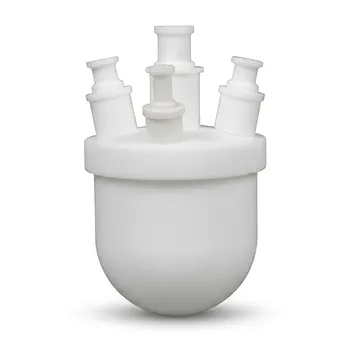
- Custom PTFE Flask 250ml High Purity Fluoropolymer Laboratory Vessel for Chemical Research
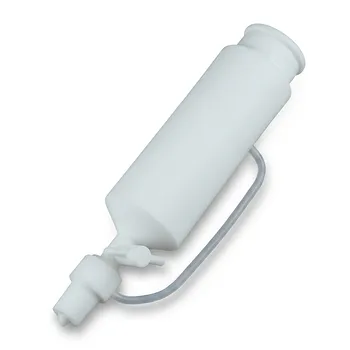
- Custom PTFE Constant Pressure Separatory Funnel 100ml Fluoropolymer Labware for Corrosive Chemical Transfer
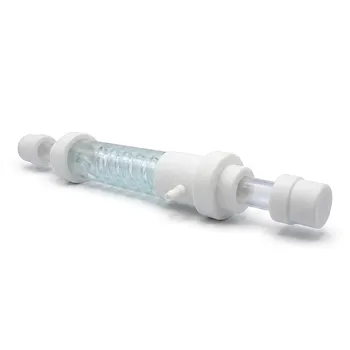
- Custom PTFE Condenser Tube 100ml Serpentine and Straight Fluoropolymer Laboratory Heat Exchanger with Flask Adapters
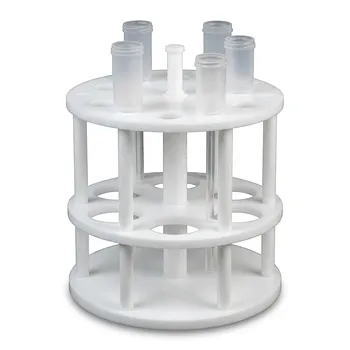
- Custom PFA Microcolumn Racks and PTFE Machined Low Background Corrosion Resistant Laboratory Fixtures
- Laboratory PTFE Three Neck Reaction Flask Corrosion Resistant 2000ml Low Background Fluoropolymer Vessel
People Also Ask
- What are the key steps for structural integrity in molded PTFE lab reaction vessels? Master fine powder processing.
- What toxicological hazards and safe handling protocols must be established when PTFE fluoropolymer reaction vessels are subjected to pyrolysis temperatures? Learn essential safety measures now.
- When synthesizing TFVE monomers involving reactive organometallic reagents and aggressive polar solvents, what material performance characteristics are required? Ensure purity with PTFE/PFA.
- Why Are High-Purity Fluoropolymer Vessels and Tubing Critical for Trace Analysis? Prevent Contamination Reliably
- How does pressure management influence molar mass distribution and reaction rate in the iodine transfer emulsion polymerization of vinylidene fluoride, and how do custom fluoropolymer reaction vessels support this process?