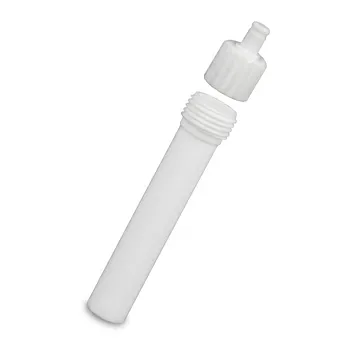
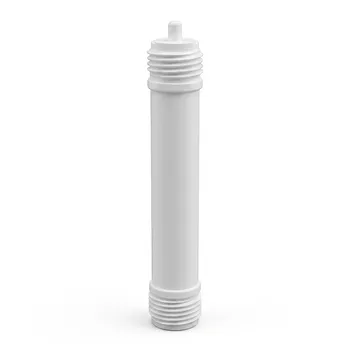
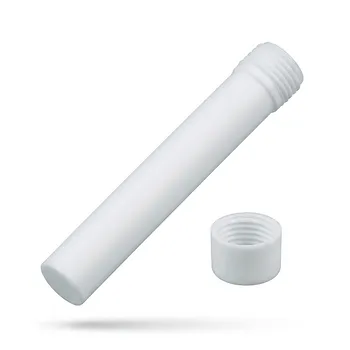
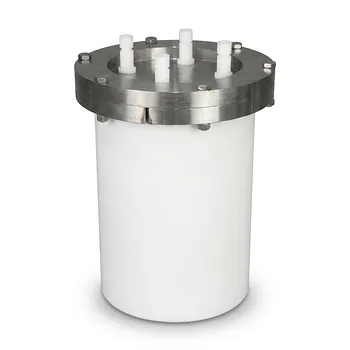
The necessity of PTFE liners in hydrothermal synthesis is driven by the requirement for absolute chemical purity and vessel protection. During the synthesis of doped calcite ceramic reference materials, these liners act as a sacrificial but inert barrier that prevents corrosive reaction media from leaching metal ions from the stainless steel autoclave. This isolation is critical to ensuring that the trace element profile of the reference material remains uncontaminated and scientifically valid.
Core Takeaway: PTFE liners are mandatory because they provide a chemically inert environment that eliminates metallic contamination from the autoclave walls, ensuring the high-purity background required for accurate doped calcite reference materials.
Eliminating Metallic Contamination
Protecting the Trace Element Profile
Doped calcite is primarily used as a reference material for trace element analysis, meaning its chemical composition must be known with extreme precision. Without a PTFE (Polytetrafluoroethylene) liner, the reaction solution would come into direct contact with the stainless steel body of the autoclave.
Preventing Ion Leaching
At high temperatures and pressures, metal ions such as iron, nickel, and chromium can leach from the autoclave walls into the solution. This leaching would introduce unwanted impurities into the calcite structure, effectively ruining its utility as a standardized reference material.
Ensuring Stable Background Values
By using high-purity PTFE, researchers can maintain stable background values. This allows for the successful "doping" of specific elements without the interference of stray metals that would otherwise skew analytical results.
Chemical and Thermal Resilience
Withstanding Harsh Synthesis Environments
Hydrothermal synthesis often involves extreme pH levels, utilizing strong acidic or alkaline media to facilitate crystal growth. PTFE is uniquely qualified for this because of its exceptional chemical inertness, meaning it does not react with these aggressive precursors.
Managing High Temperature and Pressure
The synthesis of ceramic materials often requires temperatures reaching 180°C and significant autogenous pressure. PTFE liners are designed to maintain their structural integrity and sealing properties under these specific conditions without degrading or releasing polymers into the sample.
Preventing Autoclave Corrosion
Beyond protecting the sample, the liner protects the structural integrity of the autoclave itself. By preventing acidic or alkaline media from corroding the metal walls, the liner ensures the operational safety of the high-pressure vessel over long-term use.
Improving Material Recovery
Excellent Mold-Release Properties
PTFE is naturally "non-stick," which provides significant advantages during the collection phase of synthesis. Its anti-adhesion properties ensure that synthesized nanopowders or calcite crystals do not bond to the container walls.
Facilitating High Yields
Because the material does not stick to the liner, researchers can achieve maximum sample recovery. This is particularly important when working with expensive dopants or limited precursor materials where high yield is a priority.
Understanding the Trade-offs
Thermal Limitations
While PTFE is robust, it has a definitive thermal ceiling, typically around 250°C, beyond which it begins to undergo thermal decomposition. For synthesis requiring temperatures higher than this, alternative liners like PPL (polyphenylene polymers) or gold/platinum must be considered.
Pressure Sensitivity and Deformation
Under extreme pressure, PTFE can exhibit "cold flow" or permanent deformation. If the liner is not properly fitted or if the cooling process is too rapid, the seal can fail, leading to vessel leakage or sample loss.
Porosity and Memory Effects
Although highly inert, PTFE can be slightly porous at a microscopic level. There is a risk of "cross-contamination" if a liner used for one dopant is not rigorously cleaned before being used for a different trace element synthesis.
How to Apply This to Your Project
Selecting the Right Approach
- If your primary focus is analytical purity: Always use a new or acid-washed PTFE liner to ensure zero cross-contamination between different doped batches.
- If your primary focus is high-temperature synthesis (above 220°C): Transition from PTFE to PPL liners or specialized metallic inserts to avoid liner degradation.
- If your primary focus is sample yield and collection: Leverage the non-stick properties of PTFE to recover fine precipitates without mechanical scraping that could introduce wear-particles.
By strictly isolating the reaction environment, PTFE liners transform a standard industrial pressure vessel into a high-precision laboratory tool capable of producing world-class reference materials.
Summary Table:
| Feature | Benefit for Doped Calcite Synthesis | Technical Constraint |
|---|---|---|
| Chemical Inertness | Prevents metallic ion leaching (Fe, Ni, Cr) | Maximum temperature < 250°C |
| Non-Stick Surface | Ensures high recovery of ceramic nanopowders | Subject to "memory effects" |
| Corrosion Resistance | Protects autoclave body from aggressive media | Potential for cold flow deformation |
| High-Purity PFA/PTFE | Maintains stable trace element background | Requires rigorous acid-washing |
Secure the Purity of Your Synthesis with KINTEK
Elevate your research precision with KINTEK’s high-performance fluoropolymer solutions. Whether you are performing hydrothermal synthesis of doped calcite or sensitive trace analysis, our comprehensive range of PTFE and PFA laboratory supplies ensures an absolute chemical barrier against contamination.
From everyday basic labware like beakers, crucibles, and reagent bottles to specialized fluid transfer components (tubing, valves) and advanced sample prep tools, we provide the inert environment your samples demand. KINTEK specializes in advanced derivative apparatus, including high-purity hydrothermal synthesis liners, microwave digestion vessels, and custom electrochemical cells.
Backed by end-to-end custom CNC fabrication, we deliver everything from high-volume standard orders to complex, bespoke laboratory setups tailored to your specific technical requirements. Don't let metallic leaching compromise your results—contact us today to source the industry's most reliable fluoropolymer labware.
References
- Sen Lin. A High-temperature and High-pressure Sintered Calcite Ceramic Reference Material CAL-D for in Situ Trace Element Microanalysis of Calcite by LA-ICP-MS. DOI: 10.46770/as.2025.093
This article is also based on technical information from Kintek Knowledge Base .
Related Products
- PTFE Lined High Pressure Digestion Vessel 50ml High Temperature Hydrothermal Synthesis Tank
- High Pressure Custom TFM Reactor Stainless Steel Outer Vessel PTFE Inner Cup for Corrosive Synthesis
- High Purity PTFE Microwave Digestion Vessel Replacement Liner for Acid Sample Preparation and Trace Analysis
- High Purity PTFE Microwave Digestion Vessel for Soil and Food Analysis Acid Resistant Fluoropolymer Sample Preparation Liners
- Custom TFM Reaction Vessel with Stainless Steel Jacket and PTFE Inner Cup for High Corrosion Resistance
People Also Ask
- What are the benefits of using a PTFE-lined vessel for carbon-sulfur cathode treatment? Maximize Purity & Performance
- Why are PTFE-lined pressure digestion vessels required for the preparation of Ag/CeO2 catalysts? Purity & Performance
- What safety features are typically incorporated into high-pressure PTFE digestion vessel designs? Ensure Lab Safety
- What is the function of PTFE lined high-pressure vessels in g-C3N4 synthesis? Achieve High-Purity Material Growth
- Role of High-Pressure Digestion Tanks in Perovskite Synthesis: Achieve Superior Stability and Latent Heat