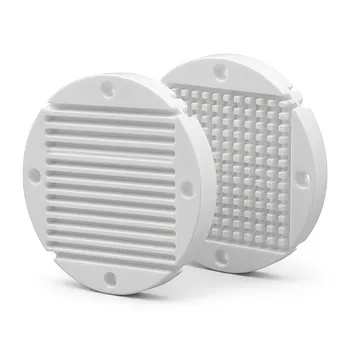
Fully fluorinated polymers such as PTFE and PFA are essential because they protect both the process and the sample from aggressive chemistry. Their strong carbon–fluorine molecular structure provides exceptional resistance to anhydrous HF, carbonyl fluoride, strong halide acids, and aggressive organic reagents. Unlike many metals and glass materials, they resist corrosion and contribute very little extractable or leachable contamination under properly selected operating conditions.
PTFE and PFA provide a chemically resistant, high-purity barrier between hazardous fluorinated reagents and the surrounding equipment or sample. Their combination of chemical inertness, low surface energy, thermal stability, and low leaching makes them well suited to reaction vessels, bottles, tubing, valves, fittings, and transfer systems.
Why Halogenated Synthesis Requires Specialized Materials
The reagents can attack conventional equipment
Fluorinated monomer and intermediate synthesis may involve anhydrous hydrofluoric acid, carbonyl fluoride, and strong halide acids. These materials can aggressively corrode common laboratory metals and attack glass, particularly when temperature, pressure, or exposure time increases.
Corrosion is not only an equipment-life problem. It can introduce metal ions, particles, or dissolved species into the reaction, changing product purity and potentially compromising analytical results.
Containment must remain chemically stable
A reaction vessel or transfer line is part of the chemical environment. If its walls swell, crack, become roughened, or chemically degrade, the system can lose containment and the sample can become contaminated.
PTFE and PFA maintain their integrity across demanding chemical exposures, helping preserve leak resistance and dimensional stability when correctly specified for the process.
How PTFE and PFA Protect Sample Purity
Strong carbon–fluorine bonding limits chemical attack
The carbon–fluorine bonds in fully fluorinated polymers are exceptionally strong. This molecular structure gives PTFE and PFA their near-total resistance to many acids, halogen-containing reagents, and aggressive solvents.
As a result, the material is less likely than conventional plastics or metals to dissolve, corrode, or release reaction-altering species into the fluid.
Low leaching reduces trace contamination
High-purity PTFE and PFA are selected for applications where even small amounts of contamination matter. They minimize the introduction of metal ions, corrosion products, plastic-derived extractables, and other unwanted species.
This is particularly important in synthesis and analysis involving catalysts or sensitive intermediates, where trace impurities can affect reaction behavior, catalyst performance, or measured concentration.
Low surface energy helps preserve the sample
PTFE and PFA have very low surface energy and minimal moisture absorption. These properties reduce wetting, surface adhesion, and the retention of residues on the container or tubing wall.
That matters when handling valuable, reactive, or trace-level samples. Less material remains on the surface, reducing carryover and helping maintain more representative sample recovery.
Why They Are Used Throughout the Fluid Path
Reaction vessels and containment bottles
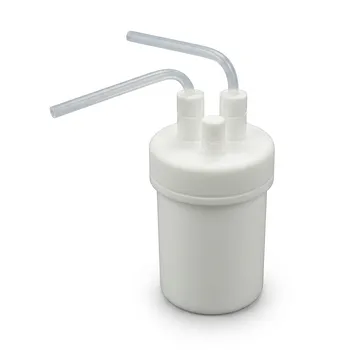
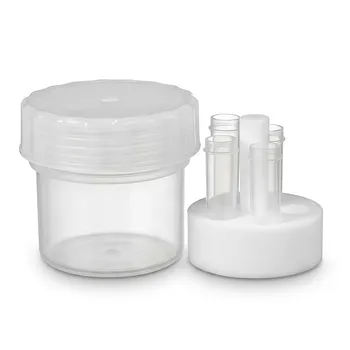
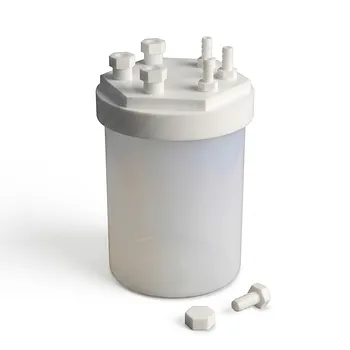
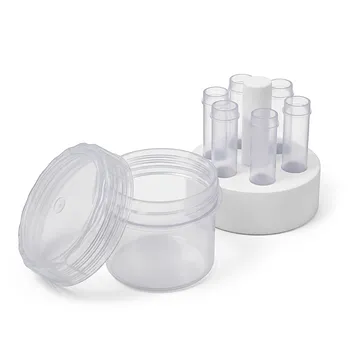
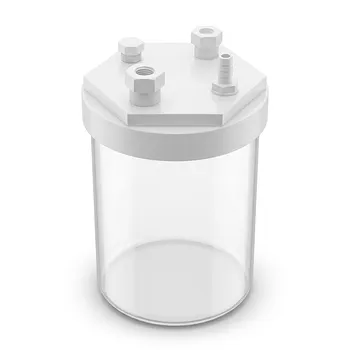
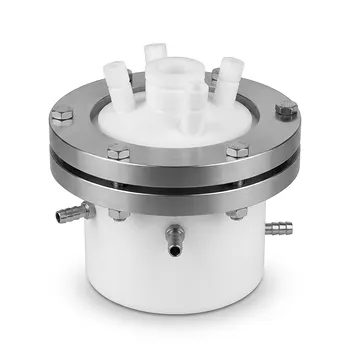
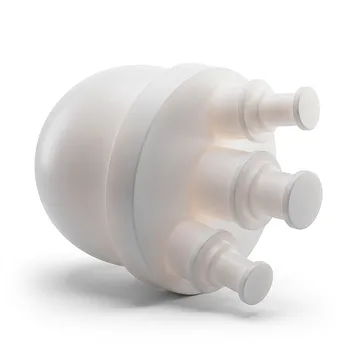
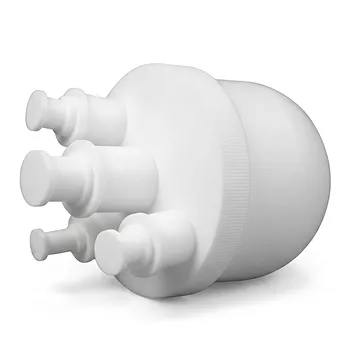
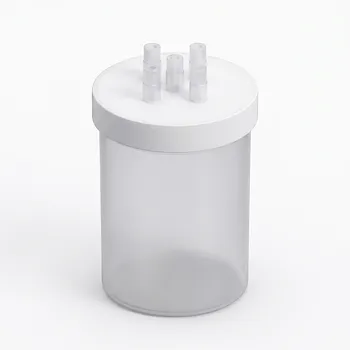
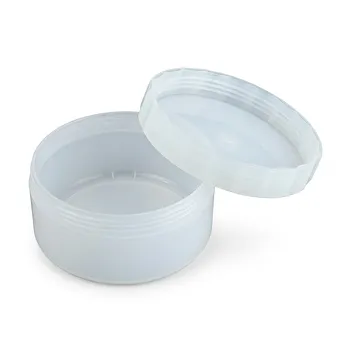
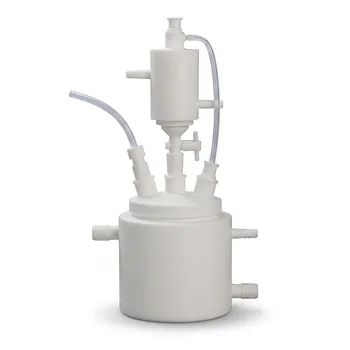
Custom-machined PTFE vessels and PFA containers provide a chemically resistant containment surface for aggressive reagents and intermediates. They are useful where glass or metal vessels could corrode or contribute impurities.
PFA is also suitable for applications requiring more complex formed or molded components because it can be melt-processed while retaining the chemical resistance expected from a perfluorinated polymer.
Tubing, valves, and fittings
Fluid transfer components are exposed continuously to the process chemistry. PTFE and PFA tubing, valves, fittings, and seals help prevent corrosion-related leaks and reduce the risk of contamination during transfer.
A chemically resistant fluid path is especially important when the system includes recirculation, long residence times, or repeated sampling.
Custom laboratory apparatus
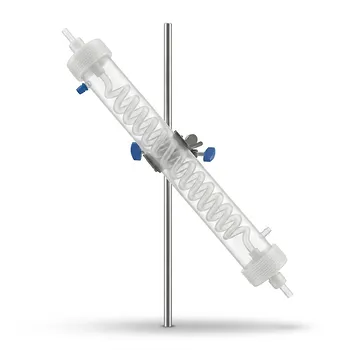
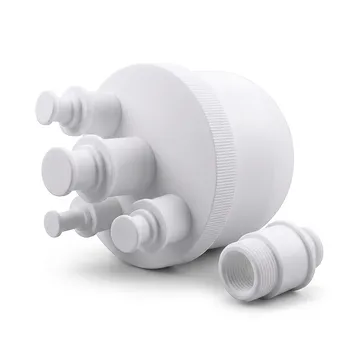
PTFE can be machined into specialized components, while PFA supports precision fabricated and melt-processed parts. This allows laboratories to design vessels, adapters, bottles, and transfer assemblies around the actual synthesis geometry rather than relying only on standard glassware.
The result is a complete containment system in which the reaction vessel, sampling interface, and transfer path are all compatible with the chemistry.
PTFE and PFA: Similar Purpose, Different Practical Strengths
PTFE for highly inert machined components
PTFE is widely used where maximum chemical inertness and low-friction surfaces are priorities. It is well suited to custom-machined vessels, seals, liners, tubing, and laboratory components.
Its high crystallinity makes conventional processing difficult, so it is commonly shaped through machining or specialized manufacturing methods rather than ordinary melt processing.
PFA for fabricated and transparent components
PFA offers comparable high chemical resistance while being more readily melt-processable. This makes it useful for tubing, bottles, vessels, fittings, and complex laboratory components that require controlled forming.
Depending on the design, PFA can also provide practical visibility into the fluid path, which can assist with inspection and process monitoring.
Understanding the Trade-offs
Chemical resistance is not unlimited under every condition
PTFE and PFA are highly resistant, but material selection must still consider temperature, pressure, reagent concentration, exposure duration, mechanical stress, and the complete chemical mixture.
The correct grade and construction should be verified against the actual process conditions rather than selected solely because a component is labeled “fluoropolymer.”
Contamination can come from more than the polymer body
Even when the PTFE or PFA wetted surface is appropriate, contamination may originate from pigments, fillers, machining residue, reinforcement materials, lubricants, or non-fluoropolymer seals and fittings.
For high-purity synthesis, specify the wetted materials, cleaning procedure, fabrication method, and allowable extractables—not just the base polymer.
Mechanical and processing requirements still matter
PTFE and PFA should be chosen with the component’s mechanical role in mind. A chemically compatible polymer may still require suitable wall thickness, support, connection design, and temperature control to remain reliable.
System integrity depends on the entire assembly, including joints, valves, gaskets, and interfaces.
Avoid assuming glass or metal is always unsuitable
Glass and metals can perform well in many chemical systems, but HF and strongly halogenated environments require particular caution. Their suitability depends on the specific alloy or glass composition and the process conditions.
The relevant question is not whether a material is generally laboratory-grade, but whether it remains stable and noncontaminating in the exact synthesis environment.
How to Apply This to Your Project
The material choice should follow the chemistry, purity requirement, and fluid-path design:
- If your primary focus is aggressive reagent containment: Use high-purity PTFE or PFA for wetted vessels, bottles, tubing, valves, and fittings after confirming compatibility with the full temperature and concentration range.
- If your primary focus is trace-level sample integrity: Prioritize virgin, high-purity fluoropolymer components with controlled fabrication and cleaning to minimize leaching, adsorption, and cross-contamination.
- If your primary focus is custom reactor design: Consider machined PTFE for specialized inert components and PFA for complex melt-processed or fabricated parts.
- If your primary focus is long-term process reliability: Evaluate the complete fluid path—including seals, connections, supports, and interfaces—rather than selecting the polymer body in isolation.
Selecting PTFE and PFA as part of a fully specified containment system helps keep aggressive fluorinated chemistry contained, stable, and analytically trustworthy.
Summary Table:
| Property | PTFE | PFA |
|---|---|---|
| Chemical Resistance | Exceptional resistance to acids, bases, and solvents | Similar to PTFE, high resistance to aggressive chemicals |
| Processing | Difficult to melt-process; typically machined | Melt-processable, allowing for complex shapes and transparent components |
| Typical Applications | Machined vessels, seals, liners, tubing | Tubing, bottles, fittings, complex labware |
| Surface Energy | Very low, reduces wetting and residue retention | Low, similar non-stick properties |
| Leaching | Minimal extractables when high-purity grade | Minimal, comparable to PTFE |
Upgrade your halogenated synthesis with chemically inert PTFE and PFA labware. Our custom-machined components and complete fluid path solutions ensure maximum purity and corrosion resistance. Contact us today to design a containment system that meets your exact requirements. Get in touch and secure your process integrity.
Related Products
- Custom PTFE Continuous Reaction Bottles Virgin Fluoropolymer High Purity Low Background Synthesis Vessels
- Corrosion Resistant PTFE Support with PFA Transparent Reaction Tank and High Purity PFA Sampling Tube for Trace Analysis
- PFA Chemical Reaction Tank with Customizable Fittings for Corrosive Solvent Synthesis and High Purity Lab Applications
- High Purity Corrosion Resistant PFA Reaction Vessel with PTFE Holder and Integrated Sampling Tube for Trace Analysis
- PFA Reaction Tank 6L Customizable Fittings Corrosion Resistant Solvent Resistant PFA Reaction Bottle for New Material Synthesis
People Also Ask
- What reaction vessel and fluid handling considerations are necessary for living cationic polymerization of fluorinated monomers involving Lewis acid catalysts? Key design and safety tips
- Ion Activation Reaction Vessel Requirements: Why PTFE is Critical for Membrane Performance
- How do perfluorinated solvent environments influence the selection of reaction vessels and fluid handling components in nonaqueous emulsion polymerizations? Choose fluoropolymer materials.
- Why are high-purity PTFE or PFA reaction vessels recommended for the synthesis of PANI-TiC hybrid materials? - Guide
- Why are fluoroplastic (PTFE) reaction vessels recommended for Methylene Blue (MB) adsorption kinetic experiments?