For PTFE and fluoropolymer micropowders, the principal ASTM methods are ASTM D4464, D895, D4567, D4591, and D1238. Together, they measure particle size, bulk density, specific surface area, melting behavior, and melt flow behavior. The appropriate method and test conditions depend on the polymer type, powder grade, and intended processing route.
ASTM D5675 provides the specification framework, while individual ASTM methods quantify the powder’s physical and thermal characteristics. Use the complete test-method designation and applicable material specification together, because PTFE and other fluoropolymers do not all behave identically during testing.
The Core ASTM Tests for Micropowders
Particle size — ASTM D4464
ASTM D4464 determines average particle size using laser light scattering.
Particle-size data help control powder handling, dispersion, blending, coating uniformity, and sintering or molding behavior. Results can vary with sample preparation, agglomeration, and the way the particle-size distribution is reported.
Bulk or apparent density — ASTM D895
ASTM D895 measures bulk density, also called apparent density, by determining the mass of powder occupying a defined volume.
Results are commonly expressed as mass per 1,000 mL or in g/L. This value is important for packaging, feeder calibration, storage-volume calculations, and evaluating differences in powder morphology or packing behavior.
Specific surface area — ASTM D4567
ASTM D4567 measures specific surface area, typically reported in square metres per gram.
Surface area influences adsorption, coating behavior, dispersion stability, sintering response, and interactions with other ingredients. Fine powders generally present greater surface area, although agglomeration can affect the measured result.
Thermal and Processing-Related Tests
Melting point — ASTM D4591
ASTM D4591 determines the powder’s peak melting point using differential scanning calorimetry, or DSC.
For PTFE powders, melting peaks commonly fall within approximately 317–334°C, depending on resin type, processing history, and crystallinity. The result is a thermal characterization value; it should not automatically be treated as the maximum continuous-use temperature of a finished component.
Melt flow rate — ASTM D1238
ASTM D1238 measures melt flow rate, also called melt flow index, using an extrusion plastometer.
For PTFE, FEP, and PFA micropowders, testing is commonly performed at elevated temperature, often around 372°C, when the material and applicable specification permit it. The exact temperature, load, die, and reporting basis must be confirmed for the specific fluoropolymer grade.
MFR is used as an indicator of flow behavior and processing consistency. It can help identify differences in molecular weight, formulation, or thermal history, but it is not a complete substitute for rheological characterization.
How the Tests Work Together
Particle size and surface area describe powder structure
Particle size shows how large the powder particles are, while specific surface area indicates how much exposed surface exists per unit mass.
These measurements should be interpreted together. Two powders with similar average particle sizes can exhibit different surface areas because of differences in morphology, porosity, or agglomeration.
Density indicates packing behavior
Bulk density reflects how the powder occupies space under the specified test conditions.
It is not the same as the polymer’s true density or specific gravity. A low bulk-density powder may contain more void space between particles, affecting filling, transport, and feeding behavior.
DSC and MFR describe thermal and flow behavior
DSC identifies the principal melting transition, while MFR evaluates how the material flows under a defined load and temperature.
Together, these tests provide a practical view of whether a powder’s thermal transition and processing behavior remain consistent from lot to lot.
Related ASTM Specifications and Material-Specific Methods
ASTM D5675 provides the broader fluoropolymer framework
ASTM D5675 is associated with the specification and characterization of PTFE and fluoropolymer micropowders.
The individual property measurements are performed using methods such as D4464, D895, D4567, D4591, and D1238. ASTM D5675 should therefore be viewed as the material-specification context rather than as a replacement for each individual test method.
PTFE resin form determines the applicable specification
For raw PTFE materials, different specifications apply to different product forms:
- ASTM D4894 covers granular PTFE resins.
- ASTM D4895 covers fine-powder PTFE resins.
- ASTM D4441 covers aqueous PTFE dispersions.
These standards may define additional requirements such as thermal stability, tensile properties, dispersion characteristics, or specific gravity. They should not be confused with the powder-property test methods used to measure particle size, surface area, density, melting point, and melt flow.
PVDF requires its own specification context
For PVDF thermoplastic resins, ASTM D3222 provides a relevant specification framework.
PVDF testing may include ASTM D1238 for melt flow rate, ASTM D3835 for rheology, and ASTM D3418 for DSC melting behavior. The applicable method should match the polymer family; a test condition suitable for PVDF is not automatically suitable for PTFE, FEP, or PFA.
Understanding the Trade-offs
A single test cannot define powder quality
Particle size alone does not establish whether a powder will process correctly. Density, surface area, melting behavior, and flow behavior can each reveal different aspects of powder performance.
A robust incoming-inspection program normally uses a relevant combination of tests rather than relying on one reported value.
Results depend strongly on test conditions
Sample conditioning, moisture exposure, agglomeration, heating rate, test load, die geometry, and instrument configuration can influence results.
For meaningful lot-to-lot comparisons, laboratories should use the same ASTM edition, sample preparation procedure, instrument settings, and reporting conventions.
MFR has important limitations for PTFE
Conventional PTFE has exceptionally high melt viscosity, so ordinary melt-flow measurements may not be meaningful for every PTFE grade.
ASTM D1238 should be applied only when the material specification and test procedure identify it as appropriate. Modified PTFE, FEP, PFA, and other melt-processible fluoropolymers may be more suitable candidates for MFR testing under defined conditions.
Powder tests are not finished-part tests
Micropowder characterization does not directly establish the tensile strength, dielectric strength, dimensional stability, or service life of a molded or machined component.
Finished products require separate standards and specimen preparation. For example, tensile testing commonly uses ASTM D638, flexural testing uses ASTM D790, and water absorption uses ASTM D570 when those properties are required.
How to Apply This to Your Project
The right test panel depends on whether you are qualifying incoming powder, comparing suppliers, or validating a finished fluoropolymer component.
- If your primary focus is incoming powder qualification: Use ASTM D4464, D895, D4567, D4591, and—where applicable—D1238 alongside the relevant material specification, such as ASTM D5675, D4894, D4895, or D3222.
- If your primary focus is processing consistency: Give particular attention to particle size, bulk density, surface area, melting behavior, and melt flow under identical, grade-specific conditions.
- If your primary focus is finished-component performance: Supplement powder testing with the mechanical, electrical, dimensional, and thermal tests specified for the final product form.
A carefully selected ASTM test program converts fluoropolymer powder characteristics into reliable evidence for material acceptance and process control.
Summary Table:
| ASTM Method | Property Measured | Key Details |
|---|---|---|
| D4464 | Particle size | Laser light scattering; controls handling and coating. |
| D895 | Bulk density | Mass per volume; affects packaging and storage. |
| D4567 | Specific surface area | m²/g; influences adsorption and dispersion. |
| D4591 | Melting point | DSC; typical PTFE peak: 317–334°C. |
| D1238 | Melt flow rate | Extrusion plastometer; at ~372°C for PTFE/FEP/PFA. |
Ensure precise powder testing with KINTEK's high-purity PTFE/PFA labware. From beakers to custom parts, our fluoropolymer products meet ASTM standards. Contact us now to optimize your material qualification and processing! Get in touch.
Related Products
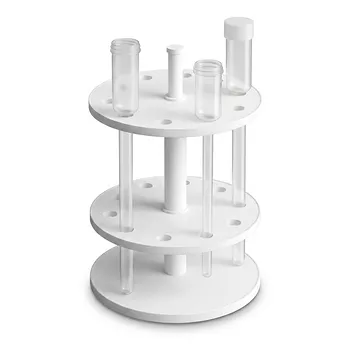
- Custom PFA Micro Column Rack and PTFE Machined Storage Solutions for Trace Analysis
- High Purity PTFE Microwave Digestion Vessel for Soil and Food Analysis Acid Resistant Fluoropolymer Sample Preparation Liners
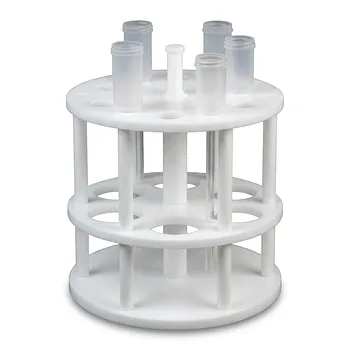
- Custom PFA Microcolumn Racks and PTFE Machined Low Background Corrosion Resistant Laboratory Fixtures
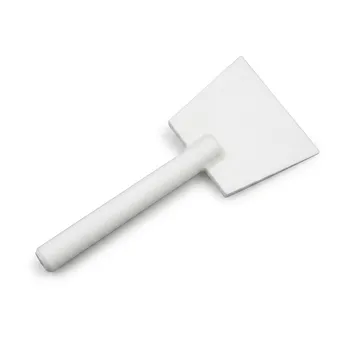
- Corrosion Resistant PTFE Laboratory Material Scoop for Biopharmaceutical Use Non Stick Easy Clean Fluoropolymer Shovel
- Corrosion Resistant PTFE Sampling Spoon for High Purity Solid Powder Reagent Handling and Laboratory Chemical Transfer
People Also Ask
- Why are PFA and PTFE fluoropolymers selected for fluid handling and trace analysis equipment in semiconductor and analytical testing laboratories? Discover the key to ultra-pure processing.
- What are the benefits of using nickel foam as a current collector for Bi2MoO6 supercapacitors? Enhanced 3D Conductivity
- Why is PTFE used in chemical transport and storage systems? Unmatched Chemical & Thermal Resistance
- What are the key factors to consider when choosing a backup ring material? Ensure Seal Integrity in High-Pressure Systems
- What are the two most common materials used for backup rings? PTFE vs. PEEK for Superior Sealing