Fluoropolymer (PTFE) sample holders generally provide more chemically stable deposition conditions than glass holders, producing more reproducible optical and photoelectric behavior in chemically bath-deposited thin films. Films grown with PTFE holders typically retain stable transient photocurrent responses and their baseline photoluminescence (PL) emission wavelengths. Glass holders exposed to strongly acidic or alkaline baths may interact slightly with the solution, contributing to small PL blue shifts and less stable photoconductivity, although the underlying crystal structure and measured impurity levels can remain largely unchanged.
PTFE minimizes holder-related chemical interference, making it the safer choice when reproducibility and stable photoresponse are priorities. Glass can still support comparable film crystallinity and overall purity, but it may introduce subtle optical or electrical variability under aggressive deposition conditions.
Why Holder Material Affects Thin-Film Behavior
The holder is part of the chemical environment
In chemical bath deposition, the sample holder is continuously exposed to the deposition solution. Its material can therefore affect the local chemical environment at the substrate surface, especially when the bath is strongly acidic, alkaline, oxidizing, or otherwise chemically aggressive.
A holder does not need to visibly corrode to influence the film. Small amounts of leaching, surface reaction, or adsorption can alter nucleation conditions or introduce trace species near the growing film.
PTFE provides chemical inertness
Machined PTFE is highly resistant to the solutions commonly used in demanding chemical bath deposition processes. It is less likely to release reactive constituents or participate in solution chemistry during film growth.
This inertness helps maintain consistent nucleation and growth conditions from one deposition to the next. The resulting benefit is primarily reproducibility, rather than a fundamental change in the film’s intended composition.
Glass can introduce subtle interactions
Glass is often sufficiently stable for routine deposition, but strong alkaline or acidic baths can attack its surface or promote minor leaching. The resulting chemical changes may be too small to produce obvious structural defects while still affecting electronic states or optical recombination.
This distinction matters: glass-related effects may appear first in photoluminescence or transient photocurrent measurements, rather than in conventional structural characterization.
Effect on Optical Properties
PTFE preserves the baseline PL response
Films deposited with PTFE holders generally maintain their expected PL emission wavelength. This indicates that the optical recombination environment remains relatively consistent when the holder does not contribute measurable chemical interference.
For comparative studies, this stable baseline makes it easier to attribute changes in PL to genuine differences in deposition parameters, film composition, thickness, or post-treatment.
Glass may cause a minor blue shift
Films grown using glass holders can exhibit a slight PL blue shift relative to films grown with PTFE holders. A blue shift means that the dominant emission moves toward a shorter wavelength, corresponding to higher photon energy.
The shift should be interpreted as a subtle change in the film’s optical environment, not automatically as evidence of a different crystalline phase. Possible contributors include small changes in defect populations, surface chemistry, local composition, or carrier confinement caused by holder-solution interactions.
The optical change is not necessarily a structural change
X-ray diffraction measurements show that the principal crystalline phase and orientations can remain consistent between films prepared with PTFE and glass holders. For PbS-based films, reflections such as the 111, 220, and 222 peaks may therefore remain essentially unchanged.
This demonstrates that crystallographic similarity does not guarantee identical optical behavior. XRD primarily evaluates long-range structural order, whereas PL is sensitive to electronic states, defects, interfaces, and recombination pathways.
Effect on Photoelectric Properties
PTFE supports stable transient photocurrent
Films grown with PTFE holders typically show consistent photocurrent behavior during illumination. The signal is less likely to decay rapidly or fluctuate because the film experiences a more stable chemical environment during deposition.
A stable transient response is valuable when evaluating photodetector behavior, carrier generation, trapping, and recombination. It also improves confidence that the measured response reflects the film rather than uncontrolled contamination or holder-induced variability.
Glass can produce unstable photoconductivity
Glass-holder deposition may result in less stable photoconductivity responses, particularly when the bath chemistry is sufficiently aggressive to interact with the holder. Rapid photocurrent decay can indicate carrier trapping, recombination, surface-state changes, or other modifications introduced during growth.
The holder is not necessarily the only cause of this behavior. Film thickness, morphology, substrate condition, electrolyte concentration, illumination intensity, and measurement bias must also be controlled before assigning the response entirely to the holder material.
Electrical measurements can reveal effects missed by composition tests
The available SIMS results indicate no significant difference in silicon or oxygen impurity levels across films and interface layers prepared with PTFE and glass holders. This suggests that any observed photoelectric instability may not result from a large, easily detected concentration of these impurities.
Instead, the relevant differences may involve trace species, chemical bonding, defect distributions, surface states, or interfaces. These factors can strongly influence conductivity and carrier lifetime even when bulk impurity profiles appear similar.
How to Interpret the Evidence Together
PTFE improves process control
The strongest case for PTFE is its ability to reduce a source of uncontrolled variation. By remaining chemically inert, it helps ensure that changes in PL or photocurrent originate from intentional deposition variables.
This is especially important when comparing small performance differences between samples or developing a repeatable synthesis protocol.
Glass may preserve the main film structure
Glass is not automatically unsuitable. The supplementary evidence indicates that films deposited with glass can retain the same major crystalline phase, preferred orientations, and broadly comparable impurity profiles as films deposited with PTFE.
Its limitation is that structural and compositional similarity does not rule out smaller optical and electrical differences.
The effect depends on bath severity
The practical difference between PTFE and glass will be greatest when the deposition bath is strongly acidic or alkaline, operated at elevated temperature, or used for long deposition times. Under mild conditions, glass may produce negligible holder-related effects.
Therefore, holder selection should be based on the actual bath chemistry and the sensitivity of the target measurement, not on material preference alone.
Understanding the Trade-offs
PTFE offers reproducibility but costs more
PTFE holders generally provide better chemical resistance and lower contamination risk. However, machined fluoropolymer components may cost more than standard glassware and can require custom fabrication for precise sample positioning.
PTFE also has different mechanical and thermal characteristics from glass, so the holder must be designed to remain stable under the process temperature and handling conditions.
Glass is accessible and often adequate
Glass holders are inexpensive, widely available, and compatible with many conventional deposition setups. They may be entirely adequate when the bath is chemically mild and the required optical or electrical precision is modest.
The risk is not necessarily catastrophic film failure. It is the introduction of small, difficult-to-control variations that become important in sensitive characterization or high-reproducibility studies.
Do not infer causation from PL alone
A PL blue shift or unstable photocurrent should not be attributed to holder material without controls. Variations in precursor concentration, pH, temperature, deposition time, substrate preparation, film thickness, and illumination conditions can produce similar changes.
A reliable comparison requires identical process conditions, multiple samples, holder-only variation, and complementary analysis such as PL, transient photocurrent, XRD, and impurity or surface characterization.
Making the Right Choice for Your Goal
Choose the holder material according to the sensitivity of the film and the measurement.
- If your primary focus is reproducible optical emission: Use PTFE to minimize chemical interaction and preserve a stable PL baseline, particularly in strongly acidic or alkaline baths.
- If your primary focus is stable photoelectric response: Prefer PTFE because it is less likely to contribute to photocurrent decay or photoconductivity fluctuations.
- If your primary focus is crystal structure: Glass may be adequate because the major crystalline phase and diffraction orientations can remain consistent with PTFE.
- If your primary focus is high chemical purity: Use PTFE as the lower-risk option, while confirming performance with impurity profiling because holder-related effects may occur below routine detection limits.
- If your primary focus is low-cost process development: Glass can be practical under mild deposition conditions, but it should be validated against PTFE before use in sensitive or comparative studies.
For thin-film deposition where optical and photoelectric reproducibility matter, PTFE is the more defensible default because it removes a chemically active variable from the process.
Summary Table:
| Aspect | PTFE Holders | Glass Holders |
|---|---|---|
| Chemical Inertness | Excellent; minimizes leaching and reaction. | Moderate; may interact with aggressive baths. |
| Optical Properties (PL) | Maintains baseline wavelength; no blue shift. | May cause slight blue shift due to surface interactions. |
| Photoelectric Properties | Stable transient photocurrent; consistent response. | Less stable photoconductivity; possible rapid decay. |
| Structural Integrity (XRD) | Consistent crystalline phase and orientation. | Similar XRD pattern; no major structural difference. |
| Impurity Levels (SIMS) | No significant difference in Si/O impurities. | No significant difference in Si/O impurities. |
| Reproducibility | High; reduces uncontrolled variation. | Lower under harsh conditions. |
| Cost | Higher; custom machining may be needed. | Lower; readily available. |
| Best For | Sensitive optical/electrical measurements; reproducibility. | Mild conditions; cost-sensitive development. |
Ensure reproducibility in your thin-film deposition with KINTEK's high-purity PTFE sample holders. Our custom CNC-machined PTFE and PFA labware provides inert, robust solutions for chemical bath deposition and beyond. Whether you need standard holders or bespoke designs, our products minimize contamination and maximize consistency. Contact us today to optimize your process and achieve reliable results. Get in touch with us!
Related Products
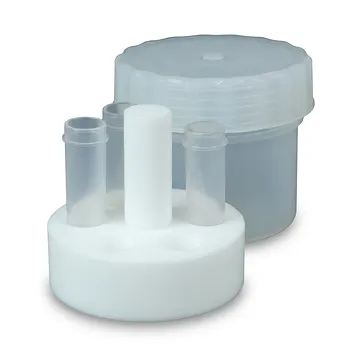
- High Purity Corrosion Resistant PTFE Sample Injection Tube Rack 6 Hole Compatible with Laboratory Reaction Vessels
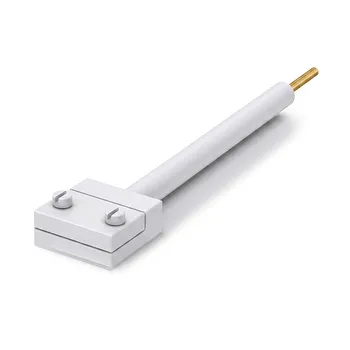
- PTFE Electrochemical Electrode Holder for Thickened Samples with Platinum Contact Sheet
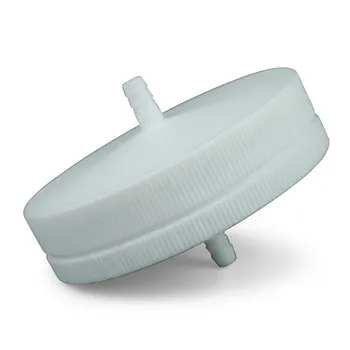
- PTFE Membrane Filter Holder for Aerosol Environmental Monitoring and Low Concentration Particulate Matter Sampling Chemical Resistant Air Quality Analysis Component
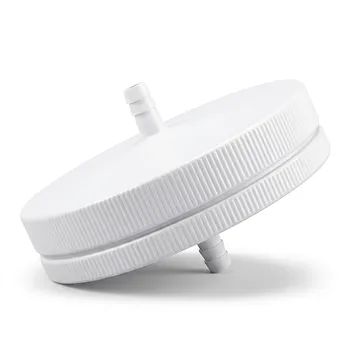
- PTFE Filter Membrane Holder for Hydrogen Chloride and Water Filtration 90mm Environmental Sampling Clamp Customizable
- PTFE Filter Membrane Holder 47mm Leak Proof Corrosion Resistant Environmental Sampling Unit Customizable
People Also Ask
- What surface chemical species and binding energy signatures are detected on PTFE fluoropolymer sample holders during XPS analysis? Key insights for accurate calcium detection.
- How does using PTFE sample holders during semiconductor thin film deposition impact the optical properties, crystal structure, and elemental impurities compared to glass holders?
- How does paste extrusion impart structural integrity to unsintered PTFE lab tubing?
- What structural components are typically found in a high-purity PTFE wafer cleaning rack? Optimize Your Cleaning Process
- Why is PTFE considered an ideal material for high-purity laboratory vessels and fluid transfer components handling harsh acids and corrosive gases?