PTFE is unusual because it technically melts but does not become a practical flowing melt. Above approximately 340°C, PTFE transforms into a clear, intractable gel with extraordinarily high viscosity rather than behaving like a conventional thermoplastic. Other fluoropolymers may begin degrading before they reach a useful melt state, so custom laboratory components are typically produced through compression molding and sintering, followed by precision CNC machining from solid stock.
The central processing challenge is the separation between melting and flow: PTFE can pass its melting point without becoming processable by injection molding. Its exceptional thermal and chemical performance therefore comes with a fabrication requirement: custom labware must usually be formed through powder-based methods or machined mechanically.
Why Fluoropolymers Resist Conventional Processing
PTFE melts without flowing
PTFE has an exceptionally high molecular weight, commonly reported in the range of 1 × 10⁶ to 5 × 10⁶ g/mol. That molecular structure produces melt viscosities many orders of magnitude above those of ordinary melt-processable plastics.
At temperatures around 380°C, PTFE melt viscosity can reach approximately 10¹¹ to 10¹² Pa·s, depending on the measurement conditions. The material behaves more like a stiff, highly viscous gel than a liquid capable of filling a mold.
High viscosity prevents injection molding
Conventional injection molding depends on a polymer flowing rapidly through gates, runners, and narrow cavities. PTFE cannot move through these features effectively, even when heated above its melting point.
This makes standard injection molding and conventional melt extrusion unsuitable for many PTFE parts. Increasing temperature is not a practical solution because thermal decomposition becomes a growing concern as processing temperatures rise.
Thermal degradation can occur before useful melt flow
Not every fluoropolymer shares PTFE's exact behavior. Some materials degrade at elevated temperatures before reaching a practical melt-processing window; PVF, for example, is described as degrading before melting near 190°C.
This distinction matters during material selection. A polymer may have a nominal melting point, yet still lack a safe and useful temperature range in which it can flow, fill a mold, and retain its required properties.
How Molecular Structure Changes Processability
PTFE prioritizes thermal and chemical resistance
PTFE's highly regular, strongly fluorinated molecular structure supports outstanding chemical resistance and high-temperature performance. Standard PTFE can provide continuous service temperatures around 260°C, making it valuable for aggressive chemical environments and high-temperature laboratory operations.
The same high molecular weight and chain structure that provide this performance also produce extreme melt resistance. In practical terms, PTFE gains durability by sacrificing ordinary melt processability.
FEP offers easier melt processing
FEP contains pendent trifluoromethyl groups that disrupt polymer-chain packing. Its virgin crystallinity is substantially lower than PTFE's, reported at roughly 40–50% compared with 92–98% for PTFE.
This structural disruption lowers FEP's melt viscosity to approximately 10⁴–10⁵ poise, compared with roughly 10¹⁰–10¹² poise for PTFE in the supplied comparison. FEP can therefore be processed using melt-based methods that are impractical for PTFE.
Processability involves a performance trade-off
FEP's improved flow comes with lower thermal performance. Its melting point is approximately 265°C, and its continuous service temperature is around 200°C, compared with approximately 327–342°C melting and 260°C continuous service for PTFE, depending on the reference and measurement convention.
FEP can be the better choice for transparent tubing, heat-sealable bags, and complex molded parts. PTFE remains preferable when maximum temperature resistance, chemical inertness, and pressure performance are the primary requirements.
How These Characteristics Change Labware Fabrication
Compression molding and sintering form the base shape
PTFE is commonly processed as granular or fine powder. The powder is first compacted under pressure into a near-net-shape blank or preform.
The compacted material is then heated through a controlled sintering cycle. Sintering consolidates the powder and develops a mechanically coherent polymer structure without requiring PTFE to flow like an injection-molding resin.
CNC machining creates the final geometry
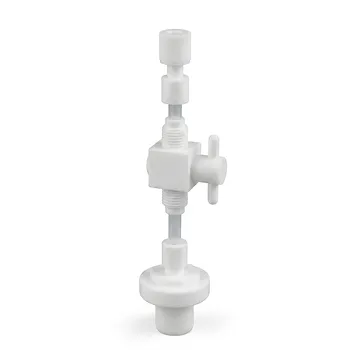
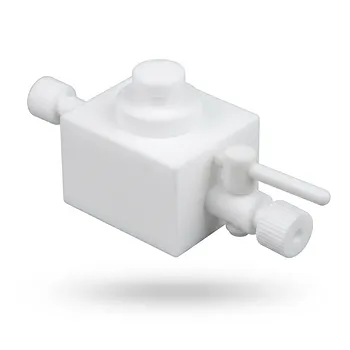
After sintering, the consolidated PTFE stock can be machined using high-precision CNC equipment. This allows manufacturers to produce internal channels, stepped bores, threaded interfaces, sealing surfaces, pockets, and other non-standard features.
Direct machining from solid PTFE or PFA stock avoids forcing the polymer through narrow mold passages. It also gives designers greater control over dimensions when the required component is too specialized to justify a dedicated mold.
Machining protects material purity
For laboratory equipment, fabrication is not only a dimensional problem. The material must also maintain its chemical purity and avoid contamination from incompatible processing aids, inserts, or manufacturing residues.
Machining a chemically resistant fluoropolymer blank can preserve the material's intended purity while producing parts for electrochemical cells, microwave digestion vessels, specialized valves, reaction apparatus, and fluid-transfer systems.
The process supports low-volume customization
Custom labware is often produced in small quantities, with each part designed around a particular instrument, reaction, sample volume, or connection standard. Tooling for conventional molding may be uneconomical or unable to reproduce the required geometry.
Compression molding followed by CNC machining is better suited to this environment. It supports bespoke dimensions and revisions without requiring the entire design to conform to a standard mold architecture.
Why Thermal Control Matters During Fabrication and Use
Processing temperature must be controlled narrowly
PTFE must be heated enough to sinter properly, but unnecessary thermal exposure should be avoided. Excessive temperature or residence time can damage the polymer and may generate hazardous decomposition products.
The relevant concern is therefore not simply whether the polymer has reached its melting point. Engineers must consider the full combination of temperature, exposure time, pressure, atmosphere, and part geometry.
Decomposition products change with conditions
At elevated temperatures, PTFE decomposition products vary with temperature and pressure. Under vacuum, tetrafluoroethylene can be a principal pyrolysis product.
Between approximately 500°C and 700°C, octafluorocyclobutane can become a significant product, while temperatures above approximately 750°C can increase hexafluoropropylene formation. Under extreme conditions near 900°C and 1 bar, highly toxic perfluoroisobutene may form in significant quantities.
These temperatures are far above normal PTFE service conditions, but the information remains important for failure analysis, fire safety, furnace operation, and accidental overheating. PTFE equipment should not be treated as indefinitely stable merely because it performs well during normal laboratory use.
Understanding the Trade-offs
PTFE offers performance at the cost of manufacturing freedom
PTFE is an excellent choice when chemical resistance, low friction, non-wetting behavior, and high-temperature capability matter most. However, its extreme viscosity limits the ability to produce intricate shapes directly through conventional melt molding.
Designers must account for machining access, tool geometry, wall thickness, tolerances, and the behavior of sintered stock. A shape that is easy to mold in another polymer may be expensive or impossible to machine in PTFE.
Melt-processable alternatives may simplify complex parts
PFA and FEP can provide greater freedom for molded or extruded geometries. They are useful when the component requires transparent walls, seamless fluid paths, heat sealing, or intricate molded fittings.
The trade-off is reduced continuous-temperature capability compared with PTFE. The correct decision depends on the actual operating temperature, chemical exposure, pressure, transparency requirement, and required production volume.
Machined parts require design discipline
CNC machining does not eliminate engineering constraints. Thin walls, sharp internal corners, deep narrow cavities, and heavily loaded threaded sections can create dimensional, mechanical, or sealing problems.
Custom labware should therefore be designed with realistic machining access and with tolerances appropriate to fluoropolymers. The design must also account for PTFE's relatively soft structure and dimensional response under load and temperature.
Thermal degradation must be separated from normal service
A PTFE component rated for continuous operation near 260°C is not automatically suitable for uncontrolled exposure to much higher temperatures. Service ratings describe intended operating conditions, not immunity to pyrolysis.
Applications involving furnaces, microwave systems, exothermic reactions, or potential dry-out conditions require independent thermal-risk analysis and appropriate ventilation and safeguards.
Making the Right Choice for Your Goal
Select the material and fabrication method according to the laboratory function rather than process convenience alone.
- If your primary focus is maximum heat and chemical resistance: Use PTFE and plan for compression molding, sintering, and precision machining rather than conventional injection molding.
- If your primary focus is transparent tubing or heat-sealable components: Consider FEP when its lower service-temperature range is compatible with the application.
- If your primary focus is complex molded fluid paths: Evaluate melt-processable fluoropolymers such as PFA or FEP, while checking their temperature, pressure, and chemical limits.
- If your primary focus is bespoke low-volume equipment: Machine the required geometry from qualified fluoropolymer stock and specify tolerances, surface finishes, and material-purity requirements early.
- If your primary focus is high-temperature safety: Design around controlled operating limits, prevent overheating, and assess potential decomposition products rather than relying only on the nominal melting point.
Understanding the difference between melting, flowing, sintering, and degrading is the key to selecting both the right fluoropolymer and the right fabrication route for reliable custom labware.
Summary Table:
| Characteristic | PTFE | FEP |
|---|---|---|
| Typical molecular weight (g/mol) | 1×10⁶ to 5×10⁶ | Lower, due to pendent groups |
| Melt viscosity (poise) | 10¹⁰–10¹² | 10⁴–10⁵ |
| Melting point (°C) | 327–342 | ~265 |
| Continuous service temperature (°C) | ~260 | ~200 |
| Processability | Not melt-processable; requires compression molding & sintering | Melt-processable (injection molding, extrusion) |
Ready to produce custom fluoropolymer labware?
At KINTEK, we specialize in high-performance PTFE and PFA components, from simple beakers to complex electrochemical cells. Leveraging our end-to-end CNC machining and custom fabrication capabilities, we deliver precision parts that meet your exact specifications, even for low-volume or highly specialized needs. Our expertise ensures that the material's exceptional thermal and chemical properties are fully preserved, giving you reliable performance in the most demanding applications.
Contact our engineers to discuss your project and receive a tailored solution.
Whether you need a single custom part or high-volume production, KINTEK has the expertise to deliver high-quality fluoropolymer labware that exceeds your expectations.
Related Products
- High Purity PFA Chromatography Column with Collection Bottle Corrosion Resistant Fluoropolymer Filtration System for Trace Analysis
- Custom PTFE Flask 250ml High Purity Fluoropolymer Laboratory Vessel for Chemical Research
- Custom PFA Tubing 1/4 Inch High Purity Corrosion Resistant Fluoropolymer Tube with Welding and Machining Services
- Corrosion Resistant PFA Syringe Translucent Visual Fluoropolymer Labware 10ml Chemical Handling Tool
- Custom PTFE Reaction Tank Corrosion Resistant Fluoropolymer Chemical Processing Barrel 10L 20L 30L
People Also Ask
- What are the primary functional and temperature differences between PFA and FEP when selecting melt-processible fluoropolymers for custom laboratory apparatus?
- How does PPVE modify PTFE to make melt-processable PFA? Discover key benefits and applications.
- Why is the chemical stability of polymer endgroups critical when selecting melt-processible fluoropolymers like PFA for high-purity laboratory apparatus? Choose Stable Endgroups for Reliable Performance
- What are the characteristics of PFA material? A Guide to Its High-Performance Balance
- Why is Perfluoroalkoxy alkane (PFA) preferred over glass or stainless steel in pharmaceutical process development? Pure Yield