The tensile strength–elasticity balance is controlled by how fluorinated side groups regulate chain packing and interchain locking. At low bulky co-substituent concentrations, residual microcrystallinity reinforces the polymer and produces high tensile strength. At intermediate concentrations, steric hindrance and chain interdigitation create reversible physical crosslinks that limit chain slippage while allowing elastic deformation. Above roughly 10% bulky-group loading, crowding prevents effective interdigitation, so the material behaves more like an extensible gum with low tensile strength.
The key mechanism is concentration-dependent physical organization: microcrystalline regions provide strength at low loading, interdigitated and sterically constrained chains provide strength with elasticity at intermediate loading, and excessive substitution disrupts the interchain contacts needed for reinforcement.
How Molecular Structure Controls the Balance
Fluorinated Side Groups Establish the Base Packing Structure
Main-chain fluorinated side groups, including trifluoroethoxy units, influence how neighboring polymer chains arrange themselves. Their size, fluorination, and distribution affect both chain mobility and the ability of segments to form ordered regions.
Fluoroalkyl side-chain length and backbone flexibility also contribute to this balance. Flexible fluorinated structures can maintain very low glass-transition temperatures, supporting elasticity, while fluorinated interactions and residual ordering can preserve mechanical integrity.
Bulky Co-Substituents Disrupt Crystallinity
Bulky co-substituents interfere with the regular packing needed for extensive crystallinity. At low concentrations, however, this disruption is limited, allowing residual microcrystallinity to remain.
These small ordered domains function as reinforcing points within the otherwise flexible polymer. They resist deformation and chain separation, which explains the high tensile strength observed at loadings up to approximately 0.25%.
Intermediate Loading Creates Physical Crosslinks
Increasing the bulky-group concentration to around 6% reduces the contribution from microcrystallinity but introduces a different reinforcement mechanism. Neighboring chains can become constrained by steric hindrance and interchain interdigitation.
Interdigitation occurs when structural features from adjacent chains penetrate or fit around one another. These contacts act as reversible, non-covalent crosslinks: they restrict chain slippage under load but can rearrange when the material is stretched.
Why Intermediate Structures Provide Elasticity
Chain Slippage Is the Central Failure Mode
A polymer can stretch easily when its chains slide past one another with little resistance. That behavior produces extensibility but usually reduces tensile strength because the material cannot efficiently transfer stress between chains.
Physical crosslinks interrupt this slippage. They distribute applied force across multiple chains while retaining enough molecular mobility for the polymer to recover after deformation.
Steric Hindrance Adds Reversible Resistance
Bulky substituents occupy space around the polymer backbone and side groups. At an appropriate concentration, this crowding makes unrestricted chain motion difficult without completely immobilizing the chains.
The result is a useful middle ground: enough steric resistance to carry tensile loads, but enough segmental freedom to support elastic response.
Interdigitation Connects Flexible Chains
Interdigitation is especially important because it provides reinforcement without requiring permanent covalent bonds. The chains remain part of a physically associated network rather than becoming a permanently fixed thermoset structure.
This reversible organization helps explain how the material can combine tensile strength with elasticity. The network resists deformation during loading and can partially reorganize as the polymer is extended.
Why Excessive Bulky-Group Loading Reduces Strength
Crowding Blocks Interchain Contact
When bulky-group loading exceeds approximately 10%, intramolecular crowding becomes dominant. The substituents interfere with the close approach and geometric alignment needed for neighboring chains to interdigitate.
The same groups that previously helped restrict chain slippage now prevent the chains from forming effective physical junctions.
The Polymer Loses Its Reinforcing Network
Without sufficient interdigitation, the polymer has fewer mechanically effective connections between chains. Stress is therefore carried more locally, and chains can extend or move past one another more readily.
The material consequently shifts toward an extensible gum-like behavior. It may undergo substantial deformation, but its low tensile strength reflects the loss of a coherent physical reinforcement network.
Structural Variables Beyond Substituent Concentration
Backbone Flexibility Sets Elastic Recovery
A flexible backbone allows chains to rearrange under stress and contributes to a low glass-transition temperature. This flexibility is necessary for elastomeric behavior, but it must be moderated by physical associations to prevent excessive flow or permanent deformation.
Kinked linkages and electron-withdrawing fluorinated units can restrict rigid chain alignment while preserving flexibility. Their effect on strength depends on how they interact with the polymer's larger packing and domain structure.
Side-Chain Length Changes Thermal and Mechanical Behavior
Longer fluorinated side chains can raise the onset of thermal degradation while maintaining very low glass-transition temperatures. This combination supports flexibility and resilience over demanding thermal cycles.
However, thermal stability alone does not determine tensile strength. Mechanical performance still depends on whether the side chains and backbone produce reinforcing domains or permit uncontrolled chain motion.
Segregated Domains Can Provide Complementary Functions
Block copolymer architectures can separate flexible and mechanically rigid segments into distinct domains. The flexible regions support rearrangement, while the more rigid domains provide structural stability.
This is a related design strategy rather than the same mechanism as the concentration-dependent physical crosslinking described above. Both approaches rely on controlled molecular organization to combine mobility with load-bearing capacity.
Understanding the Trade-offs
More Order Usually Means More Strength and Less Stretch
Microcrystallinity and rigid physical domains improve tensile strength by resisting chain movement. Their drawback is reduced extensibility when the ordered or constrained regions become too extensive.
The strongest material is therefore not necessarily the most elastic. Performance depends on preserving enough ordered reinforcement without suppressing the chain mobility required for recovery.
More Bulky Substitution Does Not Continuously Improve Toughness
Bulky groups initially improve mechanical behavior by increasing steric resistance and enabling interdigitation. Their benefit has an optimum rather than a simple linear relationship with concentration.
Beyond that optimum, intramolecular crowding disrupts the very contacts responsible for reinforcement.
Physical Crosslinks Are More Reversible Than Covalent Networks
Non-covalent crosslinks can support elasticity and molecular rearrangement, but they may be less permanent than covalent networks under sustained stress or unfavorable conditions. Covalently cross-linked fluoropolymers provide greater structural permanence but become insoluble and less amenable to solution processing.
The appropriate architecture depends on whether the application prioritizes recoverable deformation, processing flexibility, long-term dimensional stability, or resistance to thermal and chemical stress.
Making the Right Choice for Your Goal
The practical design decision is to target the molecular regime that matches the required deformation and load-bearing behavior.
- If your primary focus is maximum tensile strength: Keep bulky co-substituent loading low enough to preserve residual microcrystallinity and other ordered reinforcing regions.
- If your primary focus is balanced strength and elasticity: Target an intermediate bulky-group concentration, approximately 6%, where steric hindrance and chain interdigitation can act as physical crosslinks.
- If your primary focus is maximum extensibility: Recognize that loading above approximately 10% may produce a gum-like material, but expect tensile strength to decline as interdigitation is suppressed.
- If your primary focus is thermal and chemical durability: Combine a flexible, highly fluorinated structure with an architecture that maintains mechanically effective domains under the intended operating conditions.
The most reliable design principle is to control chain packing and reversible interchain contacts so the polymer can deform without allowing its chains to slip freely.
Summary Table:
| Structural Feature | Concentration Range | Mechanical Effect |
|---|---|---|
| Residual microcrystallinity | Low (≤0.25%) | High tensile strength due to reinforcing ordered domains |
| Steric hindrance & chain interdigitation | Intermediate (~6%) | Balanced strength and elasticity via reversible physical crosslinks |
| Intramolecular crowding | High (>10%) | Reduced tensile strength, gum-like behavior due to disrupted interchain contacts |
Optimize your fluoropolymer's tensile strength and elasticity with precision-engineered PTFE/PFA solutions. From custom CNC machined parts to high-purity labware, KINTEK delivers tailored materials for your exact performance needs. Contact us today to discuss your application and discover how our expertise can enhance your product's durability and flexibility.
Related Products
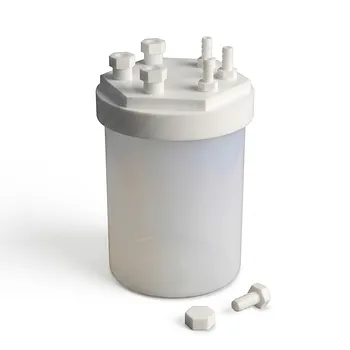
- PFA Chemical Reaction Tank with Customizable Fittings for Corrosive Solvent Synthesis and High Purity Lab Applications
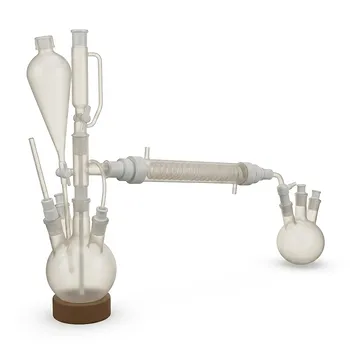
- PTFE Distillation Condensation Apparatus High Temperature Hydrofluoric Acid Resistant Fluorination Reaction Flask
- High Purity PFA Chromatography Column with Collection Bottle Corrosion Resistant Fluoropolymer Filtration System for Trace Analysis
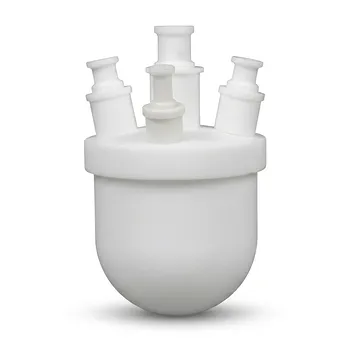
- Custom PTFE Flask 250ml High Purity Fluoropolymer Laboratory Vessel for Chemical Research
- Custom PTFE Condenser Tube 100ml Serpentine and Straight Fluoropolymer Laboratory Heat Exchanger with Flask Adapters
People Also Ask
- How does the molecular structure of fluorinated polymers contribute to the extreme thermal stability and chemical resistance required for high-performance laboratory reaction vessels and digestion containers? Discover the science behind PTFE and PFA for your lab.
- How do choice of solvent and chain transfer activity affect molecular weight during vinylidene fluoride (VDF) radical polymerization? Learn Key Factors for High-MW PVDF
- What role do low-surface-energy fluoropolymer reaction vessels play in preventing fouling during particle synthesis and emulsion polymerization?
- Why are fluoropolymer reaction vessels essential for SnO2/rGO synthesis? The Key to High-Performance Composites
- When synthesizing TFVE monomers involving reactive organometallic reagents and aggressive polar solvents, what material performance characteristics are required? Ensure purity with PTFE/PFA.