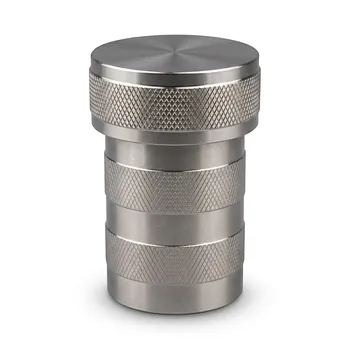
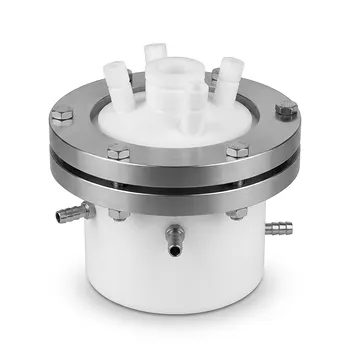
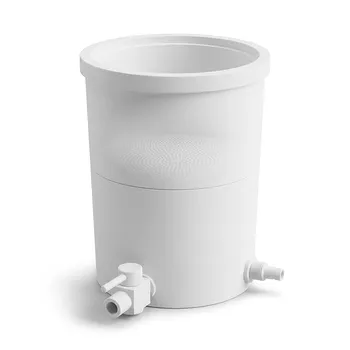
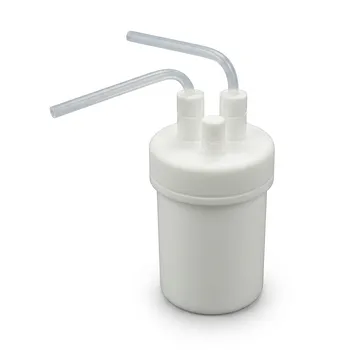
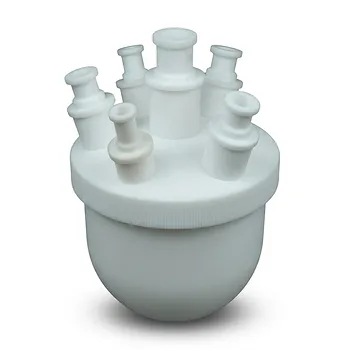
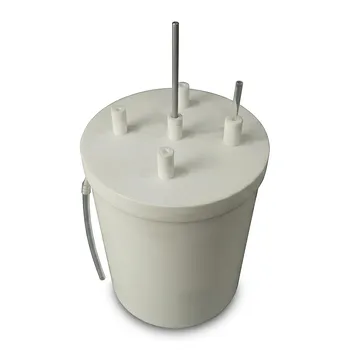
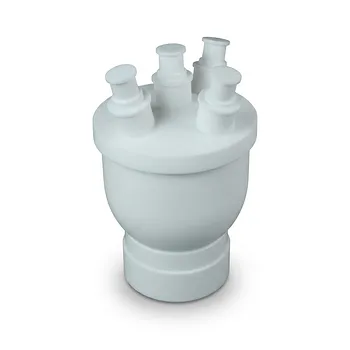
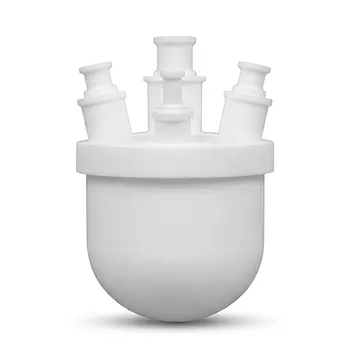
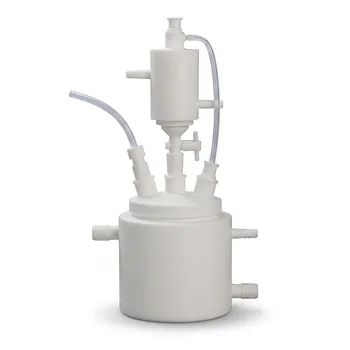
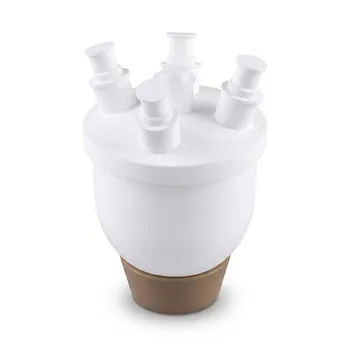
The PTFE-lined hydrothermal synthesis reactor serves as the primary vessel for the high-purity decomposition of actinide oxalates into actinide dioxide ($AnO_2$) nanopowders. It provides a stable, high-pressure environment that facilitates controlled crystallization while maintaining absolute chemical inertness. This ensures that the resulting nanocrystals, such as $NpO_2$ and $UO_2$, are free from metallic impurities and vessel-wall contamination.
The core role of a PTFE-lined reactor is to provide a chemically isolated, high-pressure environment that enables the hydrothermal synthesis of actinide dioxides. By preventing corrosion and leaching, it guarantees the chemical purity and structural uniformity required for advanced nuclear material research.
Maintaining Chemical Purity in Actinide Synthesis
Prevention of Metallic Contamination
The primary function of the PTFE (polytetrafluoroethylene) liner is to act as a barrier between the actinide solution and the metal walls of the autoclave. Under high-temperature hydrothermal conditions, reaction media can be highly aggressive, potentially leaching chromium, nickel, or iron from stainless steel vessels.
The chemical inertness of PTFE ensures that no foreign metal ions are introduced into the reaction. This is critical for synthesizing $NpO_2$ and $UO_2$ nanocrystals, where maintaining extremely high chemical purity is the priority for subsequent research or fuel applications.
Isolation of Corrosive Precursors
Actinide synthesis often involves strong acids or corrosive precursors like oxalates and nitrates. PTFE is exceptionally resistant to chemical erosion from these substances, even at elevated temperatures.
By isolating these corrosive media, the liner ensures that the chemical composition of the reaction remains strictly controlled. This stability allows for precise study of the hydrothermal decomposition process without interference from byproduct reactions with the container.
Facilitating the Hydrothermal Process
Enabling High-Pressure Crystallization
The reactor provides a sealed environment that allows the reaction to reach temperatures above the boiling point of the solvent. This increased pressure accelerates the hydrolysis and decomposition of actinide precursors, such as oxalates.
These high-pressure conditions are essential for the complete transition of precursors into their dioxide forms. This process drives the formation of tetragonal or cubic lattice structures, ensuring the nanopowder reaches the desired crystalline phase.
Promoting Uniform Nanocrystal Growth
The stable thermal environment within the PTFE liner facilitates proper nucleation and growth of nanoparticles. In hydrothermal synthesis, constant pressure and temperature are necessary to produce uniform, often hierarchical, structures.
This controlled growth is what allows researchers to produce actinide dioxides with specific morphologies and narrow size distributions. The sealed nature of the PTFE vessel prevents the loss of volatile components, maintaining the stoichiometry of the final $AnO_2$ product.
Operational Advantages of the PTFE Liner
High-Temperature Stability
Standard PTFE liners are designed to withstand temperatures typically up to 220°C. This range is sufficient for most hydrothermal decomposition processes used to create actinide dioxide nanopowders.
This thermal threshold allows for the synthesis of complex oxides and solid solutions where manganese or other dopants must be incorporated into a lattice. The liner maintains its structural integrity and sealing properties throughout these long-duration heating cycles.
Ease of Product Recovery
PTFE is known for its excellent non-stick properties, which are highly beneficial during the post-experimental phase. This allows researchers to recover the synthesized $AnO_2$ nanopowders more efficiently from the vessel.
The non-stick surface also simplifies the cleaning process, reducing the risk of cross-contamination between different batches of actinide materials. This is a vital safety and quality control factor when handling radioactive or high-purity substances.
Understanding the Trade-offs and Limitations
Temperature and Pressure Constraints
While PTFE is highly versatile, it has a definitive thermal ceiling, usually around 220°C to 250°C. Exceeding these temperatures can lead to the "creeping" or deformation of the liner, which compromises the seal and may damage the outer stainless steel shell.
Mechanical Fragility
The material is relatively soft compared to metal and can be easily scratched or gouged by metal spatulas or abrasive cleaning. Scratches can harbor residual radioactive material or precursors, leading to contamination in subsequent experiments.
Protection of the External Autoclave
While the liner protects the product, its presence is also a safety requirement for the equipment itself. Without the PTFE barrier, the corrosive actinide solutions would erode the high-pressure stainless steel shell, leading to structural failure of the autoclave over time.
How to Optimize Your Synthesis Goal
Recommendations for Preparation
- If your primary focus is Maximum Chemical Purity: Use a high-quality, virgin PTFE liner and ensure it is dedicated to a single actinide type to avoid cross-contamination.
- If your primary focus is High-Temperature Crystallization (above 220°C): Consider switching to a PPL (polyphenylene polymers) liner, which can typically handle temperatures up to 280°C.
- If your primary focus is Efficient Product Recovery: Leverage the non-stick properties of PTFE by using plastic or silicone tools to harvest the nanopowder, avoiding any metal contact that could scratch the surface.
The PTFE-lined reactor is the indispensable "clean room" of the hydrothermal process, ensuring that the extreme conditions required for actinide synthesis do not compromise the integrity of the resulting nanopowder.
Summary Table:
| Feature | Function in AnO2 Synthesis | Impact on Research |
|---|---|---|
| Chemical Inertness | Prevents leaching of Cr, Ni, or Fe from vessel walls | Ensures metallic-impurity-free nanocrystals |
| Pressure Stability | Allows temperatures above solvent boiling point | Drives complete decomposition of precursors |
| Non-Stick Surface | Facilitates efficient harvest of nanopowders | Minimizes product loss and cross-contamination |
| Thermal Isolation | Maintains a stable 220°C environment | Promotes uniform crystal nucleation and growth |
Elevate Your Synthesis Purity with KINTEK
Ensure absolute chemical integrity in your actinide research with KINTEK’s high-performance fluoropolymer solutions. Whether you require standard PTFE-lined hydrothermal synthesis reactors or custom-engineered components, we deliver the precision and inertness your laboratory demands.
From everyday basic labware like beakers, crucibles, and digestion tubes to specialized fluid transfer components (tubing, valves) and advanced hydrothermal synthesis liners or microwave digestion vessels, KINTEK manufactures virtually every imaginable laboratory supply from premium PTFE and PFA.
Why Choose KINTEK?
- End-to-End Customization: Our custom CNC fabrication capabilities mean we can deliver everything from complex non-standard machined parts to high-volume orders.
- Material Expertise: An exclusive focus on high-performance fluoropolymers for extreme chemical resistance.
- Bespoke Solutions: We build laboratory setups tailored specifically to your unique reaction parameters.
Contact us today to optimize your lab's performance!
References
- Viktoria Baumann, Olaf Walter. Grain growth of NpO<sub>2</sub> and UO<sub>2</sub> nanocrystals. DOI: 10.1039/d3ra00487b
This article is also based on technical information from Kintek Knowledge Base .
Related Products
- PTFE Lined High Pressure Digestion Vessel 50ml High Temperature Hydrothermal Synthesis Tank
- High Pressure Custom TFM Reactor Stainless Steel Outer Vessel PTFE Inner Cup for Corrosive Synthesis
- High Temperature Corrosion Resistant Hydrothermal Synthesis Reactor with TFM Inner Liner and Straight Cylinder Design
- Custom TFM Reaction Vessel with Stainless Steel Jacket and PTFE Inner Cup for High Corrosion Resistance
- Custom PTFE Reaction System with Hose Barb Fittings Corrosion Resistant High Sealing 2L 4L Lab Reactor with Separatory Funnel
People Also Ask
- What are the benefits of using a PTFE-lined vessel for carbon-sulfur cathode treatment? Maximize Purity & Performance
- Why are PTFE-lined pressure digestion vessels required for the preparation of Ag/CeO2 catalysts? Purity & Performance
- What safety features are typically incorporated into high-pressure PTFE digestion vessel designs? Ensure Lab Safety
- What is the function of PTFE lined high-pressure vessels in g-C3N4 synthesis? Achieve High-Purity Material Growth
- Role of High-Pressure Digestion Tanks in Perovskite Synthesis: Achieve Superior Stability and Latent Heat