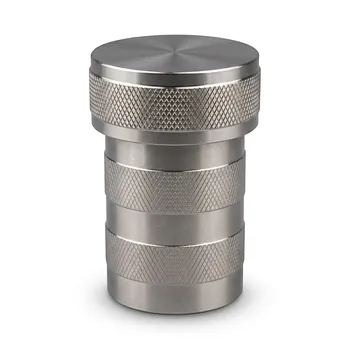
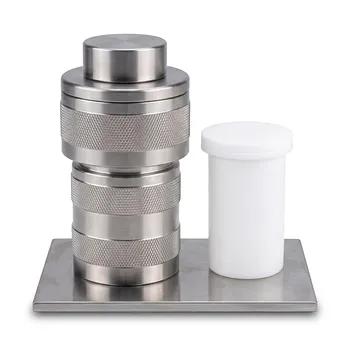
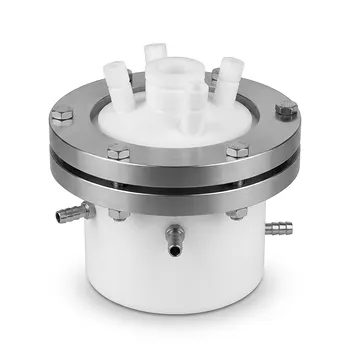
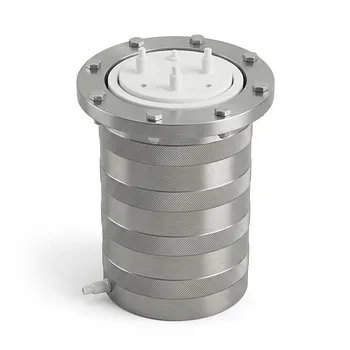
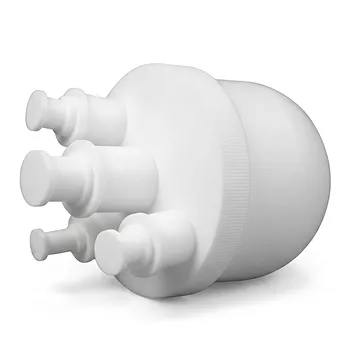
The hydrothermal synthesis reactor is the primary vessel used to facilitate complete ion-exchange and ensure structural uniformity in polyoxometalate-viologen hybrid ionic liquids (POM-ILs). By providing a sealed, high-pressure environment at controlled temperatures (such as 80°C for 12 hours), the reactor allows polyoxometalate anions and viologen cations to react thoroughly. This process results in a solid product characterized by high crystallinity and a precisely balanced chemical composition.
Core Takeaway: A hydrothermal synthesis reactor acts as a high-pressure incubator that overcomes the kinetic barriers of ambient-pressure reactions. It is essential for achieving the deep ion exchange and molecular order required to produce high-quality, crystalline POM-IL hybrids.
Driving Chemical Reaction Efficiency
Facilitating Complete Ion Exchange
In the synthesis of POM-IL series like $C_n-PMo_{12}$, the reactor’s sealed environment is vital for forcing the ion-exchange reaction to completion. Under these conditions, the polyoxometalate anions and viologen cations can interact more effectively than they would in an open system.
Enhancing Solvent Diffusion Capabilities
The elevated pressure inside the reactor significantly enhances the diffusion capability of the solvent. This allows ions to penetrate deeper into the molecular structures of the precursors, ensuring that every active site is involved in the hybrid formation.
Overcoming Ambient Pressure Limitations
Many POM-IL precursors are difficult to dissolve or react under standard laboratory conditions. The hydrothermal environment exploits the unique properties of water or solvents at high temperatures and pressures to perform dissolution-precipitation reactions that are otherwise impossible.
Ensuring Material Quality and Precision
Controlling Crystallinity and Morphology
The constant-temperature environment of the reactor allows for controlled nucleation and growth of the hybrid crystals. This results in a final solid product with high crystallinity, which is critical for the material’s electronic and chemical properties.
Maintaining Component Uniformity
Because the reactor is a closed system, it prevents the evaporation of volatile components and maintains a stable concentration throughout the 12-hour reaction period. This stability ensures that the resulting POM-ILs have a uniform composition across the entire batch.
Protecting the Reaction from Contamination
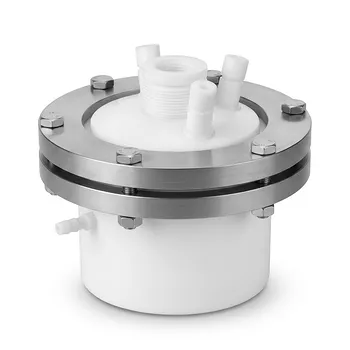
High-quality reactors use PTFE (Teflon) or similar liners to act as a chemical barrier between the reactive medium and the stainless-steel vessel. This prevents the corrosion of the metal shell and ensures that no metallic impurities leach into the sensitive POM-IL hybrid.
Understanding the Trade-offs
Safety and Pressure Management
While high pressure is beneficial for the reaction, it introduces significant safety risks if the reactor is not operated within its thermal and mechanical limits. Overfilling the reactor or exceeding the temperature rating of the liner can lead to vessel failure or explosive decompression.
Challenges in Real-Time Monitoring
The sealed, opaque nature of the hydrothermal autoclave makes it impossible to observe the reaction in real-time. Researchers must rely on pre-calculated timing and post-reaction analysis, which can make optimization a trial-and-error process compared to open-beaker chemistry.
Scalability Constraints
Hydrothermal synthesis is primarily a batch process, which can limit the volume of POM-ILs produced at one time. Scaling up requires larger, more expensive pressure vessels that maintain identical thermal gradients, which can be technically challenging.
How to Apply This to Your Project
Recommendations for Successful Synthesis
- If your primary focus is high crystallinity: Ensure the reactor maintains a strictly constant temperature for at least 12 hours to allow for slow, orderly crystal growth.
- If your primary focus is material purity: Always use a clean, undamaged PTFE liner to prevent the polyoxometalate anions from reacting with the steel walls of the autoclave.
- If your primary focus is deep ion exchange: Experiment with slightly higher temperatures to increase the solvent's diffusion rate, provided you stay within the safety limits of your specific reactor.
By mastering the high-pressure environment of the hydrothermal reactor, you can transform simple precursors into highly ordered, high-performance hybrid ionic liquids.
Summary Table:
| Feature | Advantage | Impact on POM-ILs |
|---|---|---|
| Sealed Environment | Facilitates complete ion exchange | Precise chemical stoichiometry |
| High Pressure | Enhances solvent diffusion rates | Deep molecular interaction & order |
| Thermal Control | Regulates nucleation & crystal growth | High crystallinity & morphology |
| PTFE/PFA Liner | Provides chemical inertness | Contamination-free, high-purity results |
Elevate Your Material Synthesis with KINTEK Expertise
Precision in POM-IL preparation demands equipment that can withstand rigorous hydrothermal conditions without compromising purity. At KINTEK, we specialize in high-performance fluoropolymer solutions designed for the most demanding laboratory environments.
From hydrothermal synthesis liners and microwave digestion vessels to high-purity PTFE and PFA labware (beakers, crucibles, and reagent bottles), we provide the tools necessary for superior trace analysis and sample preparation. Our end-to-end custom CNC fabrication allows us to deliver everything from complex non-standard machined parts to bespoke laboratory setups tailored to your specific research needs.
Ready to optimize your high-pressure reactions? Contact us today to discover how our expert-crafted fluoropolymer components and custom engineering can enhance your laboratory's efficiency and material quality.
References
- Hanfei Deng, Yan Bai. Multi-stimulus responsive polyoxometalate–viologen hybrid ionic liquids for rewritable inkless printing and environmental monitoring. DOI: 10.1039/d5ra05884h
This article is also based on technical information from Kintek Knowledge Base .
Related Products
- High Temperature Corrosion Resistant Hydrothermal Synthesis Reactor with TFM Inner Liner and Straight Cylinder Design
- PTFE Lined High Pressure Digestion Vessel 50ml High Temperature Hydrothermal Synthesis Tank
- Custom PTFE Reaction System with Hose Barb Fittings Corrosion Resistant High Sealing 2L 4L Lab Reactor with Separatory Funnel
- High Pressure Custom TFM Reactor Stainless Steel Outer Vessel PTFE Inner Cup for Corrosive Synthesis
- High Purity PFA Reaction Vessel for Biopharmaceutical Synthesis and Corrosive Chemical Fluid Handling with Customizable Tube Fittings
People Also Ask
- What is the role of a corrosion-resistant reactor in the synthesis of lignin-based carbon dots? Ensure Maximum Purity
- What are the technical advantages of using hydrothermal synthesis reactors for advanced electronic & optical nanomaterials?
- How does a hydrothermal synthesis reactor facilitate the production of crystalline materials with tailored morphologies? Precision Crystal Growth
- Why is the sealing reliability of a hydrothermal synthesis reactor critical for 24-hour cycles? Ensure Nano-Precision
- What role do hydrothermal synthesis reactors play in CQD preparation? Achieve High-Purity Nanomaterial Synthesis