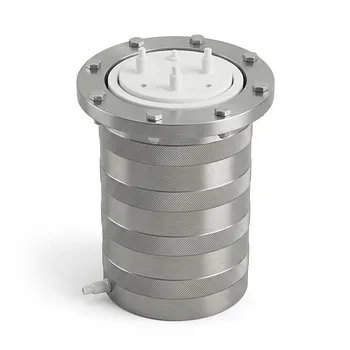
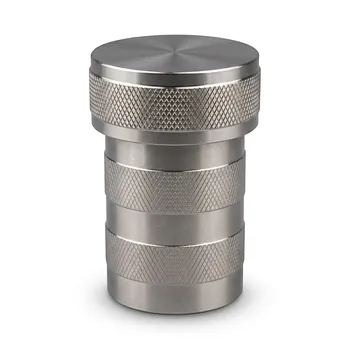
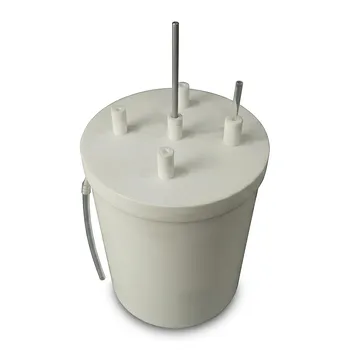
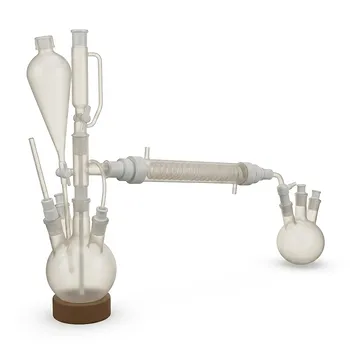
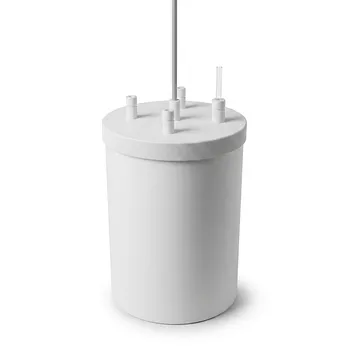
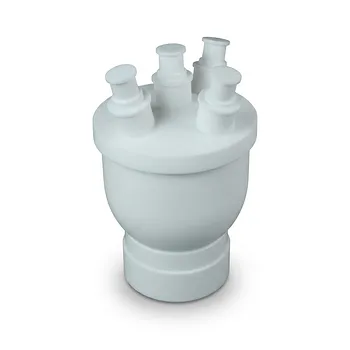
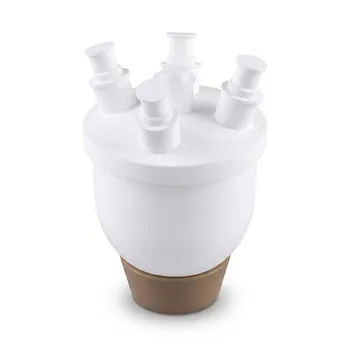
The high-pressure hydrothermal synthesis reactor provides a controlled, sealed environment that enables temperatures up to 200°C and high autogenous pressure. This specific environment is essential for driving the chelation and dehydration reactions between precursors like tetrabutyl titanate, oleylamine, and EDTA, which are necessary to construct a molecularly encapsulated two-dimensional titanium dioxide (TiO2) framework.
Core Takeaway: The reactor acts as a high-energy thermodynamic chamber that facilitates the precise molecular assembly of organic-inorganic hybrids by exceeding atmospheric boiling points while protecting the chemical integrity of the process through specialized inert liners.
Driving Complex Chemical Transformations
Facilitating Chelation and Dehydration
The reactor is designed to handle the specific requirements of precursors such as tetrabutyl titanate and EDTA. At temperatures reaching 200°C, the system provides the thermal energy required for chelation and dehydration reactions.
These reactions allow for the formation of a two-dimensional titanium dioxide framework. Without the sealed environment, the solvents would evaporate before reaching the activation energy needed for these complex molecular bonds.
Molecular-Level Encapsulation
A key role of the reactor is ensuring that the organic layer—often derived from oleylamine—properly encapsulates the inorganic TiO2 core. This process occurs at the molecular level, requiring a stable environment where pressure and temperature remain constant.
This encapsulation is what defines the organic-inorganic hybrid nature of the material. The reactor ensures that the organic and inorganic components integrate uniformly rather than segregating into separate phases.
The Role of the Corrosion-Resistant Liner
Maintaining High Product Purity
The corrosion-resistant liner, typically made of materials like PTFE (Polytetrafluoroethylene) or PPL, is critical for preventing contamination. It acts as a barrier between the reactive precursors and the metal walls of the reactor.
In the synthesis of hybrid-TiO2, even trace amounts of metal ions from the reactor wall could disrupt the crystalline phase transition. The liner ensures that the final product remains chemically pure and structurally consistent.
Withstanding Harsh Chemical Environments
The synthesis often involves acidic or basic environments that would otherwise corrode stainless steel. Liners are designed to resist acidic catalysts and high-concentration solutions that are necessary to dissolve precursors.
This resistance allows the reactor to maintain its structural integrity over long reaction times. It also ensures that the autogenous pressure generated inside remains safely contained.
Thermodynamic Advantages of Sealed Systems
Achieving Subcritical Solvent States
In a sealed reactor, solvents can be heated far beyond their normal boiling points. This creates a subcritical or supercritical state that significantly enhances the diffusion capability of ions within the solution.
Increased diffusion allows precursors to penetrate layered structures more efficiently. This is vital for achieving a high dispersion of components and avoiding the segregation common in traditional synthesis methods.
Controlling Phase Transition and Morphology
The high-pressure environment is the primary driver for the transition from amorphous structures to the anatase phase. This crystalline phase is often preferred for its superior photocatalytic and electronic properties.
Furthermore, the pressure influences the final morphology of the nanoparticles. By adjusting the reactor conditions, researchers can guide the growth of TiO2 into specific shapes, such as nanosheets or highly ordered arrays.
Understanding the Trade-offs and Limitations
Temperature Constraints of Liners
While the reactor can handle high pressures, the liner material often dictates the maximum operating temperature. For example, standard PTFE liners typically should not exceed 220°C to avoid deformation or the release of toxic fumes.
Exceeding these limits can lead to liner failure, which risks both the experiment's success and the operator's safety. Choosing the right liner material is a critical balance between chemical resistance and thermal stability.
Kinetic vs. Equilibrium Control
Hydrothermal synthesis is often a slow process compared to alternative methods like microwave-assisted synthesis. The long reaction times required to achieve high crystallinity can lead to grain growth that might exceed the desired nanometer scale.
Additionally, the sealed nature of the reactor means that real-time monitoring of the reaction is difficult. This requires precise pre-calculation of precursor concentrations and heating profiles to ensure the desired outcome.
Making the Right Choice for Your Synthesis Goal
Recommendations for Implementation
When utilizing a high-pressure reactor for hybrid-TiO2 synthesis, your configuration should align with your specific material requirements:
- If your primary focus is molecular-level hybrid dispersion: Ensure the reactor is rated for at least 200°C to fully drive the chelation reactions between EDTA and the titanium precursor.
- If your primary focus is extreme chemical purity: Use a high-quality PTFE or PFA liner to eliminate the risk of metallic leaching from the reactor vessel.
- If your primary focus is specific crystalline morphology: Prioritize a reactor with precise temperature ramp controls, as the rate of heating directly influences the transition to the anatase phase.
The high-pressure hydrothermal reactor is the foundational tool that transforms raw precursors into sophisticated, molecularly-engineered hybrid materials.
Summary Table:
| Key Feature | Functional Role | Impact on Hybrid-TiO2 Synthesis |
|---|---|---|
| High Temp (200°C+) | Drives chelation & dehydration | Constructs the 2D titanium dioxide framework |
| Autogenous Pressure | Achieves subcritical solvent states | Enhances ion diffusion & prevents phase segregation |
| Corrosion-Resistant Liner | Chemical barrier (PTFE/PPL) | Maintains high purity & prevents metallic contamination |
| Sealed Environment | Constant thermodynamic state | Ensures uniform molecular-level organic encapsulation |
| Morphology Control | Guided particle growth | Enables transition to the high-performance anatase phase |
Elevate Your Material Synthesis with KINTEK’s Precision Fluoropolymer Engineering
Achieving the delicate balance of molecular encapsulation and crystalline purity in hybrid-TiO2 requires equipment that never compromises. KINTEK manufactures virtually all imaginable laboratory supplies crafted from high-performance PTFE and PFA, ensuring your synthesis environment remains inert and ultra-pure.
From everyday basic labware (beakers, measuring cylinders, crucibles, reagent bottles, and digestion tubes) to advanced hydrothermal synthesis liners, microwave digestion vessels, and microchannel reactors, we provide the tools necessary for high-stakes research. Backed by end-to-end custom CNC fabrication, we deliver everything from complex non-standard machined parts and bespoke laboratory setups to high-volume orders.
Ready to optimize your high-pressure reactions? Contact KINTEK today to discover how our exclusive focus on fluoropolymer excellence can drive your next breakthrough in organic-inorganic hybrids.
References
- Mengpei Jiang, Gang Liu. Floatable organic-inorganic hybrid-TiO2 unlocks superoxide radicals for plastic photoreforming in neutral solution. DOI: 10.1038/s41467-025-59467-x
This article is also based on technical information from Kintek Knowledge Base .
Related Products
- High Pressure Custom TFM Reactor Stainless Steel Outer Vessel PTFE Inner Cup for Corrosive Synthesis
- PTFE Lined High Pressure Digestion Vessel 50ml High Temperature Hydrothermal Synthesis Tank
- High Temperature Corrosion Resistant Hydrothermal Synthesis Reactor with TFM Inner Liner and Straight Cylinder Design
- Custom TFM Reaction Vessel with Stainless Steel Jacket and PTFE Inner Cup for High Corrosion Resistance
- PTFE 10L Reaction Vessel with Stirring Paddle Customizable Corrosion Resistant High Temperature Reactor for Biopharmaceutical and Chemical Processing
People Also Ask
- Why is a PTFE-lined reactor required for Mn2O3 synthesis? Achieve High Purity & Corrosion Resistance
- What is the technical value of 180 bar pressure for MgO nanostructures? Unlock Superior Crystallinity and Morphology
- What are the technical advantages of using high-pressure PTFE reaction vessels during metal digestion? Expert Insights.
- How does the regulation of initial pressure within a high-pressure reaction system affect the production of MIL-100(Fe)?
- Why is a high-pressure reactor necessary for the esterification reaction between oleic acid and methanol at 150°C? Guide