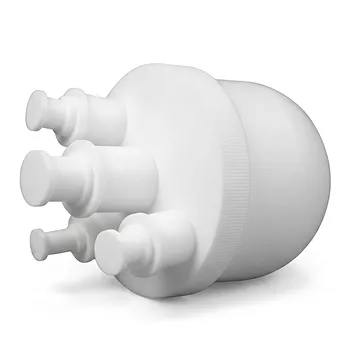
The high-pressure hydrothermal reactor serves as the fundamental catalyst for producing high-crystallinity Zirconia ($ZrO_2$) nanopowders. By creating a sealed, high-temperature environment, it forces aqueous solutions to remain liquid well beyond their standard boiling points. This energy-dense state is required to facilitate the complete hydrolysis of zirconium precursors and provide the kinetic energy necessary for precise nucleation and crystal growth.
A high-pressure hydrothermal reactor acts as a "pressure cooker" for chemistry, enabling the synthesis of advanced Zirconia particles that are physically impossible to create under standard atmospheric conditions. It transforms precursor solutions into high-purity nanocrystals by manipulating the solubility, reactivity, and diffusion rates of the reactants.
The Mechanics of the Hydrothermal Environment
Maintaining Liquid States Beyond Boiling Points
The primary role of the reactor is to sustain a sealed environment that prevents the evaporation of the solvent. By keeping water in a liquid state at temperatures exceeding 100°C, the system can utilize much higher thermal energy than an open-air vessel.
Accelerating Chemical Kinetics and Hydrolysis
High-pressure conditions significantly lower the energy barriers for chemical reactions. In Zirconia synthesis, this environment ensures the complete hydrolysis of precursors like zirconium oxychloride or zirconium nitrate, which is a prerequisite for forming the oxide structure.
Increasing Precursor Solubility and Diffusion
Under high pressure, the solubility and diffusion rates of reactants increase dramatically. This allows the zirconium ions to move more freely and interact more effectively, leading to a more uniform chemical reaction throughout the solution.
Controlling Nanoparticle Morphology and Structure
Driving Nucleation and Crystal Growth
The reactor provides the specific kinetic conditions required for the transition from a liquid precursor to a solid crystal. This controlled energy input allows for the formation of "seeds" (nucleation) that grow into high-crystallinity nanopowders.
Defining Geometric Morphologies
By precisely regulating the internal temperature and reaction time, researchers can induce the growth of specific crystal facets. This control is essential for creating nanoparticles with specialized shapes, such as nanocubes or flakes, which may be required for specific industrial applications.
Overcoming Activation Energy Barriers
The autogenous pressure generated inside the reactor facilitates the ordered self-assembly of atoms. This pressure allows the system to overcome activation energy barriers that would otherwise stall the reaction, ensuring the final material achieves its intended stoichiometry and fine particle size.
Understanding the Trade-offs
Safety and Equipment Integrity
Operating at high pressures and temperatures requires specialized, chemically inert liners (such as PTFE or PFA) and robust reactor walls. Failure to maintain these components can lead to equipment failure or contamination of the Zirconia batch.
Complexity and Cost
Hydrothermal synthesis is often more time-consuming and expensive than simpler precipitation methods. It requires precise monitoring of temperature and pressure cycles, making it less ideal for low-cost, bulk applications where high crystallinity is not a priority.
Scalability Constraints
While effective at the laboratory and pilot scale, maintaining uniform pressure and temperature in large-scale industrial reactors presents significant engineering challenges. Any fluctuations in the internal environment can lead to inconsistent particle sizes across the batch.
Applying Reactor Technology to Your Project
The use of a high-pressure hydrothermal reactor should be dictated by the specific requirements of your final Zirconia product.
- If your primary focus is high crystallinity: Utilize the reactor to maintain temperatures above 160°C to ensure complete crystal lattice formation.
- If your primary focus is uniform particle size: Carefully control the heating rate and reaction duration to manage the nucleation phase precisely.
- If your primary focus is specific morphology: Adjust the precursor concentration and autogenous pressure to favor the growth of desired crystal facets.
By mastering the extreme physical environment of the hydrothermal reactor, you can engineer Zirconia nanoparticles with the exact structural and chemical properties required for advanced technical applications.
Summary Table:
| Key Reactor Function | Impact on Zirconia (ZrO2) Synthesis |
|---|---|
| Sustained Liquid State | Enables temperatures >100°C under pressure, providing high thermal energy for reaction. |
| Accelerated Kinetics | Lowers energy barriers, ensuring complete hydrolysis of zirconium precursors. |
| Enhanced Diffusion | Increases solubility and ion mobility, resulting in more uniform chemical reactions. |
| Morphology Control | Regulates internal energy to drive specific crystal facet growth (e.g., nanocubes). |
| Ordered Self-Assembly | Overcomes activation energy barriers to achieve intended stoichiometry and fine particle size. |
Elevate Your Nanomaterial Synthesis with KINTEK
Achieving the perfect $ZrO_{2}$ crystal structure requires equipment designed for extreme chemical and thermal environments. At KINTEK, we provide high-performance fluoropolymer solutions precisely engineered for advanced hydrothermal synthesis.
From PTFE and PFA hydrothermal synthesis liners and microwave digestion vessels to custom-machined laboratory setups, we manufacture virtually all imaginable laboratory supplies. Our expertise spans from everyday basic labware (beakers, tubes, and reagent bottles) to complex fluid transfer components and advanced reaction apparatus like custom electrochemical cells and microchannel reactors.
Backed by end-to-end custom CNC fabrication, KINTEK is equipped to deliver everything from complex non-standard parts to high-volume orders with an exclusive focus on high-performance materials.
Ready to optimize your Zirconia synthesis? Contact us today to discover how KINTEK's bespoke lab supplies and engineering expertise can enhance your research efficiency and material purity.
References
- Yuriy A. Garanin, Maxim V. Zdorovets. Influence of precursors and mineralizers on phase formation in ZrO2 nanoparticles synthesized by the hydrothermal method. DOI: 10.1038/s41598-025-12213-1
This article is also based on technical information from Kintek Knowledge Base .
Related Products
- High Temperature Corrosion Resistant Hydrothermal Synthesis Reactor with TFM Inner Liner and Straight Cylinder Design
- High Pressure Custom TFM Reactor Stainless Steel Outer Vessel PTFE Inner Cup for Corrosive Synthesis
- PTFE Lined High Pressure Digestion Vessel 50ml High Temperature Hydrothermal Synthesis Tank
- Custom TFM Reaction Vessel with Stainless Steel Jacket and PTFE Inner Cup for High Corrosion Resistance
- High Purity PFA Constant Pressure Condensation Reaction System Acid Resistant High Temperature Customizable Teflon Labware
People Also Ask
- What is the role of a corrosion-resistant reactor in the synthesis of lignin-based carbon dots? Ensure Maximum Purity
- What are the technical advantages of using hydrothermal synthesis reactors for advanced electronic & optical nanomaterials?
- How does a hydrothermal synthesis reactor facilitate the production of crystalline materials with tailored morphologies? Precision Crystal Growth
- Why is the sealing reliability of a hydrothermal synthesis reactor critical for 24-hour cycles? Ensure Nano-Precision
- What role do hydrothermal synthesis reactors play in CQD preparation? Achieve High-Purity Nanomaterial Synthesis