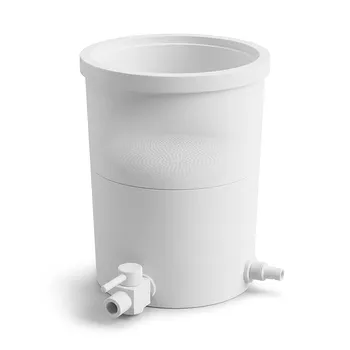
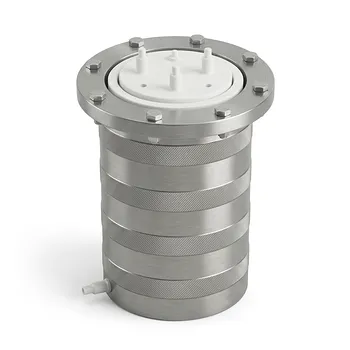
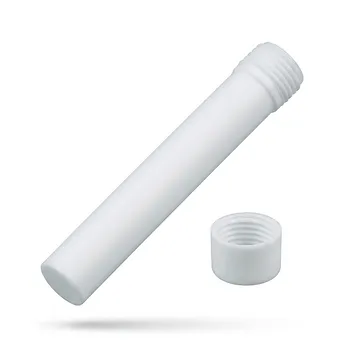
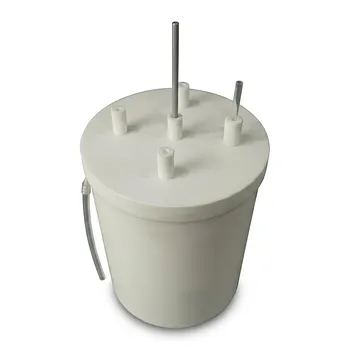
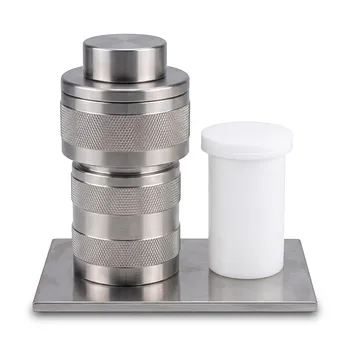
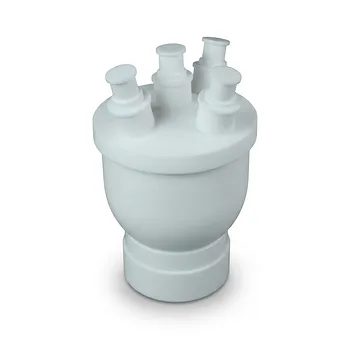
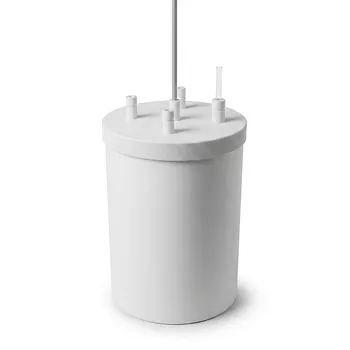
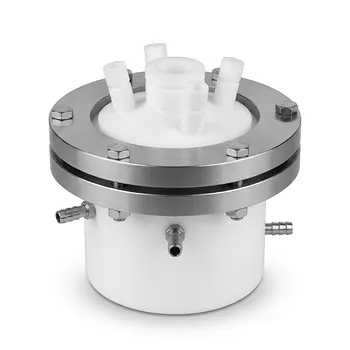
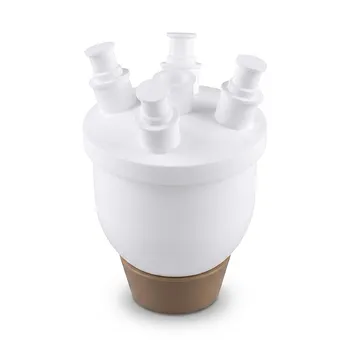
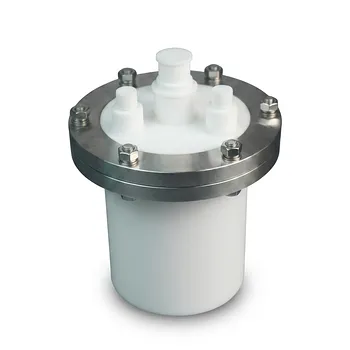
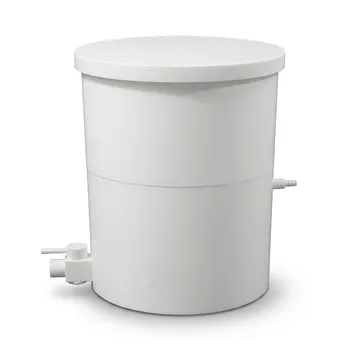
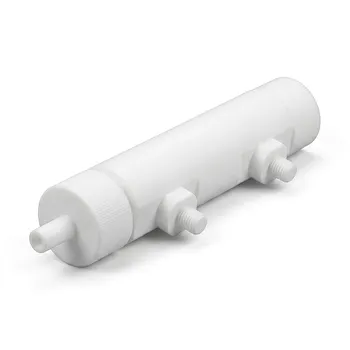
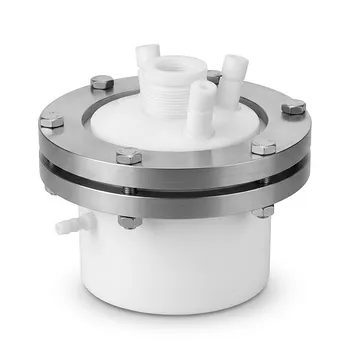
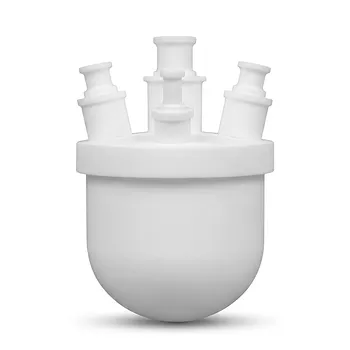
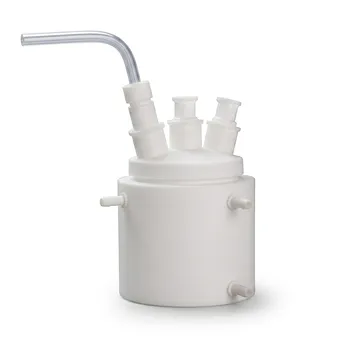
PTFE-lined reactors are the critical infrastructure for synthesizing high-performance nanoparticles. These vessels provide a chemically inert, non-stick, and corrosion-resistant environment that ensures biogenic nanoparticles like ZnO (Zinc Oxide) and Fe3O4 (Magnetite) maintain the precise size and purity required for environmental applications.
The core role of a PTFE-lined reactor is to provide a stable, "zero-interaction" environment that prevents contamination and agglomeration. By isolating the chemical reaction from the metal autoclave shell, these reactors guarantee the morphological consistency and surface activity essential for effective phytoremediation.
Ensuring High-Purity Synthesis Environments
Eliminating Metal Ion Contamination
During the synthesis of Fe3O4 or ZnO, the introduction of stray metal ions from a standard stainless steel reactor can compromise the magnetic or photocatalytic properties of the particles. PTFE liners act as a physical barrier, preventing the reaction media from leaching chromium, nickel, or iron from the autoclave walls. This ensures the resulting nanoparticles are "biogenic-grade" and chemically pure for sensitive phytoremediation tasks.
Chemical Resistance to Aggressive Precursors
The synthesis of metal oxide nanoparticles often involves precursor solutions with extreme pH levels—either highly acidic or strongly alkaline. PTFE is uniquely resistant to these aggressive chemicals, even under the high temperatures (up to 200°C) used in hydrothermal synthesis. This stability allows researchers to use a wide range of reagents without risking vessel degradation or reaction interference.
Optimizing Physicochemical Properties for Phytoremediation
Preventing Secondary Agglomeration
In phytoremediation, the effectiveness of nanoparticles depends on their surface area-to-volume ratio. The non-stick characteristics of PTFE prevent the synthesized nanoparticles from depositing onto the vessel walls or clumping together during the growth phase. This results in a more uniform particle size distribution, which directly translates to higher reactivity when treating contaminated soil or water.
Facilitating Uniform Nucleation and Growth
PTFE-lined reactors provide a controlled, closed environment where solvothermal pressure remains constant. This stability is vital for the proper nucleation of nanocrystals, allowing them to grow into specific hierarchical structures, such as flower-like or spherical shapes. Consistent morphology is a prerequisite for predictable performance in absorbing or degrading environmental pollutants.
Protecting the Synthesis Infrastructure
Safeguarding the External Autoclave
While the internal reaction requires specific chemical conditions, those same conditions can be catastrophic for the structural integrity of a metal autoclave. The PTFE liner protects the external stainless steel shell from corrosion and erosion by corrosive media. This dual-layer approach ensures the safety of the laboratory environment while extending the lifespan of expensive high-pressure equipment.
Improving Post-Experimental Product Recovery
The non-stick nature of fluoropolymers significantly simplifies the recovery of the synthesized powder. Because the nanoparticles do not adhere to the liner, researchers can achieve higher yields with less effort during the cleaning process. This ease of recovery is particularly important when working with expensive precursors or complex biogenic extracts.
Understanding the Trade-offs
Temperature and Pressure Limitations
While PTFE is exceptionally inert, it has a finite thermal ceiling, typically around 200°C to 250°C. Exceeding these temperatures can cause the liner to soften or "creep," leading to potential sealing failures or vessel deformation. Engineers must carefully balance the thermal requirements of the nanoparticle synthesis with the mechanical limits of the fluoropolymer material.
Thermal Conductivity Challenges
PTFE is a thermal insulator, meaning it does not transfer heat as efficiently as metal. This can lead to thermal lag between the oven temperature and the internal reaction temperature. Precise synthesis of nanoparticles requires account for this delay to ensure that the reaction occurs at the intended kinetic rate.
How to Apply This to Your Project
Recommendations for Targeted Goals
- If your primary focus is maximizing surface reactivity for phytoremediation: Prioritize high-quality PTFE liners with a polished internal surface to minimize any potential for particle adhesion and clumping.
- If your primary focus is the synthesis of magnetic Fe3O4: Ensure the liner is fully intact and free of scratches to prevent the introduction of iron impurities that could alter the magnetic core's signature.
- If your primary focus is scaling up biogenic ZnO production: Implement a rigorous cleaning protocol for the PTFE liners between batches to prevent cross-contamination from organic biogenic templates.
The strategic use of PTFE-lined reactors transforms a volatile chemical process into a controlled, repeatable synthesis method for high-performance nanoparticles.
Summary Table:
| Feature | Role in Nanoparticle Synthesis | Impact on Phytoremediation |
|---|---|---|
| Chemical Inertness | Eliminates metal ion leaching and contamination. | Ensures biogenic-grade purity for sensitive soil/water tasks. |
| Non-stick Surface | Prevents secondary agglomeration and clumping. | Maintains high surface area-to-volume ratio for reactivity. |
| Corrosion Resistance | Withstands aggressive pH levels and precursors. | Facilitates stable growth of specialized hierarchical structures. |
| Easy Recovery | Simplifies powder collection without material loss. | Increases yield of high-performance photocatalytic particles. |
Elevate Your Nanoparticle Research with KINTEK
Ready to achieve superior consistency in your synthesis? KINTEK provides high-performance fluoropolymer solutions designed for the most demanding laboratory environments. From everyday basic labware (beakers, measuring cylinders, crucibles, dishes, reagent/wash bottles, centrifuge and digestion tubes) and high-purity trace analysis instruments to comprehensive fluid transfer components (tubing, fittings, valves), we ensure your experiments remain contamination-free.
Our expertise extends to sample prep and filtration tools (separatory funnels, burettes, filters, pipettes, tweezers, spatulas) and general consumables (stirring bars, O-rings, gaskets, seal tapes, caps, septa). For advanced research, we offer derivative and reaction apparatus like standard or custom electrochemical cells, battery testing fixtures, electrode accessories, hydrothermal synthesis liners, microwave digestion vessels, microchannel reactors, and condensation/reflux devices.
Why choose KINTEK?
- Comprehensive Range: Virtually all imaginable laboratory supplies crafted from premium PTFE and PFA.
- Custom Fabrication: End-to-end custom CNC fabrication for complex, non-standard machined parts.
- Precision Focus: An absolute commitment to high-performance fluoropolymer materials.
Contact us today to discuss your custom project or high-volume orders!
References
- Aysha Siddika Jarin, Lam-Son Phan Tran. Plant Responses to Heavy Metal Stresses: Mechanisms, Defense Strategies, and Nanoparticle-Assisted Remediation. DOI: 10.3390/plants14243834
This article is also based on technical information from Kintek Knowledge Base .
Related Products
- Custom TFM Reaction Vessel with Stainless Steel Jacket and PTFE Inner Cup for High Corrosion Resistance
- Large Scale PTFE Double Layer Reaction Tank with Integrated Filter Plate for Chemical Processing
- High Pressure Custom TFM Reactor Stainless Steel Outer Vessel PTFE Inner Cup for Corrosive Synthesis
- High Purity TFM Microwave Digestion Vessels PTFE Acid Evaporation Liners Domestic GT-400 Equivalent Laboratory Reaction Containers
- PTFE 10L Reaction Vessel with Stirring Paddle Customizable Corrosion Resistant High Temperature Reactor for Biopharmaceutical and Chemical Processing
People Also Ask
- Why is a Polytetrafluoroethylene (PTFE) lined reaction vessel an ideal choice for preparing PtNPs/FeSAC tandem catalysts?
- Why are high-performance pressure-resistant reaction vessels required for oxygen-assisted hydrothermal conversion at 150 °C?
- How do magnetic stirring and reaction vessels impact MOF-derived carbon quality? Optimize Your Composite Performance
- Why are high-quality fluoropolymer-lined reaction vessels required for alk-Ti3C2Tx MXene? Ensure Purity & HF Resistance
- Why are PTFE-lined reaction vessels necessary for forced degradation studies? Ensure high-purity results and accuracy.