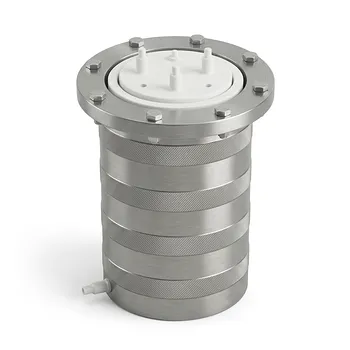
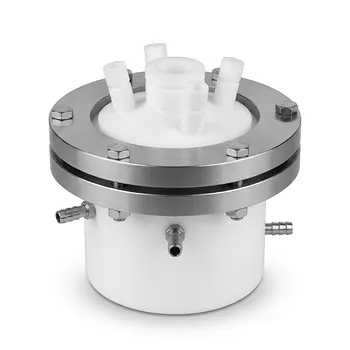
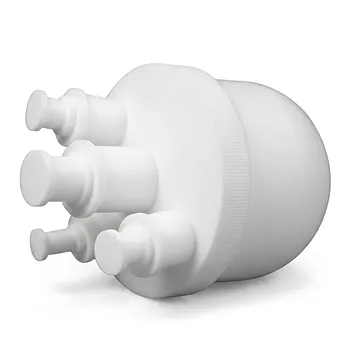
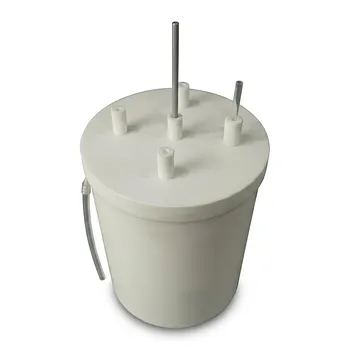
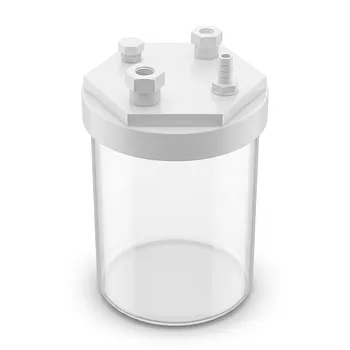
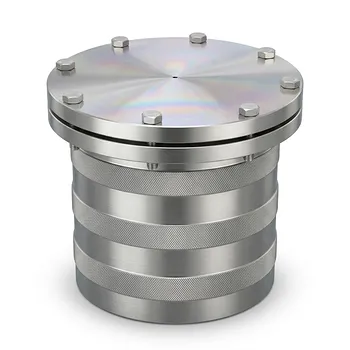
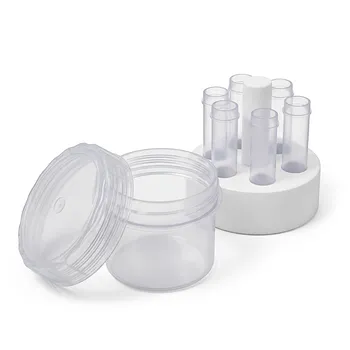
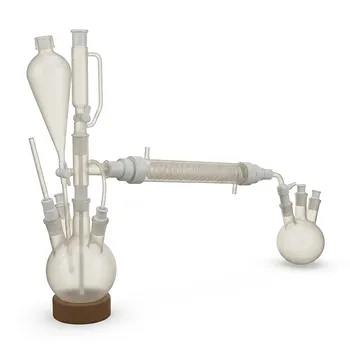
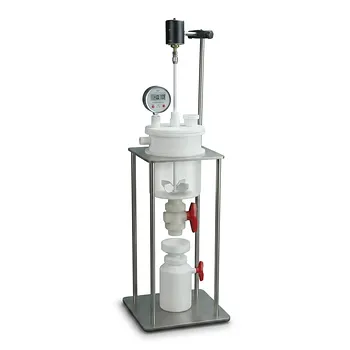
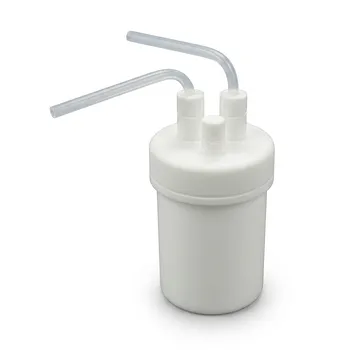
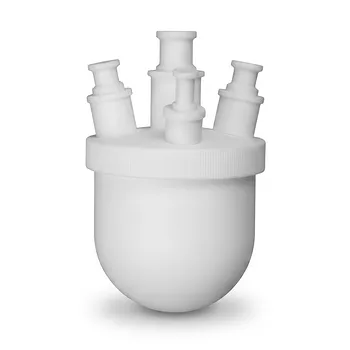
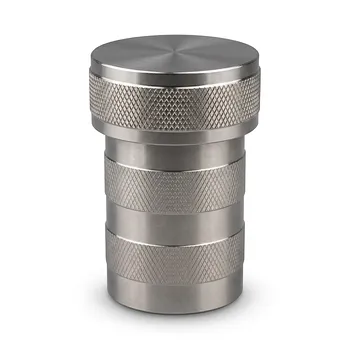
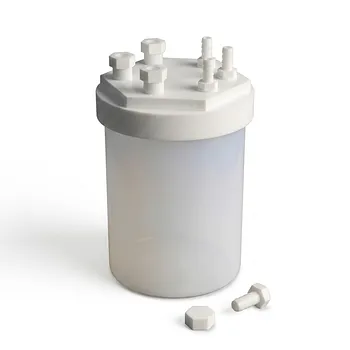
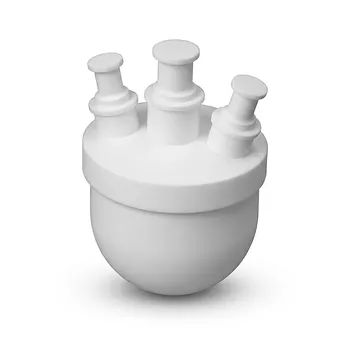
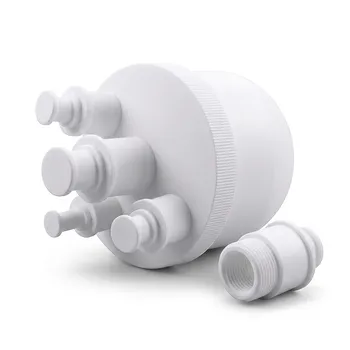
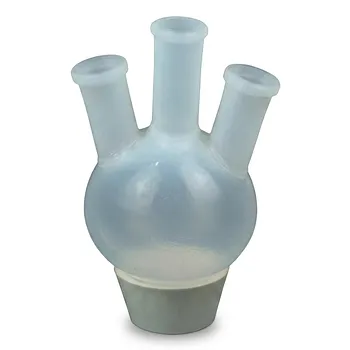
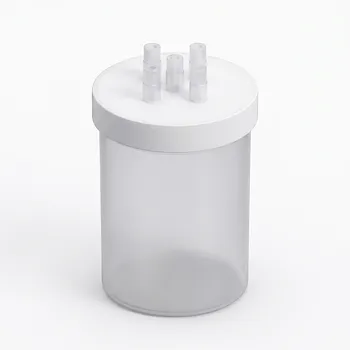
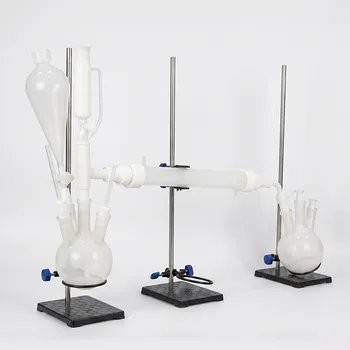
Fluoropolymer-lined high-pressure reactors are the foundational vessels that enable the precise solvothermal synthesis of $Fe_3O_4$ nanoparticles. These liners, typically made of Polytetrafluoroethylene (PTFE) or Perfluoroalkoxy (PFA), provide a chemically inert and thermally stable environment that protects the external reactor shell from corrosion. By isolating the reaction, they ensure the resulting magnetic nanoparticles achieve high chemical purity and a uniform particle size distribution.
The core role of fluoropolymer liners is to provide a contamination-free, "non-stick" reaction zone that survives the high-pressure conditions required for synthesis. This isolation is critical for maintaining the specific magnetic properties and structural integrity of $Fe_3O_4$ nanoparticles.
Protecting the Reactor Infrastructure
Defense Against Chemical Corrosion
Solvothermal synthesis often involves aggressive solvents and precursors that can degrade standard stainless steel. Fluoropolymer liners act as a impermeable barrier, preventing these fluids from reaching and corroding the reactor's metallic structural shell.
Prevention of Metallic Contamination
If the reaction fluid contacts the reactor walls, it can leach metal ions into the solution. The chemical inertness of PTFE and PFA ensures that no unwanted metallic impurities are introduced, which is vital for maintaining the specific magnetic core purity of $Fe_3O_4$.
Ensuring Product Quality and Uniformity
Control Over Particle Size and Distribution
The high-purity environment established by the liner allows for precise control over the nucleation and growth phases. This consistency is what leads to the uniform particle size distribution required for high-performance magnetic applications.
Prevention of Secondary Agglomeration
The non-stick surface properties of fluoropolymers are significant in nanoparticle synthesis. This characteristic prevents nanoparticles from depositing onto the vessel walls or undergoing secondary agglomeration, ensuring the particles maintain their intended surface activity and size.
Maintaining Crystalline Phase Integrity
In the synthesis of metal oxides, the purity of the environment influences the resulting crystalline structure. Using a fluoropolymer liner helps ensure that the $Fe_3O_4$ reaches the desired crystalline phase without interference from external chemical leachable.
Maximizing Yield and Recovery
Efficient Product Recovery
Because fluoropolymers have a naturally low surface energy, the synthesized $Fe_3O_4$ powder does not easily adhere to the liner walls. This facilitates the complete recovery of the target product, increasing the overall efficiency of the laboratory or industrial process.
Support for Prolonged Reaction Times
Many solvothermal processes require extended periods under high temperature and pressure. The thermal stability of high-performance fluoropolymers ensures that the liner does not degrade or leach organic impurities into the mixture during these long-duration reactions.
Understanding the Trade-offs
Temperature Limitations
While fluoropolymers like PTFE are highly stable, they have a strict upper temperature limit (typically around 250°C to 260°C). Exceeding these temperatures can lead to mechanical failure of the liner or the release of toxic decomposition gases.
Mechanical Creep and Deformation
Under high pressure, fluoropolymers can exhibit "creep," where the material slowly deforms over time. This requires the liner to be properly fitted within a supporting metal autoclave to prevent the vessel from losing its shape or seal.
How to Apply This to Your Project
When selecting a reactor setup for $Fe_3O_4$ synthesis, your choice of liner should align with your specific experimental constraints:
- If your primary focus is Maximum Purity: Prioritize high-purity PFA liners, which offer even greater chemical resistance and lower leachable profiles than standard PTFE.
- If your primary focus is High Yield and Recovery: Utilize the non-stick properties of PTFE to ensure that the magnetic nanoparticles do not adhere to the walls, facilitating easier collection.
- If your primary focus is Structural Consistency: Ensure the reactor is used within the recommended thermal range to prevent liner deformation, which could disrupt the uniformity of the pressure environment.
By strictly controlling the reaction environment through fluoropolymer lining, researchers can reliably produce $Fe_3O_4$ nanoparticles with the exact magnetic and structural specifications required for advanced applications.
Summary Table:
| Key Role | Benefit to Synthesis | Material Property |
|---|---|---|
| Contamination Control | Prevents metallic ion leaching; ensures core purity | High Chemical Inertness |
| Yield Optimization | Non-stick surface allows for complete product recovery | Low Surface Energy |
| Reactor Protection | Acts as a barrier against aggressive solvents | Impermeability |
| Growth Control | Enables uniform particle size and crystal phase integrity | Thermal Stability |
| Process Stability | Maintains a stable environment for long reaction times | Mechanical Durability |
Elevate Your Synthesis Precision with KINTEK
Maximize the purity and yield of your $Fe_3O_4$ nanoparticles with KINTEK’s specialized fluoropolymer solutions. From everyday basic labware like beakers, crucibles, and reagent bottles to high-purity PFA liners and complex fluid transfer components, we provide the ultimate contamination-free environment for advanced materials research.
Backed by end-to-end custom CNC fabrication, KINTEK is equipped to deliver everything from standard liners to bespoke, non-standard machined parts and advanced reaction apparatus like microwave digestion vessels or custom electrochemical cells. We maintain an absolute focus on high-performance PTFE and PFA to ensure your lab achieves consistent, high-quality results.
Ready to optimize your reactor setup? Contact us today to discuss your custom requirements!
References
- Tiantian Li, Ding‐Ming Xue. Generating Strongly Basic Sites on C/Fe3O4 Core–Shell Structure: Preparation of Magnetically Responsive Mesoporous Solid Strong Bases Catalysts. DOI: 10.3390/catal15080743
This article is also based on technical information from Kintek Knowledge Base .
Related Products
- High Pressure Custom TFM Reactor Stainless Steel Outer Vessel PTFE Inner Cup for Corrosive Synthesis
- Custom PTFE Reaction System with Hose Barb Fittings Corrosion Resistant High Sealing 2L 4L Lab Reactor with Separatory Funnel
- High Purity PTFE Single Neck Reaction Flask Acid Resistant Customizable Fluoropolymer Laboratory Reactor
- PTFE 10L Reaction Vessel with Stirring Paddle Customizable Corrosion Resistant High Temperature Reactor for Biopharmaceutical and Chemical Processing
- PFA Reaction Tank 6L Customizable Fittings Corrosion Resistant Solvent Resistant PFA Reaction Bottle for New Material Synthesis
People Also Ask
- Why is a PTFE-lined reactor required for Mn2O3 synthesis? Achieve High Purity & Corrosion Resistance
- What is the technical value of 180 bar pressure for MgO nanostructures? Unlock Superior Crystallinity and Morphology
- What are the technical advantages of using high-pressure PTFE reaction vessels during metal digestion? Expert Insights.
- How does the regulation of initial pressure within a high-pressure reaction system affect the production of MIL-100(Fe)?
- Why is a high-pressure reactor necessary for the esterification reaction between oleic acid and methanol at 150°C? Guide