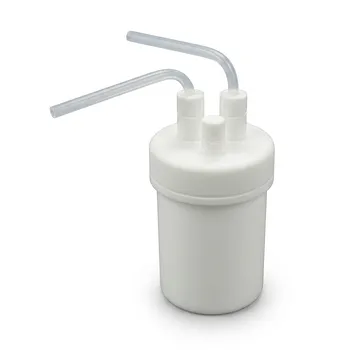
To achieve successful solid-state polymerization (SSP) of PEDOT within M(salen)-COFs, reaction vessels must prioritize two critical engineering standards: absolute sealing performance and superior temperature uniformity. These requirements ensure that monomers are contained and polymerized precisely within the framework's one-dimensional channels, which is essential for optimizing the material's electrochemical performance.
Core Takeaway: The reaction vessel acts as a precision-controlled micro-environment where sealing and thermal stability dictate the quality of polymer growth. By strictly maintaining these conditions, researchers can ensure uniform monomer distribution, which is the foundational requirement for high-performance hydrogen evolution reaction (HER) catalysts.
The Critical Role of Atmospheric Integrity
The vessel must act as a closed system to manage the volatile nature of the monomers used in the polymerization process.
Preventing Monomer Escape and Oxidation
Sealing performance is paramount because it prevents the escape of monomer vapors before they can infiltrate the COF pores. Without a perfect seal, the concentration of the monomer fluctuates, leading to inconsistent polymer loading and degraded electrical properties.
Maintaining Internal Pressure Consistency
A well-sealed vessel maintains a stable internal environment, which is necessary for the solid-state reaction to proceed at a predictable rate. This consistency is vital when attempting to grow PEDOT chains deep within the one-dimensional (1D) channels of the M(salen)-COF structure.
The Necessity of Thermal Precision
Solid-state polymerization is highly sensitive to temperature fluctuations, requiring hardware that can maintain a steady state over long durations.
Ensuring Growth Within 1D Channels
Superior temperature uniformity is required to ensure that the polymer grows precisely inside the pores rather than on the external surface of the COF. If hot spots exist, the polymerization may occur prematurely or unevenly, blocking the channels and reducing the effective surface area.
Supporting Long-Term Reaction Stability
Because SSP often requires extended timeframes, the vessel must support stable, long-term temperature control. This stability allows the monomers to diffuse deeply into the framework, ensuring that the resulting composite is homogeneous and mechanically stable.
Understanding the Trade-offs
Achieving the required level of precision involves specific challenges that researchers must navigate during vessel selection.
Seal Integrity vs. Pressure Hazards
While excellent sealing is necessary, it can lead to pressure build-up depending on the thermal expansion of the gases inside. Operators must balance the need for a vacuum-tight environment with the structural limits of the vessel to prevent mechanical failure.
Thermal Mass and Response Time
Vessels designed for high temperature uniformity often have high thermal mass, which means they take longer to reach the target temperature. This lag must be accounted for in the experimental protocol to ensure the reaction time is calculated accurately from the moment the internal environment stabilizes.
How to Apply This to Your Project
When selecting or designing a reaction vessel for M(salen)-COF polymerization, consider your primary objective to determine the necessary hardware specifications.
- If your primary focus is maximizing HER performance: Prioritize a vessel with a high-precision heating jacket to ensure absolute temperature uniformity across the entire sample.
- If your primary focus is material consistency: Invest in high-grade vacuum-sealed ampoules or autoclaves that guarantee no monomer loss during the long-term heating cycle.
- If your primary focus is rapid screening: Use smaller, modular vessels that allow for faster thermal equilibration while still maintaining a robust mechanical seal.
By treating the reaction vessel as a critical component of the chemical synthesis rather than just a container, you ensure the precise spatial control necessary for high-performance conductive polymers.
Summary Table:
| Key Requirement | Engineering Standard | Impact on Synthesis Performance |
|---|---|---|
| Atmospheric Integrity | Absolute Sealing Performance | Prevents monomer escape/oxidation; ensures consistent internal pressure for deep 1D channel infiltration. |
| Thermal Precision | Superior Temperature Uniformity | Ensures polymer growth inside pores rather than on external surfaces; prevents premature channel blockage. |
| Reaction Stability | Long-Term Thermal Control | Supports extended diffusion timeframes; maintains mechanical stability and homogeneity of the composite material. |
Elevate Your Synthesis Precision with KINTEK’s High-Performance Fluoropolymer Solutions
Achieving the absolute sealing and thermal uniformity required for advanced solid-state polymerization demands labware that exceeds standard expectations. At KINTEK, we specialize in high-performance PTFE and PFA laboratory supplies designed to withstand the most rigorous chemical and thermal environments.
Whether you need:
- Everyday Basic Labware: Beakers, crucibles, reagent bottles, and digestion tubes.
- Fluid Transfer & Filtration: High-purity tubing, fittings, valves, filters, and pipettes.
- Advanced Reaction Apparatus: Custom-machined electrochemical cells, hydrothermal synthesis liners, microwave digestion vessels, and microchannel reactors.
Our end-to-end custom CNC fabrication allows us to deliver everything from complex, non-standard machined parts to high-volume orders with precision. Ensure your PEDOT/M(salen)-COF projects achieve maximum HER performance by utilizing vessels that guarantee atmospheric and thermal integrity.
Ready to optimize your lab setup? Contact us today to discuss your custom requirements!
References
- Wei Zhou, Xing Lü. Metallosalen covalent organic frameworks for heterogeneous catalysis. DOI: 10.1002/idm2.12140
This article is also based on technical information from Kintek Knowledge Base .
Related Products
- Customizable PTFE Reaction Vessel with Electric Stirring Paddle and Buchner Funnel Vacuum Filtration System
- High Purity Corrosion Resistant PFA Reaction Vessel with PTFE Holder and Integrated Sampling Tube for Trace Analysis
- PTFE 10L Reaction Vessel with Stirring Paddle Customizable Corrosion Resistant High Temperature Reactor for Biopharmaceutical and Chemical Processing
- PFA Reaction Tank 6L Customizable Fittings Corrosion Resistant Solvent Resistant PFA Reaction Bottle for New Material Synthesis
- High Purity Custom PTFE Large Volume 15L Flask Corrosion Resistant Low Trace Background Fluoropolymer Reaction Vessel
People Also Ask
- Why are fluoroplastic (PTFE) reaction vessels recommended for Methylene Blue (MB) adsorption kinetic experiments?
- Why are high-purity PTFE or PFA reaction vessels recommended for the synthesis of PANI-TiC hybrid materials? - Guide
- Why is a high-quality PTFE reaction vessel required for the etching preparation of Ti3C2Tx MXene? Ensure Pure Synthesis.
- How do perfluorinated solvent environments influence the selection of reaction vessels and fluid handling components in nonaqueous emulsion polymerizations? Choose fluoropolymer materials.
- What reaction vessel and fluid handling considerations are necessary for living cationic polymerization of fluorinated monomers involving Lewis acid catalysts? Key design and safety tips