PTFE is thermally stable because its C–F-rich backbone resists ordinary bond-breaking, but extreme heat eventually shifts the chemistry toward radical chain scission and depolymerization. Under pyrolysis, thermally generated carbon-centered radicals and unsaturated perfluorocarbon species—especially tetrafluoroethylene (TFE)—control subsequent reactions. Lewis bases, strongly basic anions, iodine, sulfur, oxygen, moisture, and surfaces can alter these pathways by stabilizing, trapping, or adding to radical intermediates.
The key distinction is between service stability and pyrolysis stability: PTFE is highly reliable within its intended operating range, but above its decomposition region the polymer can generate reactive fluorocarbon radicals and hazardous volatile products. The atmosphere and contacting materials strongly influence what those radicals do next.
Why PTFE Resists Thermal Breakdown
Strong carbon–fluorine bonding
PTFE’s backbone is protected by fluorine atoms surrounding the carbon chain. The resulting carbon–fluorine bonding and fluorine-rich environment make ordinary chemical attack, oxidation, dissolution, and swelling difficult.
This resistance explains PTFE’s useful continuous operating temperature of approximately 260°C, even though its melting point is near 327–342°C, depending on the material’s thermal history and measurement method.
Restricted chain mobility
The polymer’s helical conformation and dense fluorine substitution limit rotational freedom and reduce access to the carbon backbone. Steric repulsion between fluorine atoms further restricts chain movement.
These structural features help PTFE retain chemical inertness and dimensional stability under severe conditions, although mechanical strength and creep resistance still decline as temperature approaches the melting range.
Stability is not the same as unlimited durability
The high C–F bond strength delays degradation; it does not eliminate it. At sufficiently high temperatures, energy becomes available for homolytic bond cleavage, in which a covalent bond breaks with one electron remaining on each fragment.
The resulting fragments are radicals. Once radicals form, the chemistry is governed less by PTFE’s ordinary inertness and more by radical propagation, recombination, hydrogen or fluorine transfer, and reactions with the surrounding atmosphere.
How Extreme Heat Creates Radical Species
Homolytic bond cleavage and chain scission
At pyrolysis temperatures, localized heating can cleave bonds in the polymer backbone or at chain ends. This produces fluorinated carbon radicals that can undergo β-scission and related fragmentation reactions.
For PTFE, the overall result is commonly described as depolymerization or “unzipping” toward TFE, although the actual product mixture depends on temperature, residence time, atmosphere, impurities, and the geometry of the heated material.
Formation and reaction of TFE
TFE contains a highly fluorinated carbon–carbon double bond and can participate in radical addition or oligomerization. In a radical pathway, an incoming radical adds to the double bond, creating a new carbon-centered radical that can continue reacting.
This behavior is important because the TFE formed during PTFE decomposition is not necessarily chemically passive. It can propagate reactions, recombine, or form higher fluorocarbon products under suitable conditions.
Biradicaloid behavior
Unsaturated perfluorocarbons such as TFE may be represented by reactive biradicaloid descriptions under thermal or electronic perturbation. Species with available lone pairs—acting as Lewis bases—or strongly basic anions such as fluoride can interact with and stabilize these reactive states.
That stabilization can be incomplete: one part of the intermediate may remain sufficiently active to undergo propagation, oligomerization, or radical addition. In practical terms, stabilization can redirect the reaction without making the fluorocarbon chemically inert.
How the Environment Controls Radical Chemistry
Inert or vacuum conditions
Under vacuum or an inert gas, PTFE decomposition is generally dominated by thermal fragmentation and formation of monomeric or low-molecular-weight fluorocarbon products. The absence of oxygen limits oxidative pathways and reduces formation of carbonyl-containing products.
This does not make the process safe by itself. Volatile fluorocarbons can still be released, and the high-temperature polymer surface may lose mass, strength, and dimensional integrity.
Air and oxygen-containing atmospheres
In air, decomposition pathways can become exothermic and more oxidatively complex. Reported products include TFE and carbonyl difluoride (COF₂) over elevated temperature ranges, with the precise composition depending on heating conditions.
Carbonyl difluoride is particularly important because it can hydrolyze in the presence of moisture to produce hydrogen fluoride (HF) and carbon dioxide-related products. Thus, humid exhaust systems can convert a volatile decomposition product into a corrosive and toxic acid hazard.
Moisture and hydrolysis reactions
Water generally does not attack intact PTFE under normal use conditions, but it can react with certain high-temperature decomposition products. COF₂ is a key example: moisture can convert it into HF-containing products.
The practical implication is that a dry or inert decomposition stream is not automatically benign, and a moist stream is not necessarily safer. Both the gas composition and downstream materials must be considered.
Reactive surfaces and contaminants
Metallic surfaces, metal oxides, salts, oxygen, and residual processing chemicals can change the fate of fluorinated radicals. They may promote radical termination, catalyze secondary reactions, or capture fluorine into metal fluoride species.
This mechanism is especially prominent for fluorinated materials containing ether linkages, such as some perfluoropolyethers. Solid PTFE lacks those vulnerable ether links, so it is generally less susceptible to that specific metal-catalyzed chain-scission mechanism.
Radical Addition and Stabilization Reactions
Lewis-base interactions
A Lewis base can interact with an electron-deficient or radical-like fluorocarbon intermediate through its lone-pair electrons. This can lower the effective reactivity of one site while leaving another site available for further reaction.
Such interactions help explain why the presence of basic species can alter TFE propagation and oligomerization rather than simply terminate all radical chemistry.
Fluoride and other basic anions
Fluoride ions and strongly basic anions can interact with reactive TFE-derived intermediates. These interactions may stabilize charged or radical character and influence which carbon–carbon or carbon–fluorine transformations occur.
The exact outcome depends on the counterion, temperature, phase, concentration, and whether the species is present in the polymer, a residue, a gas stream, or a contacting surface.
Iodine and sulfur radicals
Thermal homolysis of iodine- or sulfur-containing species generates radicals that can add to fluorocarbon double bonds. Addition to TFE or another unsaturated fluorocarbon creates a new carbon-centered radical, which may continue through propagation or terminate through recombination.
This is why trace additives or contamination can matter during high-temperature processing. A chemically inert polymer in ordinary service can encounter a substantially different reaction network once unsaturated decomposition products and radical-forming additives coexist.
Radical termination
Not every radical propagates indefinitely. Radicals can recombine with one another, abstract atoms from other molecules, add to unsaturated species, or become trapped by oxygen and other scavengers.
Termination reduces chain propagation but may generate new volatile or oxidized products. Consequently, “radical quenching” does not necessarily mean that decomposition has stopped.
What These Mechanisms Mean for Thermal Stability
PTFE remains stable in its intended operating range
For laboratory components, the most relevant practical limit is usually the continuous-use temperature near 260°C, not the temperature at which complete pyrolysis begins. A component can lose stiffness, creep, or sealing performance before substantial chemical decomposition is visible.
Temperature, load, exposure time, pressure, and thermal gradients must therefore be evaluated together.
Melting does not equal decomposition
PTFE melts near the mid-300°C range, while substantial thermal decomposition is generally associated with still higher temperatures. Melting changes morphology and mechanical behavior; pyrolysis changes chemical composition and produces volatile species.
Operating near the melting point can therefore cause serious mechanical failure even if the material has not yet entered its most aggressive decomposition regime.
Long-term exposure is cumulative
Repeated heating cycles, hot spots, poor heat removal, and mechanical stress can accelerate loss of performance. A component that survives a brief excursion may not tolerate prolonged exposure at the same temperature.
The relevant question is not only “What is the decomposition temperature?” but also “What temperature does the part actually reach, for how long, under what load, and in what atmosphere?”
Understanding the Trade-offs
Thermal resistance does not guarantee mechanical reliability
PTFE’s chemical inertness and temperature resistance are major advantages, but the material is relatively soft and can deform or creep under load at elevated temperature. Pressure vessels, threaded components, seals, and thin walls require particular caution.
A chemically compatible part can still fail mechanically.
Fire resistance does not mean harmless overheating
PTFE has high flame resistance and does not readily sustain combustion in normal air. However, overheating can still generate hazardous decomposition products, including HF-forming species and reactive fluorocarbon gases.
Self-extinguishing behavior should therefore not be treated as permission to exceed the component’s thermal rating.
PFA is not interchangeable in every design
PFA provides comparable thermal and chemical resistance and offers melt-processability, which can be advantageous for molded or high-purity components. Its behavior should nevertheless be evaluated using the specific grade, geometry, stress state, and manufacturer’s temperature limits.
Material selection should not rely only on a generic “fluoropolymer” classification.
Product data can conceal important conditions
Reported degradation temperatures vary with test method, atmosphere, sample mass, heating rate, and analytical technique. A thermogravimetric onset, a decomposition midpoint, and a practical equipment limit are different measurements.
Use decomposition data as a hazard-screening tool, not as the sole basis for an operating specification.
Applying the Mechanisms to High-Temperature Equipment
Control the atmosphere
Where extreme heating is unavoidable, identify whether the system contains air, oxygen, inert gas, vacuum, moisture, or reactive additives. These variables determine whether decomposition remains primarily pyrolytic or shifts toward oxidative and hydrolytic products.
Provide compatible ventilation and exhaust treatment whenever decomposition is credible.
Avoid hot spots and confinement
Localized temperatures can exceed the measured or displayed bulk temperature. Thin sections, heater interfaces, microwave hot spots, blocked tubing, and poorly cooled vessel walls are common sources of thermal excursions.
Confinement also raises the consequences of volatile release by increasing pressure and residence time.
Inspect for early mechanical degradation
Look for deformation, creep, cracking, discoloration, mass loss, changes in sealing force, and altered surface texture. Chemical compatibility alone cannot reveal all failure modes.
Replace components that have experienced an uncontrolled temperature excursion, especially when they are used under pressure or in contamination-sensitive work.
Separate PTFE stability from decomposition-product safety
The intact polymer may be highly inert while its decomposition products are reactive or toxic. Risk assessments should separately address the solid component, the gas-phase products, downstream moisture, and any metal or oxide surfaces in the exhaust path.
This distinction is essential for digestion vessels, reaction assemblies, tubing, crucibles, and heated analytical equipment.
How to Apply This to Your Project
The appropriate design choice depends on whether your main concern is material longevity, radical chemistry, contamination control, or process safety.
- If your primary focus is continuous high-temperature service: Keep normal operation within the component’s rated continuous-use temperature, approximately 260°C for PTFE, and evaluate creep, load, pressure, and hot spots separately.
- If your primary focus is extreme-temperature pyrolysis: Treat PTFE decomposition as a radical-driven process that can generate TFE, fluorocarbon mixtures, and atmosphere-dependent products rather than as simple melting.
- If your primary focus is chemical purity: Assess off-gassing, decomposition products, additives, moisture, and contacting metals—not merely the compatibility of intact PTFE with the reagent.
- If your primary focus is reaction-mechanism control: Characterize Lewis bases, fluoride or other basic anions, iodine, sulfur, oxygen, and unsaturated fluorocarbons because they can stabilize, propagate, redirect, or terminate radical pathways.
- If your primary focus is equipment safety: Use independent temperature monitoring, prevent localized overheating, provide suitable exhaust control, and do not infer safe operation from PTFE’s flame resistance alone.
PTFE is exceptionally durable because its fluorinated structure suppresses ordinary reactions, but extreme heat exposes a distinct radical chemistry that must be managed through temperature, atmosphere, contamination, and mechanical design.
Summary Table:
| Factor | Influence on PTFE Thermal Stability |
|---|---|
| C-F bond strength | High stability up to ~260°C continuous use |
| Chain mobility | Restricted, enhances inertness |
| Temperature above melting | Melting (~327-342°C) causes mechanical failure before pyrolysis |
| Extreme heat | Homolytic bond cleavage, chain scission, depolymerization |
| TFE formation | Unsaturated monomer that can propagate radical reactions |
| Lewis bases/anions | Stabilize but redirect radical chemistry |
| Oxygen/moisture | Oxidative pathways, COF₂ formation, HF risk |
| Surfaces/contaminants | Catalyze or trap radicals |
| Long-term exposure | Cumulative degradation; not just decomposition temperature |
Key trade-offs: Thermal resistance ≠ mechanical reliability; fire resistance ≠ harmless overheating; PFA not interchangeable; decomposition data varies with conditions.
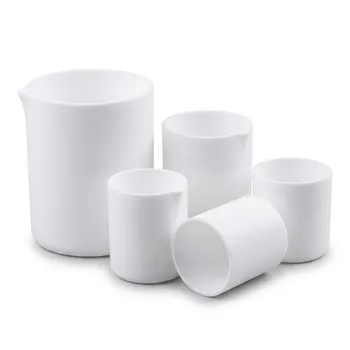
Need high-performance PTFE or PFA labware that withstands extreme heat? At KINTEK, we specialize in manufacturing virtually all laboratory supplies from PTFE and PFA—from beakers and digestion vessels to custom electrochemical cells and high-purity fluid systems. Our end-to-end CNC machining ensures precision even for complex parts. Backed by expert knowledge of fluoropolymer behavior, we help you select components for safe, reliable operation. For distributors, we offer OEM/ODM support, certified quality, and consistent supply. Contact us today to discuss your high-temperature application and get tailored solutions—get in touch!
Related Products
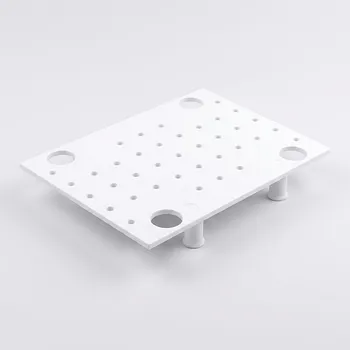
- High Temperature Resistant PTFE Thermal Insulation Board Corrosion Resistant Metal Free Fluoropolymer Stand for Ultra Clean Laboratories
- Custom PTFE Insulating Gaskets and Corrosion Resistant Fluoropolymer Seals for Industrial Electrical Applications
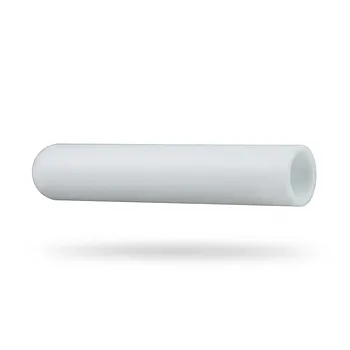
- Custom PTFE Test Tubes Corrosion Resistant Low Background Fluoropolymer Labware 50ml 30ml
- Custom PTFE Filtration System Acid Resistant Chemical Semiconductor Fluoropolymer Filter Assembly
- Custom PTFE Condenser Tube 100ml Serpentine and Straight Fluoropolymer Laboratory Heat Exchanger with Flask Adapters
People Also Ask
- What are the limitations of pure PTFE in high temperature applications? Understanding the 200°C Ceiling
- What materials are used to manufacture PTFE bars? A Guide to Virgin & Filled PTFE
- What factors should be considered when choosing PTFE bars for chemical applications? Select the Right Grade for Your Process
- What advantages do PTFE bars offer in chemical industries? Ensure Safety and Efficiency in Demanding Applications
- Why are PTFE bars considered essential in modern industrial applications? Unlock Unmatched Chemical & Thermal Resistance