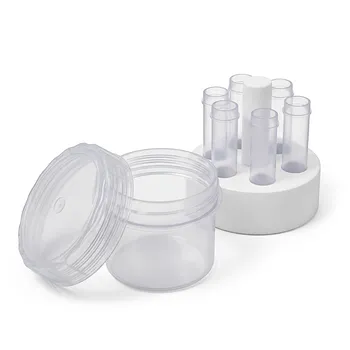
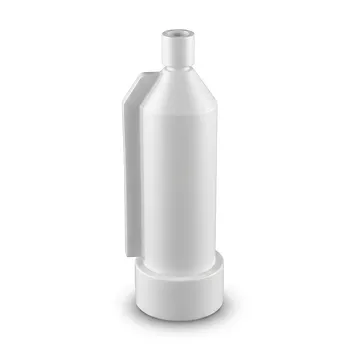
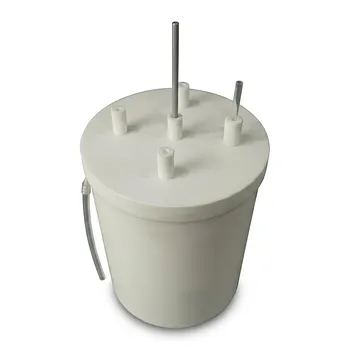
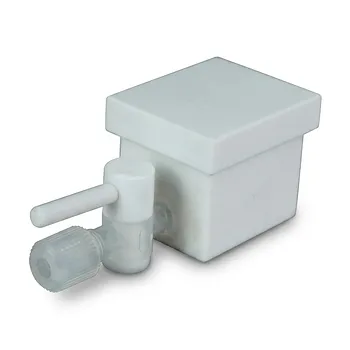
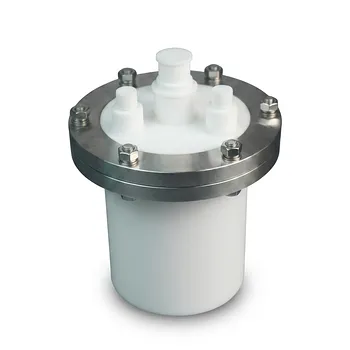
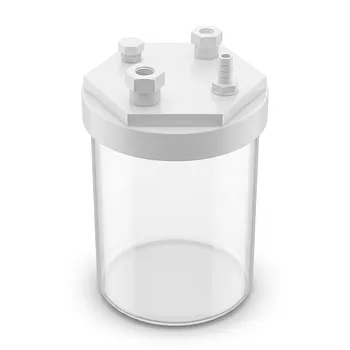
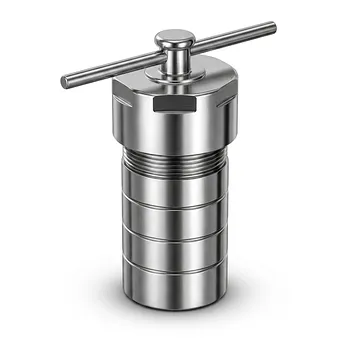
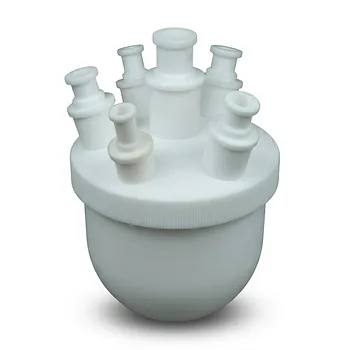
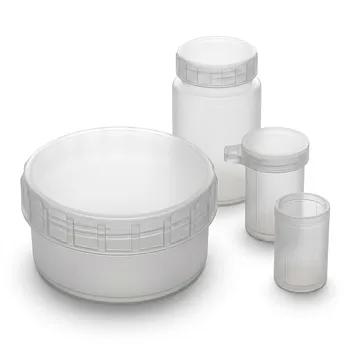
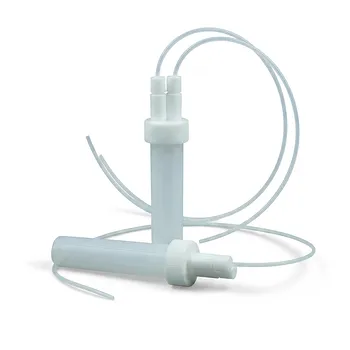
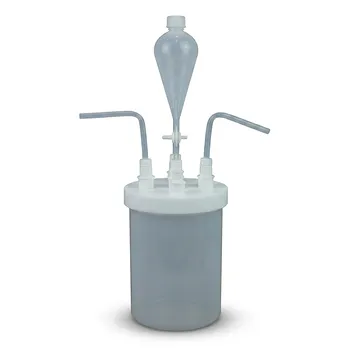
Select materials and vessel designs that preserve chemical integrity, seal reliability, and process control. For direct gas fluorination, reaction vessels, tubing, fittings, valves, and seals should generally use high-purity, fully fluorinated polymers such as PTFE or PFA, because elemental fluorine and fluorinated plasmas can rapidly attack conventional polymers, elastomers, glass, and metals. The design must also accommodate vacuum evacuation, pressure containment, gas distribution, thermal exposure, and—where relevant—controlled mixing without introducing contaminants or creating leak paths.
The safest selection combines fluorine-resistant materials with a vessel geometry designed for the actual pressure, temperature, gas-flow, and mixing conditions. Material compatibility alone is insufficient if the system cannot maintain a reliable seal, provide uniform gas exposure, or safely contain reactive fluorinated gas.
Why Material Compatibility Is the First Constraint
Elemental fluorine attacks conventional materials
Direct gas fluorination uses highly reactive F2 or fluorinated plasmas such as CF4 and SF6. These species can degrade ordinary plastics, elastomers, and other materials by cleaving vulnerable bonds, including C-N and C-Si bonds.
Materials that appear chemically stable in ordinary laboratory service may therefore become contamination sources or structural weaknesses under fluorination conditions.
Prefer fully fluorinated polymers
High-purity PTFE and PFA are the primary material choices identified for reaction cells, digestion vessels, tubing, fittings, valves, and sealing components. Their highly fluorinated carbon backbones provide strong resistance to chemical attack in aggressive halogenating environments.
These materials also offer low surface energy and non-porous surfaces, helping reduce adsorption, contamination, and difficult-to-clean residues.
Protect process purity
Metal vessels and fittings can introduce trace metal ions, while degraded plastics can release reaction products into the process. This is particularly important for surface modification, synthesis, electrochemical fluorination, and analytical sample preparation.
A chemically inert fluoropolymer contact surface helps maintain the intended chemistry and reduces the risk that vessel materials alter the result.
How to Select Sealing Components
Treat seals as part of the reaction boundary
Seals are not secondary hardware. In a fluorination system, they are directly exposed to reactive gas and must maintain integrity throughout evacuation, fluorination, purge, and pressurization cycles.
Conventional elastomer seals can degrade rapidly, swell, embrittle, or become permeable. High-purity fluoropolymer sealing components are therefore preferred where the seal is exposed to the process atmosphere.
Design for both vacuum and pressure
Direct gas fluorination commonly requires pre-evacuation followed by controlled gas admission. The seal must remain leak-tight across both sub-atmospheric and pressurized conditions.
The vessel and flange design should limit deformation, seal extrusion, and accidental opening while also allowing inspection, maintenance, and controlled replacement of sealing parts.
Minimize leak paths
Every joint, valve, fitting, and removable lid creates a potential escape path for fluorine-containing gas. A robust design uses as few connections as practical and keeps fittings and transfer lines compatible with the same chemical environment as the vessel.
The sealing strategy should be evaluated as a complete assembly rather than by selecting an isolated gasket based only on its nominal material name.
Vessel Design Factors That Control Process Performance
Match the vessel to the pressure regime
The reaction vessel must be designed for the full operating envelope, including evacuation, gas introduction, pressure fluctuations, and abnormal containment conditions. The mechanical structure, closures, fittings, and seals must be assessed together.
A chemically resistant liner does not automatically make the overall vessel suitable for pressure service. The supporting structure and containment arrangement must also be compatible with the intended operating conditions.
Control gas exposure and diffusion
Direct gas fluorination is diffusion-controlled, so vessel geometry affects how uniformly the gas reaches the polymer substrate. Internal volume, sample placement, gas inlet location, and flow paths should prevent stagnant regions and unwanted concentration gradients.
The design should provide predictable exposure without forcing gas through unnecessarily complex or contamination-prone paths.
Use suitable fluid-transfer hardware
Tubing, valves, fittings, and connectors can become the weakest points in the system if they use incompatible materials. PTFE or PFA transfer components support chemical resistance while maintaining the controlled movement of reactive gas and related process fluids.
Connections should be arranged so that dead volume, trapped gas, and difficult-to-purge sections are minimized.
Consider agitation where an emulsion is involved
Some fluoropolymer processing uses gaseous monomers above an aqueous latex phase. In that case, the reactor must create sufficient gas-liquid interfacial area for mass transfer from the headspace into the latex particles.
Stirrers and baffles should be selected to support steady transport while preserving latex stability. Excessive agitation can create shear that destabilizes the emulsion, so mixing capability must include accurate speed control rather than simply maximizing agitation.
Thermal and Chemical Resistance
Evaluate the combined environment
Material selection should account for the combined effects of reactive fluorine, temperature, pressure, vacuum, and process chemicals. A component that performs well under chemical exposure at ambient conditions may behave differently when heated, evacuated, or subjected to repeated cycling.
PTFE and PFA are useful because they combine chemical inertness with high thermal resistance, but the complete component design still determines whether the system remains reliable.
Consider adjacent process chemistries
The same apparatus may encounter strong acids, acyl fluorides, electrochemical environments, organic peroxides, or fluorinated surfactants. These chemistries can impose requirements beyond elemental fluorine compatibility.
For electrofluorination and high-temperature synthesis, fluoropolymer vessels and transfer lines help resist corrosion and reduce metal contamination. For peroxide-containing processes, non-porous and thermally stable surfaces help prevent degradation and sample contamination.
Understanding the Trade-offs
Chemical resistance does not remove mechanical constraints
Fluoropolymers provide excellent chemical resistance, but vessel selection must still address structural stability, closure design, pressure containment, and dimensional behavior under thermal cycling.
The correct decision is therefore not simply “choose PTFE.” It is “choose a compatible fluoropolymer component in a mechanically appropriate system.”
Flexibility can increase leak risk
Flexible tubing and polymer seals simplify assembly, but excessive flexibility can make connections more sensitive to deformation, movement, or repeated pressure changes. Rigid supports and carefully designed fittings may be necessary for reliable operation.
More mixing is not always better
In gas-liquid fluoropolymer processes, higher stirrer speeds can improve interfacial renewal but may also damage emulsion stability through excessive shear. Mixing should be optimized for mass transfer and product stability together.
Avoid material substitution without compatibility review
Standard elastomers, plastics, glass, or metal parts should not be substituted merely because they are convenient or commonly used in laboratory equipment. Their resistance, cleanliness, permeability, and behavior under the actual fluorination conditions must be established before use.
Making the Right Choice for Your Goal
The selection should follow the dominant risk and performance requirement of the process.
- If your primary focus is chemical containment: Use high-purity PTFE or PFA for wetted vessel surfaces, seals, tubing, fittings, and valves exposed to fluorine or fluorinated media.
- If your primary focus is leak prevention: Design the full assembly for both vacuum evacuation and pressure containment, minimizing joints and using fluoropolymer sealing components at exposed interfaces.
- If your primary focus is process uniformity: Optimize vessel geometry, gas-flow paths, sample placement, and—where applicable—stirrer and baffle configuration to control diffusion and interfacial area.
- If your primary focus is analytical or synthesis purity: Use non-porous, low-surface-energy fluoropolymer surfaces and avoid materials that can degrade or introduce metal-ion contamination.
- If your primary focus is long-term reliability: Evaluate chemical, thermal, mechanical, and cycling conditions together rather than qualifying the vessel material in isolation.
A reliable direct gas fluorination system is built by matching fluorine-resistant materials with deliberate control of containment, sealing, transport, and process geometry.
Summary Table:
| Factor | Key Considerations | Recommended Choice |
|---|---|---|
| Material Compatibility | Resistance to F2, CF4, SF6; avoid degradation and contamination | High-purity PTFE/PFA |
| Sealing Components | Leak-tight under vacuum and pressure; exposed to reactive gas | PTFE/PFA seals, minimize joints |
| Vessel Design | Pressure containment, gas distribution, diffusion control | Match geometry to pressure and flow; avoid dead volumes |
| Thermal & Chemical Resistance | Combined effects of temperature, reactive chemicals | PTFE/PFA with high thermal stability |
| Process Purity | Avoid metal ion contamination and degradation byproducts | Non-porous fluoropolymer surfaces |
Ensure safe and reliable direct gas fluorination with KINTEK's high-purity PTFE/PFA reaction vessels, seals, and fluid handling components. Our custom-designed solutions are engineered to withstand aggressive fluorination conditions, maintaining integrity under vacuum and pressure. From standard labware to complex reaction systems, we provide end-to-end support tailored to your specific process needs. Contact us today to discuss your requirements and benefit from our expertise in fluoropolymer technology. Contact KINTEK
Related Products
- High Purity Corrosion Resistant PFA Reaction Vessel with PTFE Holder and Integrated Sampling Tube for Trace Analysis
- High Purity PTFE Reaction Vessel with Electric Stirring System and Customizable 5L Tank including Buchner Funnel Filtration Assembly
- High Purity PTFE Corrosion Resistant Reaction Vessel with Luer Fittings and Caps for Trace Analysis
- High Performance Customizable PTFE Reaction Vessel and Corrosion Resistant Polytetrafluoroethylene Flask for Chemical Laboratory Use
- PTFE 10L Reaction Vessel with Stirring Paddle Customizable Corrosion Resistant High Temperature Reactor for Biopharmaceutical and Chemical Processing
People Also Ask
- Why is the choice of reaction vessel material critical during B-NiBDC synthesis? Optimize MOF Purity & Performance
- What is the function of corrosion-resistant reaction vessels in the acid hydrolysis process of molasses for microalgae culture media?
- How do the material choice and sealing integrity of the reaction vessel affect the growth of NiFe-LDH? Optimize Synthesis
- Why are corrosion-resistant vessels needed for alkaline cellulose extraction? Ensure Purity and Process Safety
- Why are well-sealed reaction vessels necessary for superacid-promoted Friedel-Crafts polycondensation? Optimize Synthesis