The key selection principle is to engineer free volume without sacrificing selectivity or stability. For high-efficiency gas permeation, fluoropolymer structures should be evaluated for fluorinated substitution, backbone rigidity, molecular asymmetry, chain packing, and the resulting balance between permeability and permselectivity. The best material is not necessarily the one with the highest gas flux; it is the one whose molecular architecture provides the required transport rate, separation factor, durability, and resistance to swelling under actual operating conditions.
High-performance fluoropolymers combine rigid, thermally stable backbones with bulky fluorinated or heterocyclic groups that disrupt tight chain packing. This creates usable fractional free volume while preserving sufficient molecular discrimination for gases such as CO₂/CH₄, O₂/N₂, or H₂/CH₄.
Start with the Gas-Transport Mechanism
Evaluate permeability as diffusion and solubility
Gas permeability is governed by both how readily a gas dissolves into the polymer and how quickly it diffuses through it:
[ P_i = D_i S_i ]
where (P_i) is permeability, (D_i) is diffusivity, and (S_i) is solubility.
Ideal permselectivity between gases A and B can therefore be expressed as:
[ \alpha^*_{A/B} = \frac{P_A}{P_B} = \frac{D_A}{D_B}\frac{S_A}{S_B} ]
Molecular modifications can affect these two terms differently. For example, increasing free volume may raise diffusivity broadly, while changing polarity can alter the relative solubility of different gases.
Define the required separation first
A material for high-throughput CO₂ removal may need a different structure from one intended for precise O₂/N₂ discrimination. The target gas pair, pressure, temperature, feed composition, and required product purity should determine whether permeability or selectivity receives greater emphasis.
Use Fluorinated Substitution to Tune Free Volume
Consider hexafluoroisopropylidene groups
Replacing an aliphatic isopropylidene group, ([-C(CH_3)_2-]), with a hexafluoroisopropylidene group, ([-C(CF_3)_2-]), introduces large, highly fluorinated units into the backbone.
These groups can increase free volume and modify polymer polarity, supporting higher gas permeability while potentially improving permselectivity relative to less appropriately structured analogues.
Use bulky fluorinated groups to resist tight packing
Bulky (-CF_3) groups and fluorinated alkyl side chains prevent polymer chains from packing too efficiently. The resulting increase in fractional free volume provides additional pathways for gas transport.
The same steric bulk can also restrict chain mobility and reduce swelling, which is important when membranes encounter condensable species or aggressive process environments.
Examine the position of fluorinated substituents
The location of fluorinated groups on an aromatic or heteroaromatic unit affects chain geometry and packing. Ortho- and para-trifluoromethyl substitution can produce substantially higher permeability than meta substitution in some fluoropolymer architectures.
Dual trifluoromethyl substitution can increase permeability even more by creating greater steric disruption. These positional effects should be treated as design variables rather than assuming that the number of fluorine atoms alone determines performance.
Control Backbone Rigidity and Molecular Geometry
Balance high glass transition temperature with transport pathways
A rigid backbone generally increases thermal and dimensional stability, helping the material retain its structure during operation. However, rigidity alone does not guarantee high permeability.
If a rigid polymer packs too efficiently, it can have insufficient free volume and therefore poor gas transport. The effective design is a rigid but geometrically frustrated structure that preserves stable, unoccupied molecular space.
Introduce non-coplanar and bulky units
Non-coplanar groups, bulky pendant substituents, and suitable ether linkages can prevent adjacent aromatic units from aligning closely. This limits dense packing while maintaining a high glass transition temperature.
The objective is not maximum disorder. It is controlled disruption of packing that creates connected transport volume without making the polymer mechanically weak or excessively mobile.
Consider backbone planarity and intermolecular interactions
Backbone planarity and intermolecular interactions influence how chains organize. Interactions such as fluorine–sulfur contacts or hydrogen bonding can alter coplanarity and packing motifs.
These effects may either improve structural organization or reduce available transport volume, depending on the polymer design. They should therefore be evaluated alongside free-volume measurements rather than considered inherently beneficial.
Use Bulky Heterocycles to Increase Molecular Free Volume
Favor asymmetric heterocyclic structures when appropriate
Bulky, asymmetric heterocycles, including pyridinyl-type groups, can create larger internal free volume than smaller or highly symmetric aromatic units.
Their irregular geometry prevents efficient chain packing and can increase gas permeation while maintaining comparable separation behavior, provided the added polarity does not eliminate the desired diffusivity advantage.
Account for heteroatom-driven polarity
Heteroatoms can change gas–polymer interactions and therefore affect solubility selectivity. This may be useful for gases whose sorption is sensitive to polymer polarity, such as CO₂.
However, stronger interactions are not automatically better. Excessive sorption or plasticization can reduce dimensional stability and compromise long-term separation performance.
Optimize the Permeability–Selectivity Relationship
Expect a compensation effect
A common limitation is the permeability–selectivity trade-off: increasing free volume often raises the transport rate of multiple gases, which can reduce the ideal permselectivity ratio.
A material with very high permeability may therefore provide less effective separation than a somewhat slower material with better diffusivity discrimination.
Separate diffusivity selectivity from solubility selectivity
A fluoropolymer can improve selectivity through differences in molecular-size-dependent diffusion, gas-specific solubility, or both. Molecular design should identify which mechanism is expected to dominate for the target gas pair.
This distinction helps avoid selecting a material based only on total permeability when the application actually depends on molecular discrimination.
Consider the operating environment
Pressure, temperature, humidity, and condensable contaminants can alter free volume and gas sorption. A structure that performs well under ideal dry-gas testing may behave differently under mixed-gas or high-pressure conditions.
Material selection should therefore compare data under conditions that represent the intended separation tool, not only under standardized single-gas measurements.
Preserve Chemical and Thermal Stability
Match fluorinated architecture to process severity
Fluorinated backbones generally provide strong resistance to chemical degradation and elevated temperatures. This is valuable for gas-handling tools exposed to aggressive reagents, cleaning cycles, or thermal fluctuations.
The relevant question is whether the complete polymer architecture—not merely its fluorine content—retains mechanical integrity and transport properties throughout the operating range.
Limit swelling and plasticization
Bulky fluorinated groups can constrain chain mobility and increase resistance to swelling. This helps maintain stable separation performance when the membrane contacts condensable gases, solvents, or other strongly interacting species.
Nevertheless, high sorption can still alter chain spacing. Swelling and plasticization must be measured for the actual feed mixture.
Verify low contamination and leachability requirements
For laboratory filtration and gas-handling components, chemical resistance is only part of the requirement. Low volatility, low extractables, and low leachability may be essential for trace analysis or high-purity gas processing.
The polymer’s molecular structure and manufacturing history should both be verified before use in contamination-sensitive systems.
Understanding the Trade-offs
More free volume can reduce discrimination
A larger free-volume population can improve gas flux, but if the pathways become too broadly distributed, gases may experience less difference in diffusivity.
High permeability should therefore be interpreted together with ideal and mixed-gas selectivity.
Greater rigidity can lower permeability
Rigid, high-(T_g) backbones improve thermal and mechanical stability, but excessive rigidity combined with efficient packing can suppress molecular transport.
Bulky, non-coplanar structures are useful because they seek both properties rather than maximizing either one independently.
Strong gas interactions can destabilize the polymer
Increasing polarity may improve solubility selectivity for certain gases, but strong sorption can promote swelling or plasticization. The material must retain its structure after prolonged exposure, not just show favorable initial permeability.
Single-gas data may overstate practical performance
Ideal permeability and selectivity measurements do not fully predict mixed-gas operation. Competitive sorption, condensable components, pressure effects, and aging can change the effective transport behavior.
For engineering decisions, molecular design should be supported by long-duration, mixed-gas, and temperature-relevant testing.
Making the Right Choice for Your Goal
Molecular structure should be selected against the complete performance target rather than a single headline property.
- If your primary focus is maximum gas throughput: Favor hexafluoroisopropylidene groups, bulky (-CF_3) substituents, asymmetric heterocycles, and architectures that generate high fractional free volume.
- If your primary focus is separation efficiency: Prioritize controlled free volume, appropriate substituent positioning, and a structure that preserves diffusivity or solubility selectivity for the target gas pair.
- If your primary focus is high-temperature operation: Select a rigid, high-(T_g) backbone with enough non-coplanar or bulky structure to prevent dense packing from suppressing permeability.
- If your primary focus is mixed-gas or solvent resistance: Favor bulky fluorinated groups that limit swelling, then verify plasticization and transport stability under realistic feed conditions.
- If your primary focus is analytical or laboratory purity: Require microstructural verification, low extractables, chemical inertness, and stable performance in the complete apparatus—not only in the membrane material.
The strongest fluoropolymer choices deliberately balance free volume, molecular discrimination, chain stability, and resistance to environmental change.
Summary Table:
| Consideration | Key Factors | Impact on Performance |
|---|---|---|
| Fluorinated Substitution | -CF3, hexafluoroisopropylidene groups, position on aromatic ring | Increases free volume, modifies polarity, improves permeability and stability |
| Backbone Rigidity & Geometry | Non-coplanar units, bulky pendant groups, ether linkages | Prevents dense packing, maintains high Tg, provides controlled free volume |
| Heterocyclic Units | Asymmetric, bulky heterocycles (e.g., pyridinyl) | Enhance free volume, alter polarity, affect diffusivity and solubility |
| Permeability-Selectivity Trade-off | Diffusivity vs. solubility selectivity, mixed-gas effects | Balances transport rate and separation factor |
| Chemical & Thermal Stability | Swelling resistance, leachability, thermal degradation | Ensures long-term performance and purity |
Unlock Optimal Gas Separation with KINTEK's High-Performance Fluoropolymers
At KINTEK, we specialize in crafting precision PTFE and PFA components that excel in demanding gas permeation and separation applications. Our materials are engineered with tailored molecular structures to maximize free volume while preserving selectivity and stability. Whether you need custom membranes, filtration components, or complete lab setups, our end-to-end CNC machining capabilities deliver exceptional purity and reliability.
Contact us today to find the perfect fluoropolymer solution for your high-efficiency gas separation needs. Get in touch with our experts and elevate your lab's performance!
Related Products
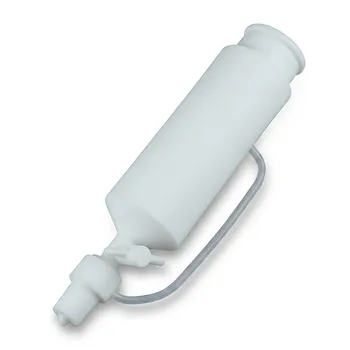
- Custom PTFE Constant Pressure Separatory Funnel 100ml Fluoropolymer Labware for Corrosive Chemical Transfer
- High Purity 4L PFA Reaction Tank for Proton Exchange Membrane Electrolysis Water Oxygen Separation Systems
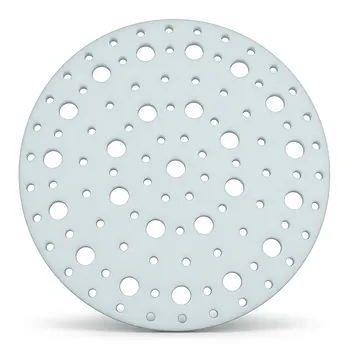
- High Temperature Resistant Insulating TFM Separator and Ultra Clean Laboratory PTFE Baffle Plate with Customizable Pore Size and Hole Configuration
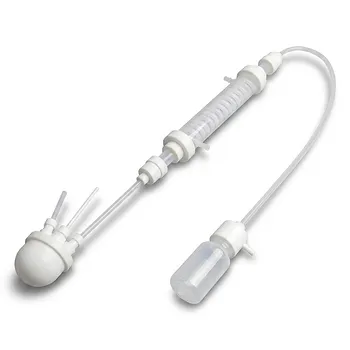
- Corrosion Resistant Hydrogen Fluoride Reflux Apparatus PTFE Flask Condenser Separatory Funnel Collection Bottle High Temperature Laboratory System
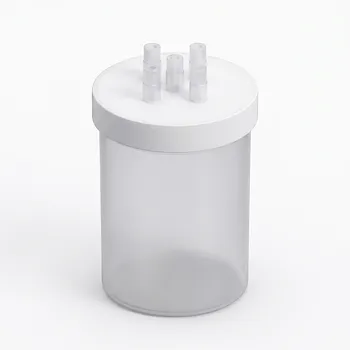
- High Purity PTFE Gas Washing Bottle Corrosion Resistant Custom Gas Absorption Unit 1/4 Inch Tube Connection
People Also Ask
- Which material characteristics make fluoropolymers suitable for lithium-ion battery separators, and how do fluoropolymer laboratory supplies support separator performance testing?
- How does structural integration of flame-retardant elements in fluorinated polymers compare to small-molecule additives, and why is this relevant to fluoropolymer laboratory material selection?
- How do perfluorinated monomer building blocks impart superhydrophobic and oleophobic properties? Low surface energy is critical for fluoropolymer labware.
- What inherent physical and chemical properties make fluoropolymers ideal for high-performance laboratory equipment and reaction apparatus? Discover the Key to Durability & Purity
- What performance changes occur when increasing the fluorine content in fluoropolymer materials used for specialized laboratory supplies?