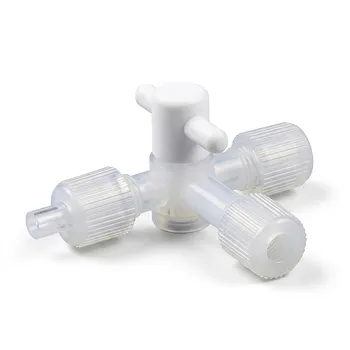
The decisive structural difference is cross-linking. Thermosetting fluoropolymers form permanent chemical bridges between polymer chains when cured by heat, light, or another reaction; they cannot be remelted or redissolved. Thermoplastic fluoropolymers have physically associated, uncross-linked chains that soften when heated and solidify when cooled, making them generally more adaptable to laboratory tubing, fittings, valves, and other fluid-transfer components.
For high-temperature laboratory fluid transfer, choose based on both thermal duty and fabrication requirements. Cross-linking can improve resistance to permanent flow, but most high-performance fluoropolymer lab components use thermoplastics—especially PTFE and PFA—because they combine chemical inertness, thermal stability, and tolerance of repeated temperature changes.
How the Polymer Structure Differs
Thermosetting fluoropolymers form a permanent network
During curing, thermosetting materials create covalent cross-links between adjacent polymer chains. The resulting three-dimensional network does not flow as a conventional melt when reheated.
This structure can provide strong dimensional retention under sustained heat and load. However, once cured, the material generally cannot be reshaped by melting; excessive heating eventually causes degradation rather than useful reprocessing.
Thermoplastic fluoropolymers retain separate chains
Thermoplastics do not develop permanent chemical bridges during normal processing. Their chains can move relative to one another as temperature rises and become more constrained as the material cools.
This allows thermoplastics to be extruded, molded, welded, or reshaped, depending on the specific fluoropolymer. It also means that high temperature and sustained mechanical stress must be evaluated for creep and dimensional change.
“Thermoplastic” does not always mean melt-processable
PTFE is a key exception to the usual processing assumption. It is structurally a thermoplastic, but its extremely high melt viscosity prevents standard injection molding and melt extrusion.
PTFE is typically produced through powder pressing and sintering, then may be precision-machined. PFA, by contrast, is a true melt-processible fluoropolymer because its comonomer structure lowers melt viscosity while retaining high chemical and thermal resistance.
Why This Matters in Fluid Transfer Components
Thermal cycling favors resilient, uncross-linked materials
Laboratory systems may cycle between cryogenic temperatures, ambient conditions, and elevated temperatures. Components must accommodate expansion and contraction without losing sealing contact or developing cracks.
PTFE and PFA can tolerate severe thermal cycling because they retain structural integrity across a broad temperature range and can absorb some expansion and contraction stresses. The exact performance still depends on geometry, wall thickness, pressure, loading, and the selected grade.
Sustained heat introduces creep concerns
Thermoplastic fluoropolymers can soften and slowly deform under continuous heat and mechanical load. This is especially important in thin tubing, valve seats, compression seals, and pressurized fittings.
Cross-linked materials may offer better resistance to flow under particular load conditions, but they sacrifice remeltability and may be less convenient for precision fabrication. A material’s published continuous service temperature should therefore be treated as a design limit, not as a guarantee against creep in every configuration.
Chemical purity is often as important as temperature
PTFE and PFA provide exceptionally broad chemical resistance and low-friction, low-surface-energy surfaces. These properties reduce contamination risk and make them well suited to aggressive reagents, high-purity transfer, and demanding laboratory cleaning protocols.
For trace analysis or ultra-clean fluid handling, the component’s manufacturing method also matters. Smooth, low-porosity surfaces and weldable constructions can be more important than small differences in nominal temperature capability.
Selecting Between PTFE, PFA, and FEP
Choose PTFE for maximum thermal and structural conservatism
PTFE has a melting point of approximately 327 °C and a maximum continuous service temperature commonly specified around 260 °C. It is widely used for machined parts, digestion vessels, seals, and components exposed to severe chemical and thermal conditions.
Its limitation is fabrication: high-molecular-weight PTFE is not conventionally melt-processable. Complex geometries may therefore require compression molding, sintering, machining, or a design assembled from multiple parts.
Choose PFA for complex, high-purity geometries
PFA melts at approximately 305 °C and can be injection-molded or melt-extruded. It is suitable for intricate fittings, valves, tubing, molded vessels, and smooth-walled fluid paths that would be difficult or costly to manufacture from PTFE.
PFA typically provides a continuous service temperature of up to approximately 260 °C, comparable to PTFE for many laboratory applications. It is especially useful when the design requires clarity or translucency, low micro-porosity, weldability, and complex molded geometry.
Consider FEP when transparency and easier processing dominate
FEP is melt-processable and can provide excellent optical clarity and chemical resistance. Its continuous service temperature is generally lower, around 200 °C, so it is better suited to moderate-high-temperature tubing, heat-sealable bags, and transparent components than to the most severe thermal duties.
FEP should not be selected solely because it is easier to mold. If the application approaches PTFE or PFA temperature limits, its lower thermal ceiling may control the design.
Understanding the Trade-offs
Cross-linking improves permanence but reduces flexibility
A cross-linked fluoropolymer network can resist remelting and may retain shape under heat and load. The trade-off is that the component cannot normally be repaired, remolded, or recycled through ordinary melting.
For laboratory systems that require custom dimensions, replacement parts, or welded fluid paths, a thermoplastic can be operationally more useful even when a thermoset might offer greater resistance to permanent deformation.
PTFE offers capability but complicates manufacturing
PTFE is often the conservative choice for maximum chemical and thermal resistance. However, its non-melt-processable behavior increases manufacturing complexity and can limit economical production of intricate, seamless geometries.
Machining also introduces design considerations such as tolerances, surface finish, joints, and potential assembly interfaces. These may matter in high-purity systems where every interface is a potential retention or contamination site.
PFA simplifies fabrication but is not immune to thermal limits
PFA’s melt processability enables smooth, complex, and highly integrated components. Nevertheless, it remains a thermoplastic and can experience creep, dimensional change, or degradation if used beyond its rated conditions.
Processing temperatures are also far above normal operating temperatures. Excessive processing or exposure can cause decomposition or undesirable reactions, so fabrication and service limits must be considered separately.
Temperature ratings must be interpreted in context
A quoted 260 °C continuous service temperature does not mean a component can safely withstand any combination of 260 °C, pressure, stress, and chemical exposure. Pressure, vacuum, cycling frequency, mechanical restraint, and contact with specific reagents can all reduce practical performance.
Design validation should therefore use the supplier’s pressure-temperature data and the actual component geometry, rather than comparing material names alone.
Making the Right Choice for Your Goal
Select the material by separating the application’s thermal duty, mechanical loading, purity requirements, and manufacturing constraints.
- If your primary focus is maximum temperature and chemical resistance: Start with PTFE, particularly for machined components, seals, and severe-duty digestion or reaction hardware.
- If your primary focus is complex molded geometry and high-purity fluid paths: Choose PFA for melt-processable tubing, fittings, valves, vessels, and weldable assemblies.
- If your primary focus is transparency at moderate-high temperatures: Consider FEP, provided the approximately 200 °C continuous-service range is adequate.
- If your primary focus is resistance to permanent deformation under sustained load: Evaluate a suitable cross-linked material, but confirm that its one-time curing, limited reworkability, and fabrication method fit the laboratory design.
- If your primary focus is repeated thermal cycling: Favor a fluoropolymer with verified cycling performance and assess creep, sealing stress, pressure, and wall geometry—not just the nominal service-temperature rating.
The best selection is the material whose molecular structure, thermal rating, and manufacturing process all match the actual fluid-transfer duty.
Summary Table:
| Property | Thermosetting Fluoropolymers | Thermoplastic Fluoropolymers (PTFE, PFA, FEP) |
|---|---|---|
| Molecular Structure | Covalently cross-linked network | Individual chains, no permanent cross-links |
| Melting/Reprocessing | Cannot be remelted or reshaped | Soften when heated, can be remelted (except PTFE) |
| Thermal Stability | High dimensional stability under heat | Good thermal stability, but creep possible |
| Fabrication | Cured once; limited to casting or compression | Extrudable, moldable, weldable (except PTFE) |
| Typical Continuous Service Temp | Varies; often high (e.g., 260°C+) | PTFE: ~260°C, PFA: ~260°C, FEP: ~200°C |
Selecting the right fluoropolymer for your lab's fluid transfer needs is critical. At KINTEK, we specialize in PTFE and PFA components—from tubing and fittings to custom-machined parts—ensuring optimal purity and thermal performance. Contact our team today to get expert guidance and a tailored solution for your application. Contact us to discuss your requirements!
Related Products
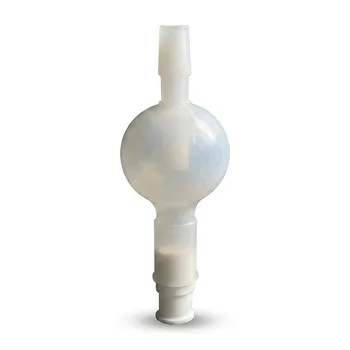
- High Purity PFA Chromatography Column with Collection Bottle Corrosion Resistant Fluoropolymer Filtration System for Trace Analysis
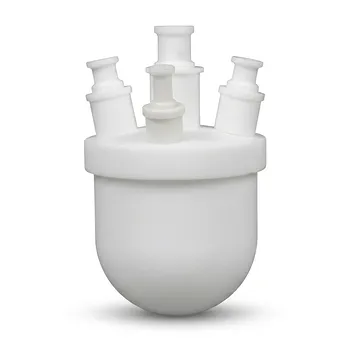
- Custom PTFE Flask 250ml High Purity Fluoropolymer Laboratory Vessel for Chemical Research
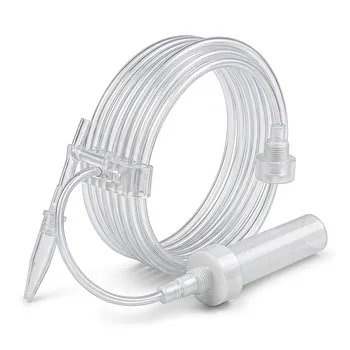
- Custom PFA Tubing 1/4 Inch High Purity Corrosion Resistant Fluoropolymer Tube with Welding and Machining Services
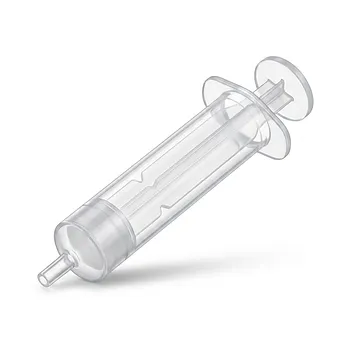
- Corrosion Resistant PFA Syringe Translucent Visual Fluoropolymer Labware 10ml Chemical Handling Tool
- Custom PTFE Reaction Tank Corrosion Resistant Fluoropolymer Chemical Processing Barrel 10L 20L 30L
People Also Ask
- Why is the chemical stability of polymer endgroups critical when selecting melt-processible fluoropolymers like PFA for high-purity laboratory apparatus? Choose Stable Endgroups for Reliable Performance
- What are the characteristics of PFA material? A Guide to Its High-Performance Balance
- Why is Perfluoroalkoxy alkane (PFA) preferred over glass or stainless steel in pharmaceutical process development? Pure Yield
- Why is PFA superior for cleaning and preventing cross-contamination? The Gold Standard for Ultra-Trace Lab Hygiene
- What are the key properties of PFA (PerFluoroAlkoxy)? A Guide to Extreme Chemical and Thermal Resistance