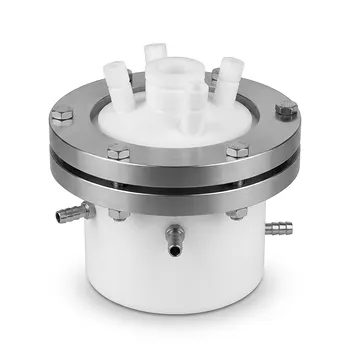
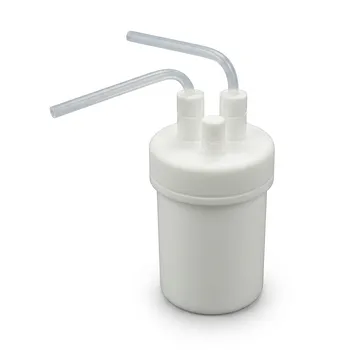
A high-pressure hydrothermal synthesis reactor provides a strictly controlled, sealed environment that enables the crystallization of titanium dioxide (TiO₂) by maintaining temperatures and pressures far exceeding the solvent's standard boiling point. This environment facilitates the regulated hydrolysis and polycondensation of titanium sources onto templates, such as nanocellulose, ensuring the formation of a stable, mesoporous anatase framework.
The core value of a high-pressure hydrothermal reactor lies in its ability to drive chemical transformations and phase transitions that are impossible at atmospheric pressure. By creating subcritical or supercritical conditions, it allows for precise, template-directed growth of mesoporous TiO₂ with specific crystal phases.
The Foundations of the Hydrothermal Environment
Sealed, High-Pressure Containment
The reactor operates as a closed system, preventing the escape of vapors and allowing internal pressure to build as the temperature rises. This containment is essential for keeping solvents in a liquid or supercritical state at temperatures where they would otherwise evaporate.
Thermal Energy Beyond Boiling Points
By reaching temperatures typically between 180°C and 200°C, the reactor provides the thermal energy necessary to overcome activation barriers for crystallization. This high-heat environment is critical for the transition of titanium dioxide from an amorphous state to a functional anatase crystal phase.
Enhanced Solvent Properties
Under high pressure, the solubility and diffusion capabilities of the reactants are significantly increased. This allows precursors, such as tetrabutyl titanate, to distribute evenly and interact more effectively with the template structures.
Mechanisms of Mesoporous Fabrication
Regulated Hydrolysis and Polycondensation
The reactor environment allows for the controlled breakdown and rebuilding of titanium molecules. These regulated reactions ensure that the TiO₂ deposit occurs systematically rather than through rapid, uncontrolled precipitation.
Template-Directed Growth
In the fabrication of mesoporous structures, the reactor environment forces the titanium dioxide to grow along a specific nanocellulose or organic template. The high-pressure conditions ensure the material conforms to the template's geometry, which later results in a stable, porous network once the template is removed.
Atomic-Level Transformation
The combination of heat and pressure facilitates the chelation and dehydration reactions required to build TiO₂ frameworks at the molecular level. This results in superior structural integrity and the ability to dope the material or create heterojunctions within the reactor.
Understanding the Trade-offs and Pitfalls
Material Corrosion and Purity
The extreme chemical environments inside the reactor, often involving acidic media or high-concentration bases, can be highly corrosive to metal walls. To prevent contamination and maintain product purity, the use of PTFE or PFA liners is mandatory.
Kinetic Control vs. Pressure Safety
While higher temperatures and pressures accelerate crystallization and improve morphology, they also increase the risk of mechanical failure of the vessel. Balancing the "cooking" time with the pressure limits of the reactor is a critical safety and quality trade-off.
Scaling and Structural Uniformity
While hydrothermal synthesis excels at creating high-quality nanoparticles and nanotubes, maintaining uniform temperature gradients in larger reactors is difficult. Inconsistencies in the thermal profile can lead to variations in the mesoporous structure or unwanted phase transitions.
Applying Reactor Conditions to Your Synthesis Goals
Success in hydrothermal synthesis requires aligning reactor settings with your specific material requirements.
- If your primary focus is Phase Purity (Anatase): Maintain temperatures near 180°C-200°C for extended periods to ensure the complete transition from amorphous precursors to the crystalline anatase phase.
- If your primary focus is Morphological Precision: Utilize a template-directed approach (like nanocellulose) within the sealed environment to force the TiO₂ to adopt specific mesoporous or tubular shapes.
- If your primary focus is High Reactivity/Doping: Focus on increasing internal pressure to enhance the solubility of dopants and precursors, facilitating atomic-level integration into the TiO₂ framework.
The high-pressure reactor is the essential tool that transforms simple chemical precursors into sophisticated, nanostructured materials through the precise manipulation of thermodynamic limits.
Summary Table:
| Key Condition | Function in Synthesis | Benefit to Material |
|---|---|---|
| High Pressure | Increases precursor solubility | Enhanced structural integrity |
| Temp (180-200°C) | Overcomes activation barriers | Transition to pure anatase phase |
| Sealed System | Prevents solvent evaporation | Subcritical/Supercritical states |
| PTFE/PFA Liners | Prevents chemical corrosion | Ensures high-purity TiO2 |
Achieve unparalleled purity in your hydrothermal synthesis with KINTEK. Whether you need high-performance PTFE/PFA liners, high-purity trace analysis instruments, or advanced reaction apparatus like microwave digestion vessels and hydrothermal synthesis reactors, KINTEK provides the fluoropolymer expertise your research demands. From everyday basic labware (beakers, crucibles, and centrifuge tubes) to complex fluid transfer components and bespoke CNC-machined laboratory setups, we ensure your materials remain uncontaminated under extreme conditions. Contact KINTEK today to optimize your laboratory setup!
References
- Wei Wang, Shiyan Han. Synthesis of Mesoporous TiO2 Induced by Nano-Cellulose and Its Photocatalytic Properties. DOI: 10.15376/biores.11.2.3084-3093
This article is also based on technical information from Kintek Knowledge Base .
Related Products
- High Temperature Corrosion Resistant Hydrothermal Synthesis Reactor with TFM Inner Liner and Straight Cylinder Design
- PTFE Lined High Pressure Digestion Vessel 50ml High Temperature Hydrothermal Synthesis Tank
- High Pressure Custom TFM Reactor Stainless Steel Outer Vessel PTFE Inner Cup for Corrosive Synthesis
- High Temperature PTFE Reaction Flask 1000ml Single Neck Round and Flat Bottom Laboratory Bottle
- Custom TFM Reaction Vessel with Stainless Steel Jacket and PTFE Inner Cup for High Corrosion Resistance
People Also Ask
- What is the role of a corrosion-resistant reactor in the synthesis of lignin-based carbon dots? Ensure Maximum Purity
- What are the technical advantages of using hydrothermal synthesis reactors for advanced electronic & optical nanomaterials?
- How does a hydrothermal synthesis reactor facilitate the production of crystalline materials with tailored morphologies? Precision Crystal Growth
- Why is the sealing reliability of a hydrothermal synthesis reactor critical for 24-hour cycles? Ensure Nano-Precision
- What role do hydrothermal synthesis reactors play in CQD preparation? Achieve High-Purity Nanomaterial Synthesis