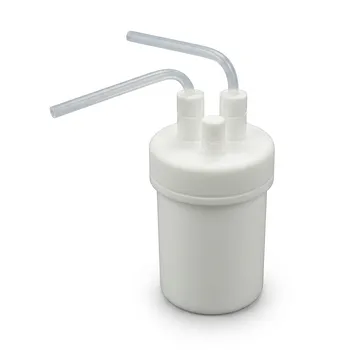
PTFE microchannel reactors are primarily limited by significant pressure drops, low individual channel throughput, and inherent mechanical weaknesses. While they offer near-universal chemical inertness, scaling these reactors requires complex "numbering-up" strategies, and their soft nature makes them susceptible to creep and deformation under high-pressure or high-temperature conditions.
Core Takeaway: PTFE microchannel reactors excel in handling aggressive chemistries but are constrained by physical durability and fluid dynamics; successful industrial implementation often requires reinforcing the polymer with metal substrates and utilizing parallel channel architectures to achieve meaningful production volumes.
Challenges in Fluid Dynamics and Scalability
The Impact of Pressure Drop on Flow
A significant limitation of PTFE microchannel reactors is the sharp increase in pressure drop as channel length increases or fluid viscosity rises. Because microchannels have a small hydraulic diameter, forcing fluids through long paths requires substantial energy and can limit the maximum flow rate achievable.
The Complexity of "Numbering-Up"
The throughput of a single microchannel is typically restricted to milliliters or liters per hour, which is insufficient for most industrial scales. To increase volume, engineers must use numbering-up (parallelization), which involves managing flow distribution across many identical channels to ensure consistent reaction performance.
Clogging and Solid Handling
While PTFE’s non-stick properties help mitigate fouling, there remains a persistent risk of clogging if a reaction produces large solids. In narrow microchannels, even minor particulate accumulation can lead to a total system failure or pressure spikes that the soft polymer cannot withstand.
Mechanical and Thermal Constraints
Low Structural Integrity and Creep
PTFE possesses low mechanical and tensile strength compared to metals or even other polymers like nylon. Under sustained pressure or weight, the material is prone to creep, meaning it can slowly change shape or "flow," potentially compromising the precise geometry of the microchannels.
Temperature-Induced Off-Gassing
While PTFE is stable at moderate temperatures, it begins to degrade when exposed to heat above 260ºC (500ºF). At these extreme temperatures, the material can release toxic fumes, posing a significant safety risk in industrial environments that are not specifically ventilated for fluoropolymer decomposition.
Moderate Pressure Ratings
Standard PTFE reactors are generally limited to moderate pressure ratings, often only a few bar. For industrial applications requiring high-pressure synthesis, PTFE must be used as a liner or coating inside a metallic or silicon substrate to provide the necessary structural containment.
Chemical and Environmental Vulnerabilities
Reactivity with Specific Agents
Despite its reputation for inertness, PTFE is not universally compatible; it can react aggressively with alkali metals and highly reactive fluorinating agents. These specific chemical interactions can lead to material degradation and potential reactor breach.
Radiation Sensitivity
PTFE has exceptionally poor resistance to high-energy radiation. Exposure to such radiation causes the PTFE molecules to break down, leading to a rapid loss of mechanical properties and eventual structural failure of the reactor components.
Difficulties in Manufacturing and Assembly
PTFE is a challenging material to work with because it cannot be easily welded or cemented. Joining PTFE components to other parts of a chemical plant often requires specialized mechanical seals or compression fittings, which can become leak points under thermal cycling.
Understanding the Trade-offs
The primary trade-off in choosing PTFE is chemical resistance versus structural durability. While a stainless steel microreactor might succumb to corrosion from strong acids, it can handle hundreds of bars of pressure; PTFE offers the inverse profile.
Furthermore, while the "numbering-up" approach avoids the traditional risks of scaling up a batch reactor (like heat transfer changes), it introduces the risk of manifold maldistribution. If the flow is not perfectly balanced across all parallel PTFE channels, product quality and safety can be compromised.
Making the Right Choice for Your Goal
- If your primary focus is handling highly corrosive acids or bases: Utilize PTFE microchannel reactors, but ensure they are housed within a secondary metal containment sleeve for safety.
- If your primary focus is high-pressure synthesis (above 10 bar): Avoid pure PTFE reactors and instead opt for PTFE-lined metallic reactors to combine inertness with structural strength.
- If your primary focus is rapid industrial scale-up: Invest in advanced manifold designs to ensure even flow distribution across your "numbered-up" channel arrays.
- If your primary focus is high-temperature processing (>260°C): Seek alternative materials like ceramics or specialized alloys, as PTFE will begin to lose structural integrity and release hazardous vapors.
By carefully balancing PTFE's unmatched chemical passivity against its mechanical and thermal ceilings, engineers can safely harness the benefits of continuous flow micro-processing.
Summary Table:
| Limitation Category | Specific Challenge | Industrial Impact |
|---|---|---|
| Fluid Dynamics | High Pressure Drop | Restricts flow rates and increases energy consumption. |
| Scalability | Complex "Numbering-Up" | Difficult to ensure uniform flow across parallel channels. |
| Mechanical | Creep & Low Strength | Risk of deformation under sustained high pressure or heat. |
| Thermal | Degradation >260°C | Structural failure and release of toxic fluoropolymer fumes. |
| Environmental | Radiation Sensitivity | Rapid loss of mechanical properties when exposed to high energy. |
| Chemical | Specific Reactivity | Vulnerable to alkali metals and strong fluorinating agents. |
Optimize Your Flow Chemistry with High-Performance Fluoropolymer Solutions
Navigating the trade-offs of PTFE in industrial applications requires precision engineering. KINTEK specializes in manufacturing virtually all imaginable laboratory supplies crafted from high-performance PTFE and PFA.
Whether you need everyday basic labware—such as beakers, reagent bottles, and digestion tubes—or advanced components like high-purity trace analysis instruments and comprehensive fluid transfer systems (tubing, fittings, and valves), we have you covered. For complex industrial needs, our end-to-end custom CNC fabrication provides bespoke reaction apparatus, including microchannel components, electrochemical cells, and hydrothermal liners designed to withstand demanding environments.
Don’t let material limitations compromise your results. Contact KINTEK today to discuss your custom laboratory setups or high-volume orders and leverage our absolute focus on high-performance fluoropolymer materials.
Related Products
- Customizable Polytetrafluoroethylene PTFE Reactor and Corrosion Resistant Teflon Flask
- PTFE 10L Reaction Vessel with Stirring Paddle Customizable Corrosion Resistant High Temperature Reactor for Biopharmaceutical and Chemical Processing
- Custom PTFE Multilayer Reaction Apparatus High Temperature Corrosion Resistant Threaded Modular Sieve System
- Custom PTFE Volatile Matter Condensation Reflux Reaction Device Corrosion Resistant Pressure Resistant
- High Performance Customizable PTFE Reaction Vessel and Corrosion Resistant Polytetrafluoroethylene Flask for Chemical Laboratory Use
People Also Ask
- What functional advantages do PTFE reactors provide over glass? Achieve Superior Purity and Safety in Synthesis
- What are the primary fabrication methods for capillary-based and monolithic PTFE reactors? Expert Production Insights
- Why are PTFE or PFA reaction vessels required for the selective etching process of MXene using hydrofluoric acid (HF)?
- Why is a Teflon-lined (PTFE) reactor vessel required for the hydrothermal synthesis of V2O5 and SnO2 nanomaterials?
- What is the role of high chemical inertness reaction vessels in the organic synthesis of acylhydrazone ligands? | Guide