The primary techniques for uniform fluoropolymer thin films are Hot Wire Chemical Vapor Deposition (HWCVD) and plasma polymerization. HWCVD uses precursor-gas pressure to control whether the coating develops a porous structure or a dense, continuous globular morphology. Plasma polymerization provides additional control through substrate temperature, RF power, and system pressure, while solution-based spin coating offers a practical route when the fluoropolymer is soluble in a suitable solvent.
Uniformity depends less on the deposition method alone than on controlling the process window. Pressure, energy input, substrate temperature, precursor or solution behavior, and chamber cleanliness determine whether the final film is continuous and defect-free or porous, rough, cracked, or locally non-uniform.
Choosing a Deposition Route
Hot Wire Chemical Vapor Deposition
In HWCVD, a heated filament activates or decomposes a fluorinated precursor before the resulting reactive species reach the substrate. The technique is attractive for fluoropolymer coatings because it can produce chemically and thermally stable films without requiring a liquid polymer solution.
Plasma Polymerization
Plasma polymerization forms a fluoropolymer-like coating from plasma-activated precursor species. It is particularly useful when a uniform, conformal coating is needed across a substrate and when morphology must be adjusted through several independently controllable process parameters.
Solution-Based Spin Coating
Spin coating is an important complementary method when the selected fluoropolymer can be dissolved in an appropriate organic solvent. The supplementary process uses polymer concentrations of approximately 5–10 wt%, spin speeds of 2000–2500 rpm, and vacuum drying at 80 °C for 24 hours to remove residual solvent.
Spin coating should not be treated as interchangeable with HWCVD or plasma polymerization. Its success depends strongly on polymer solubility, solution quality, substrate cleanliness, solvent evaporation, and drying conditions.
How HWCVD Pressure Controls Morphology
Lower-Pressure and Porous Growth
The primary reference identifies precursor-gas pressure as the key HWCVD variable for tuning film morphology. Under one portion of the operating window, the deposited material can form a porous structure rather than a fully closed coating.
Porosity may be useful when increased surface area or a textured interface is desired, but it is generally undesirable for dielectric insulation and barrier applications. Open or weakly connected structures can create local variations in thickness and electrical behavior.
Higher-Density Continuous Films
Adjusting the gas pressure can shift growth toward a dense, continuous globular film. This morphology is better suited to applications requiring consistent coverage, chemical resistance, and electrical isolation.
The relevant pressure is not simply a universal “high” or “low” value. The correct setting depends on the precursor, filament conditions, chamber geometry, substrate, and desired deposition rate, so morphology must be verified experimentally rather than inferred from pressure alone.
Pressure as a Morphology Control
Pressure changes the transport and arrival conditions of reactive species at the substrate. In practical terms, it changes how readily the growing film fills gaps and develops a continuous structure.
A useful HWCVD development strategy is to vary pressure systematically while holding other variables stable. Film continuity, surface texture, thickness distribution, and defect density can then be compared to identify the process window for the intended application.
How Plasma Parameters Influence Film Structure
Substrate Temperature
Substrate temperature influences the mobility and organization of deposited species after they reach the surface. The primary reference identifies temperature as one of the principal controls for producing well-defined and uniform plasma-polymerized coatings.
Temperature that is poorly matched to the chemistry or substrate can contribute to non-uniform growth, inadequate film formation, or defects. It should therefore be optimized together with pressure and RF power rather than adjusted in isolation.
RF Power
RF power determines the energy delivered to the plasma and affects precursor activation. Changing it can alter the balance between the supply of reactive fragments and the conditions under which those fragments form the growing polymer film.
Excessive or insufficient power may produce an unsuitable film structure even when pressure is appropriate. RF power should be evaluated through the resulting coating morphology and performance, not only through plasma stability.
System Pressure
System pressure controls the environment in which activated species move from the plasma to the substrate. It therefore affects deposition uniformity, reaction pathways, and the structure of the resulting fluoropolymer coating.
Because pressure interacts with RF power and substrate temperature, a uniform film usually requires a coordinated parameter study. The objective is a stable operating region that produces continuous coverage without excessive roughness or defects.
Substrate and Chamber Conditions
The substrate surface must be clean and compatible with the deposition chemistry. Chamber geometry, precursor delivery, and thermal conditions also influence local deposition behavior, particularly across larger or complex substrates.
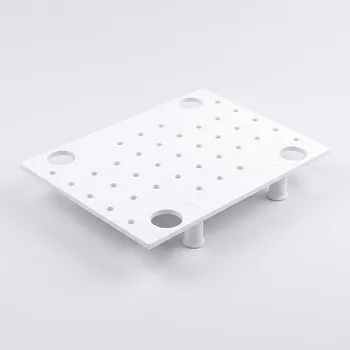
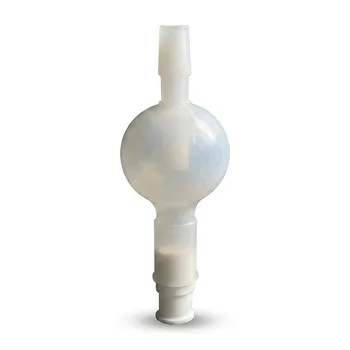
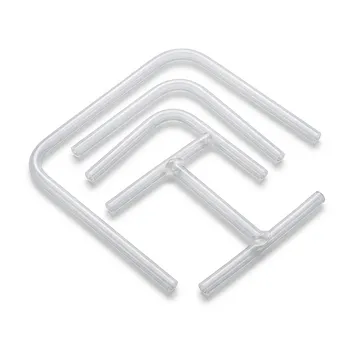
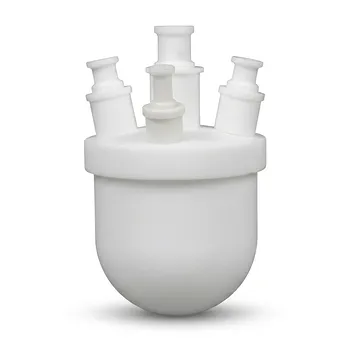
High-purity PTFE or PFA fittings, tubing, and custom substrate holders help prevent trace contamination during reactive processing. These components are valuable when chemical purity, reproducibility, and reliable chamber performance are important.
Why Uniformity Matters in Applications
Electrical Insulation
Non-uniform films create localized thickness variations and uneven dielectric properties. Under high electric fields, these weak regions can contribute to electrical short-circuits.
For semiconductor substrates, sensor devices, and electrochemical components, a continuous and defect-free film is therefore a functional requirement rather than merely a cosmetic improvement.
Chemical Barrier Performance
A dense, continuous fluoropolymer layer provides more consistent chemical barrier behavior than a film containing pores, cracks, or uncovered regions. Uniformity is especially important when the coating separates a reactive environment from an underlying substrate or device.
Surface Property Measurements
Surface evaluations such as water contact angle measurements are sensitive to local variations in morphology and contamination. Controlled droplet volumes, measurements at multiple surface regions, and averaging help distinguish real coating behavior from local defects.
The supplementary procedure uses 10 µL HPLC-grade water droplets placed on different regions of the surface. This supports more consistent evaluation of coating uniformity, although contact angle alone does not fully characterize thickness or internal defects.
Understanding the Trade-offs
Porosity Versus Continuity
Porous films may provide increased texture or surface area, but they are less appropriate where insulation and barrier integrity are priorities. Dense continuous films generally offer more reliable protection, though they may not provide the same interfacial area.
Deposition Control Versus Process Complexity
Plasma polymerization offers several control variables, including temperature, RF power, and pressure. That flexibility improves optimization potential but also creates interactions that make process development more complex.
HWCVD can provide a direct pressure-based route to morphology control, but its outcome still depends on precursor activation, chamber design, and substrate conditions.
Solubility Versus Material Selection
Spin coating can be straightforward when the polymer dissolves cleanly and forms a stable solution. However, many fluoropolymers have limited solubility, so the method may require specially modified resins that are compatible with solvents such as DMF.
Soluble modified fluoropolymer resins can produce smooth, crack-free films with water contact angles of approximately 103°–108°, but those results cannot automatically be generalized to every fluoropolymer chemistry or processing condition.
Surface Uniformity Versus Film Thickness
A visually smooth surface does not prove that the film has uniform thickness throughout the substrate. Morphology, thickness distribution, adhesion, chemical composition, and electrical integrity should be assessed separately when the coating will be used as an insulating or barrier layer.
How to Apply This to Your Project
The appropriate method depends on whether the priority is vapor-phase purity, adjustable plasma chemistry, or a practical solution-based coating process.
- If your primary focus is dense, continuous morphology: Use HWCVD or plasma polymerization and optimize pressure for continuity, while verifying the film for pores, cracks, and local thickness variation.
- If your primary focus is broad process control: Use plasma polymerization and study substrate temperature, RF power, and system pressure as an interacting parameter set.
- If your primary focus is a practical laboratory coating route: Use spin coating only with a fluoropolymer that forms a stable solution, then control concentration, spin speed, substrate cleanliness, and vacuum drying.
- If your primary focus is electrical insulation or chemical barrier reliability: Prioritize defect-free, continuous coverage and use high-purity PTFE or PFA chamber components to limit contamination.
- If your primary focus is reproducible surface characterization: Measure multiple substrate regions with controlled water droplets and average the results alongside independent checks of thickness and defect density.
The most reliable fluoropolymer coatings come from matching the deposition method and process window to the required film morphology, then verifying uniformity with measurements that reflect the intended application.
Summary Table:
| Technique | Key Parameters | Morphology Control |
|---|---|---|
| HWCVD | Precursor gas pressure | Pressure low → porous; high → dense, continuous |
| Plasma Polymerization | Substrate temp, RF power, system pressure | Interacting parameters, optimize for uniformity |
| Spin Coating | Polymer concentration, spin speed, drying | 5-10 wt%, 2000-2500 rpm, vacuum dry at 80°C for 24h |
Achieve uniform, high-performance fluoropolymer coatings with precision-engineered PTFE and PFA components from KINTEK. Our labware, fluid handling systems, and custom machined parts are designed for demanding thin-film processes. Contact our experts today to optimize your deposition setup and ensure consistent results—get in touch!
Related Products
- Custom PTFE Insulating Gaskets and Corrosion Resistant Fluoropolymer Seals for Industrial Electrical Applications
- High Temperature Resistant PTFE Thermal Insulation Board Corrosion Resistant Metal Free Fluoropolymer Stand for Ultra Clean Laboratories
- High Purity PFA Chromatography Column with Collection Bottle Corrosion Resistant Fluoropolymer Filtration System for Trace Analysis
- High Purity PFA Coiled Tubing Custom PTFE Machining PFA Welding and Precision Bending Solutions
- Custom PTFE Teflon Balls for Advanced Industrial Applications
People Also Ask
- What are the three primary types of PTFE available for gaskets and seals? Choose the Right Material for Your Application
- Why is PTFE an ideal material choice for sealing gaskets, valves, and fluid transfer tubing exposed to extremely aggressive chemicals? Discover Its Superior Chemical Resistance and Reliability
- How is PTFE utilized in seals and gaskets? Leverage Its Chemical & Temperature Resistance
- What are the key properties of PTFE that make it suitable for seals and gaskets? Unlock Superior Sealing Performance
- How are custom PTFE parts used in the automotive sector? Enhance Vehicle Performance & Durability