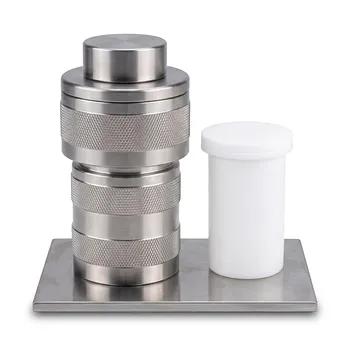
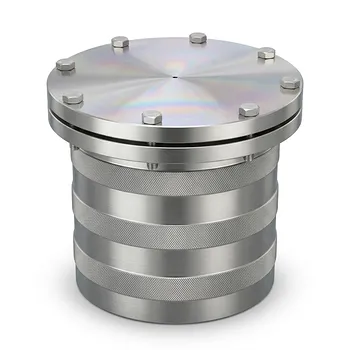
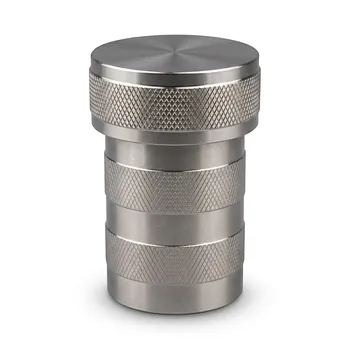
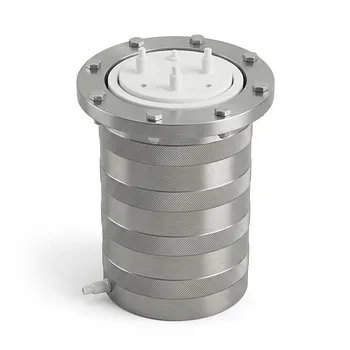
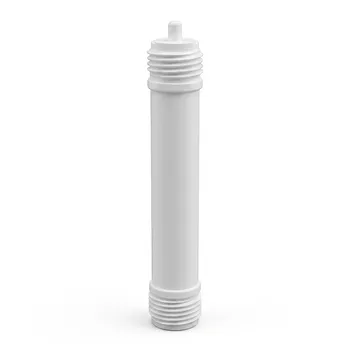
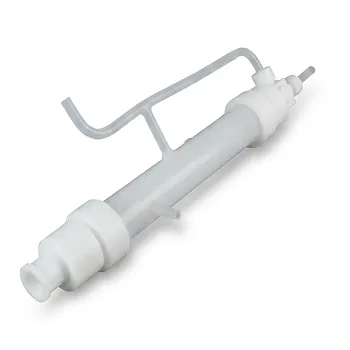
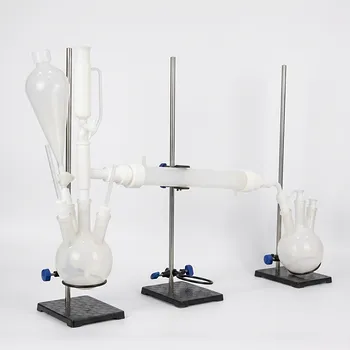
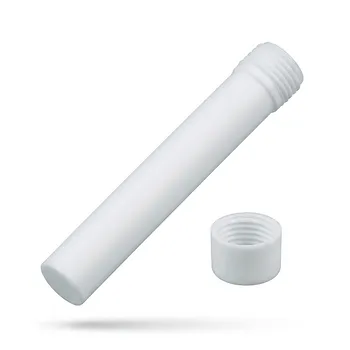
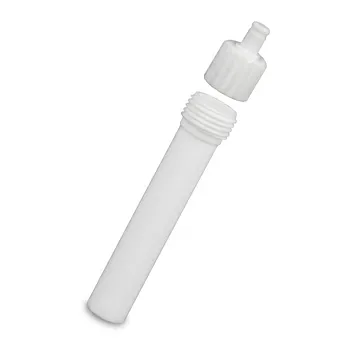
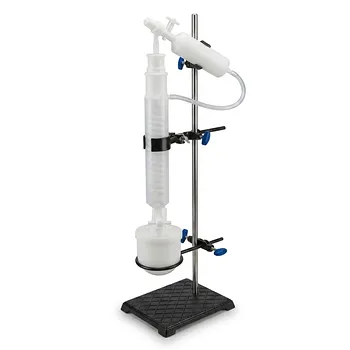
In the hydrothermal synthesis of $\text{Fe}_2(\text{MoO}_4)_3$ nanomaterials, a high-pressure autoclave with a PTFE or PFA liner serves as a critical reactor that enables precise phase control and molecular-level crystallization. This specialized environment maintains a constant temperature of approximately 180°C and high internal pressure for extended periods, significantly increasing solvent reactivity to promote the growth of orthogonal phase iron molybdate nanoparticles with high electrochemical activity.
The core function of the lined autoclave is to provide a chemically inert, pressurized environment that facilitates the uniform mixing of iron and molybdenum precursors while protecting the vessel from corrosion. This ensures the synthesis of high-purity nanomaterials with specific morphologies that are otherwise impossible to achieve at atmospheric pressure.
Enhancing Reactivity and Phase Transformation
Molecular-Level Mixing and Crystallization
The sealed environment of the autoclave forces precursors into a high-energy state, increasing the solubility and reactivity of the iron and molybdenum sources. This allows for uniform mixing at the molecular level, which is essential for the formation of the orthogonal phase of $\text{Fe}_2(\text{MoO}_4)_3$.
Morphology and Structural Precision
By maintaining a stable high-temperature environment (typically 180°C for 24 hours), the autoclave promotes oriented crystal growth. This process allows researchers to tailor the morphology of the nanoparticles, which directly impacts their electrochemical activity and surface area.
The Critical Role of PTFE and PFA Liners
Preventing Metallic Contamination
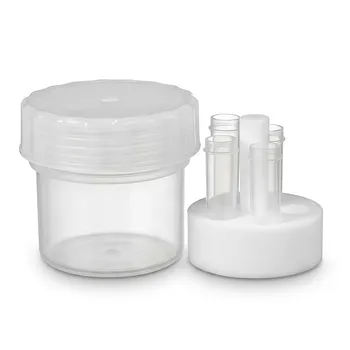
The PTFE (Polytetrafluoroethylene) or PFA (Perfluoroalkoxy) liner acts as a chemically inert barrier between the reaction solution and the stainless steel walls of the autoclave. This prevents the introduction of metallic impurities from the vessel itself, which is vital for maintaining the high purity required for electrochemical applications.
Corrosion Resistance Against Precursors
Iron and molybdenum precursors can often be corrosive under hydrothermal conditions. The exceptional corrosion resistance of PTFE and PFA protects the structural integrity of the autoclave from aggressive chemical attacks by strong acids, bases, or oxidizing agents.
Non-Stick Properties and Yield
The low surface energy of these liners prevents the synthesized nanomaterials from adhering to the vessel walls. This non-stick characteristic ensures a higher yield of the $\text{Fe}_2(\text{MoO}_4)_3$ nanoparticles and facilitates easier cleaning and recovery of the product.
Understanding the Trade-offs and Limitations
Temperature Constraints
While PTFE is highly effective, it has a functional thermal limit, typically around 250°C. Exceeding these temperatures can lead to the deformation of the liner or the release of toxic vapors, requiring careful monitoring of the hydrothermal process.
Pressure Management and Safety
The internal pressure generated during the 24-hour cycle is substantial and depends on the filling degree of the liner. Improper calculation of the solvent volume can lead to over-pressurization, risking a catastrophic failure of the autoclave seals.
Scaling Challenges
Hydrothermal synthesis in lined autoclaves is often limited to batch processing in relatively small volumes. Scaling this process for industrial production requires significant engineering to maintain the same uniformity of temperature and pressure across larger reaction vessels.
Applying This Technology to Your Synthesis
Selecting the right parameters for your autoclave is essential for achieving the desired material properties.
- If your primary focus is phase purity: Ensure the autoclave is perfectly sealed to maintain the constant pressure required for the formation of the orthogonal phase of $\text{Fe}_2(\text{MoO}_4)_3$.
- If your primary focus is morphology control: Use a PTFE liner to prevent wall-adhesion and ensure that crystal growth is driven by solvent reactivity rather than surface interactions with the vessel.
- If your primary focus is hardware longevity: Always inspect the PTFE or PFA liner for cracks or thinning to prevent corrosive precursors from reaching and weakening the stainless steel outer shell.
By leveraging the unique pressurized environment and chemical inertness of a lined autoclave, you can achieve the precise molecular architecture necessary for high-performance iron molybdate nanomaterials.
Summary Table:
| Function | Key Benefit | Technical Feature |
|---|---|---|
| Phase Control | Enables orthogonal phase formation | Constant high-pressure environment |
| Contamination Prevention | Ensures high-purity nanomaterials | Chemically inert PTFE/PFA barrier |
| Morphology Tuning | Tailors nanoparticle surface area | Stable 180°C thermal environment |
| Corrosion Resistance | Protects vessel structural integrity | Resists aggressive iron/molybdenum precursors |
| Product Recovery | Increases synthesis yield | Low-surface-energy, non-stick liners |
Optimize Your Synthesis with KINTEK’s Fluoropolymer Excellence
Achieve uncompromising precision in your hydrothermal research with KINTEK. We specialize in high-performance fluoropolymer solutions designed for the most demanding chemical environments. From standard PTFE and PFA labware—including beakers, digestion tubes, and filtration tools—to advanced custom-machined hydrothermal synthesis liners and reaction apparatus, we ensure your precursors remain pure and your equipment remains protected.
Whether you require high-volume consumables or bespoke CNC-fabricated components for complex electrochemical cells and microchannel reactors, KINTEK delivers the durability and chemical inertness essential for nanomaterial innovation. Partner with us for end-to-end expertise in fluoropolymer laboratory setups tailored to your specific research goals.
Contact KINTEK today to request a custom quote for your lab
References
- V. Subapriya, K. Venkatachalam. Hydrothermal Synthesis and Characterization of Fe2(MoO4)3/g-C3N4 Composites for Improved Energy Storage Applications. DOI: 10.14233/ajchem.2025.34579
This article is also based on technical information from Kintek Knowledge Base .
Related Products
- PTFE Lined High Pressure Digestion Vessel 50ml High Temperature Hydrothermal Synthesis Tank
- Custom TFM Reaction Vessel with Stainless Steel Jacket and PTFE Inner Cup for High Corrosion Resistance
- PTFE Corrosion Resistant Filter with PFA Valve Connections and Integrated Sieve Plate
- PTFE PFA Vacuum Filtration System Corrosion Resistant Customizable Shatterproof Laboratory Device
- High Purity PTFE PFA Plastic Crucible for Corrosion Resistant Acid Digestion and Trace Analysis
People Also Ask
- What are the benefits of using a PTFE-lined vessel for carbon-sulfur cathode treatment? Maximize Purity & Performance
- Why are PTFE-lined pressure digestion vessels required for the preparation of Ag/CeO2 catalysts? Purity & Performance
- What safety features are typically incorporated into high-pressure PTFE digestion vessel designs? Ensure Lab Safety
- What is the function of PTFE lined high-pressure vessels in g-C3N4 synthesis? Achieve High-Purity Material Growth
- Role of High-Pressure Digestion Tanks in Perovskite Synthesis: Achieve Superior Stability and Latent Heat