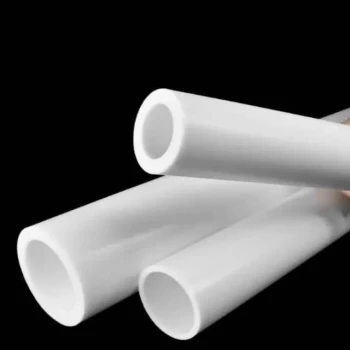
The maximum pore size of porous ePTFE tubing is determined by measuring its bubble point pressure. The tubing is fully wetted with a low-surface-tension liquid, commonly isopropyl alcohol, and gas pressure is gradually increased on one side. The pressure at which the first continuous stream of bubbles emerges is recorded as the bubble point; because this pressure is inversely related to the largest wetted pore, a higher bubble point indicates a smaller maximum pore size.
The bubble point identifies the largest effective pore in a wetted ePTFE structure. This makes it a practical quality and performance measure for confirming filtration retention, liquid barrier integrity, and predictable flow behavior.
How the Bubble Point Method Works
Wetting the ePTFE Tubing
The tubing is first saturated with a liquid that can enter and occupy its pores. Low-surface-tension liquids such as isopropyl alcohol are commonly used because PTFE is naturally hydrophobic and does not wet easily with water.
Complete wetting is essential. Any dry or incompletely filled pore can allow gas to pass prematurely and produce an inaccurate maximum-pore-size result.
Applying Gas Pressure
After wetting, the tubing is mounted so that gas pressure can be applied to one side of the porous wall while the other side is exposed to the surrounding liquid or a suitable collection environment.
Gas pressure is increased gradually. At lower pressures, the wetting liquid remains held inside the capillary-like pores by surface tension and capillary forces.
Identifying the Bubble Point
The bubble point is the pressure at which the first continuous stream of gas bubbles passes through the tubing wall. This stream indicates that gas has displaced the wetting liquid from the largest effective pore.
A few isolated bubbles may result from trapped air, incomplete wetting, or a leak. The relevant measurement is the pressure associated with the first sustained, continuous flow of bubbles through the sample.
Why Pressure Reveals Pore Size
The Young-Laplace Relationship
The method is based on the relationship between capillary pressure and pore diameter, commonly expressed in simplified form as:
[ d_{\text{max}} \approx \frac{4\gamma \cos\theta}{\Delta P} ]
Here, (d_{\text{max}}) is the maximum effective pore diameter, (\gamma) is the liquid surface tension, (\theta) is the liquid contact angle, and (\Delta P) is the measured bubble point pressure.
The exact calculation depends on the test liquid, wetting condition, pore geometry, and test configuration. For a fixed liquid and comparable test conditions, the key relationship is straightforward: larger pores require less pressure to clear, while smaller pores require more pressure.
What the Result Represents
The bubble point does not describe the average pore size. It primarily reflects the largest effective wetted pore that provides a continuous gas path through the structure.
This distinction matters because the largest pores often determine the earliest breakthrough point and therefore strongly influence the tubing's maximum passage size and potential particle-retention limit.
Using ASTM F316
ASTM F316 describes the Bubble Point and Mean Flow Pore test method for hydrophobic microporous membranes. The same principle can be applied to porous ePTFE tubing with appropriate fixtures and controlled test conditions.
The broader method can also generate dry, wet, and calculated half-dry flow curves. These curves provide additional information, such as mean flow pore size, while the bubble point remains the primary indicator of maximum pore size.
Why Maximum Pore Size Matters
Confirming Particle Retention
In filtration applications, maximum pore size is closely tied to the largest passage available through the media. A pore structure with an uncontrolled or unexpectedly large pore can permit particles to pass even when the nominal or average pore rating appears correct.
Bubble point testing therefore helps verify that the tubing's pore structure is consistent with its intended filtration rating.
Protecting Liquid Barrier Performance
Porous ePTFE tubing may need to allow gas or vapor transmission while preventing liquid passage. The maximum pore size and wetting characteristics determine how effectively the structure resists liquid intrusion under differential pressure.
A verified bubble point provides evidence that the tubing can maintain its intended liquid barrier behavior within the relevant operating conditions.
Predicting Flow and Pressure Drop
Pore size also affects permeability. Smaller pores generally provide greater retention but lower throughput, while larger pores allow higher flow at the cost of reduced retention and lower resistance to liquid breakthrough.
Bubble point testing gives designers a measurable pore-size-related parameter for balancing flow rate, differential pressure, and filtration performance.
Supporting Process Consistency
For fluoropolymer components used in demanding fluid-handling systems, nominal material descriptions are not enough. Variations in expansion, processing, wall structure, or damage can alter the effective pore network.
Routine bubble point testing can identify lot-to-lot variation and confirm that tubing meets a defined performance range before it enters service.
Where the Method Is Especially Valuable
Gas Venting and Liquid Protection
Hydrophobic ePTFE tubing is often used where gases must pass while liquids, aerosols, or contaminants are retained. The bubble point helps verify that the venting structure has the required pore-size and barrier characteristics.
This is important in pressure-equalization, tank venting, analytical equipment, and other systems where liquid escape or contamination would be unacceptable.
Analytical and Laboratory Filtration
In laboratory workflows, porous PTFE media may be used for sample preparation, solvent handling, or gas filtration. A reproducible bubble point supports confidence in particle retention and sample containment.
Premature bubble formation can also reveal physical membrane damage, defective seals, or leaks in the test assembly.
Chemical and Aggressive Fluid Handling
ePTFE is selected for chemical resistance, but chemical compatibility alone does not establish filtration performance. The tubing must also maintain its intended pore structure and pressure behavior in the application.
Bubble point data helps connect material selection with measurable functional performance.
Understanding the Trade-offs
Smaller Pores Are Not Always Better
A smaller maximum pore size can improve particle and microbial retention, but it usually increases flow resistance. The result may be lower throughput and a higher required operating pressure.
The correct pore size is therefore the smallest size that meets the retention requirement without creating unacceptable pressure drop or process time.
Bubble Point Is Sensitive to Test Conditions
The measured pressure depends on the wetting liquid's surface tension and contact angle, as well as temperature, sample preparation, pressure ramp rate, and fixture design.
Results should be compared only when these conditions are controlled. Changing from isopropyl alcohol to water, for example, can produce a materially different result because PTFE's wetting behavior changes.
Leaks Can Mimic Large Pores
A damaged tube, poor seal, puncture, or fixture leak may cause bubbles before gas has cleared the largest intact pore. That can falsely suggest an oversized pore structure.
The sample and test apparatus should therefore be inspected whenever the result is unexpectedly low, unstable, or inconsistent with flow and retention data.
The Test Does Not Replace Application Testing
Bubble point is a powerful structural and quality-control measurement, but it does not by itself establish complete real-world filtration performance. Particle loading, fluid viscosity, chemical exposure, temperature, fouling, and mechanical stress can all affect service behavior.
Application-specific testing remains necessary when those conditions are significant.
Making the Right Choice for Your Goal
Select and interpret bubble point results alongside the actual retention, flow, and pressure requirements of the system.
- If your primary focus is particle retention: Specify and verify a sufficiently high bubble point, which indicates a smaller maximum effective pore size and a lower risk of oversized passageways.
- If your primary focus is fluid throughput: Use the largest pore size that still satisfies the required retention and liquid-barrier performance, since larger pores generally provide higher permeability.
- If your primary focus is liquid containment: Confirm that the bubble point and wetting conditions represent the operating fluid and differential pressure, not only a laboratory test liquid.
- If your primary focus is quality assurance: Control wetting, pressure ramping, temperature, seals, and fixtures, and investigate unexpectedly low or unstable bubble points for damage or leakage.
- If your primary focus is fluoropolymer component design: Treat bubble point as one part of a broader specification that also includes flow rate, pressure drop, chemical compatibility, mechanical integrity, and application testing.
A controlled bubble point measurement turns the hidden pore structure of ePTFE tubing into a practical basis for reliable filtration and fluid-handling decisions.
Summary Table:
| Aspect | Key Insight |
|---|---|
| Method | Bubble point measurement, using ASTM F316 principles. |
| Wetting Liquid | Low-surface-tension liquid (e.g., isopropyl alcohol) to ensure complete pore wetting. |
| Measurement | Gas pressure gradually increased until first continuous bubble stream appears. |
| Correlation | Higher bubble point = smaller maximum pore size (Young-Laplace relationship). |
| Critical for | Particle retention, liquid barrier integrity, predictable flow, and process consistency. |
| Trade-offs | Smaller pores improve retention but increase flow resistance; balance needed. |
| Considerations | Test conditions, leaks, and application requirements impact interpretation. |
Ensure your fluoropolymer filtration and fluid handling systems meet exacting standards. At KINTEK, we specialize in high-performance PTFE and PFA components, including porous ePTFE tubing. Our expert team can help you specify and verify pore sizes for your critical applications. Contact us today to discuss your requirements and benefit from our end-to-end custom machining and manufacturing capabilities.
Related Products
- Custom High Purity PTFE Digestion Tubes and Centrifuge Tubes for Trace Metal Analysis
- Corrosion Resistant PTFE Digestion Tubes for Graphite Digestion Systems with Reflux Caps and Customizable Dimensions
- High Purity PTFE Digestion Tubes and Custom Centrifuge Tubes 100ml for Trace Analysis and Chemical Digestion
- Custom PTFE Digestion Tube Double Sided Openable High Temperature Corrosion Resistant Low Background
- Corrosion Resistant PTFE Digestion Tube White Opaque Tubular Bottle for Geological Mineral Sample Preparation Screw Cap Sealed Laboratory Vessel
People Also Ask
- What are the common capacities and physical configurations available for PTFE digestion tubes? Expert Selection Guide
- How do PTFE digestion tubes minimize contamination during ultra-trace elemental analysis? Achieve high-purity results.
- How do PTFE digestion tubes assist in pharmaceutical and biological sample preparation? Ensure High Recovery & Purity
- What is the primary function of PTFE digestion tubes in a laboratory setting? Essential for Pure Sample Mineralization
- How does the synergy of pressure and temperature within a PTFE digestion tube improve digestion efficiency? Accelerate Sample Prep