The maximum pore size of microporous PTFE laboratory filter media is measured by wetting the media, gradually increasing air pressure, and recording the pressure at which the first continuous stream of bubbles emerges. The test is commonly performed according to a method such as ASTM F316. Because the bubble point pressure is inversely related to pore diameter, a higher measured pressure indicates a smaller maximum pore size.
The largest pore produces the first continuous gas path through the wetted PTFE media. Measuring the pressure required to create that path provides a quantitative indication of the media’s maximum pore size and structural integrity.
How the Bubble Point Test Works
Wetting the PTFE Media
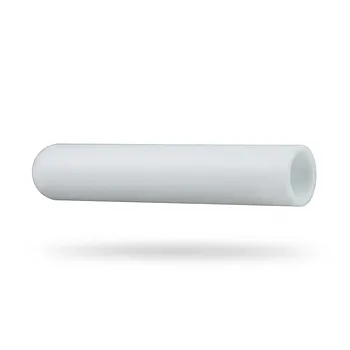
The PTFE filter, membrane, or tubular component is first thoroughly saturated with a wetting liquid. Isopropyl alcohol is commonly used because PTFE is naturally hydrophobic and resists wetting by water.
The liquid fills the interconnected pores and is held in place by surface tension and capillary forces. Complete wetting is essential; an incompletely wetted sample can produce an inaccurate bubble point.
Applying Gas Pressure
After wetting, the sample is positioned so that air or another test gas can be applied to one side. Pressure is then increased gradually under controlled conditions.
At lower pressures, the wetting liquid remains in the pores and prevents continuous gas flow through the media. The pressure is monitored while the downstream side is observed for emerging bubbles.
Identifying the Bubble Point
The bubble point is the pressure at which the first continuous stream of bubbles appears. This occurs when the applied gas pressure is sufficient to displace the wetting liquid from the largest wetted pore.
A few isolated bubbles may result from trapped air, residual liquid movement, or minor system effects. The relevant measurement is the onset of a steady, continuous bubble stream, not necessarily the first individual bubble observed.
Relating Pressure to Maximum Pore Size
The Capillary Principle
The wetting liquid forms a liquid barrier inside each pore. Smaller pores hold the liquid more strongly, while larger pores require less pressure to clear.
The relationship is described by the Young-Laplace equation, commonly expressed in simplified form as:
[ d_{\text{max}} \approx \frac{4\gamma \cos\theta}{\Delta P} ]
where:
- (d_{\text{max}}) is the maximum pore diameter,
- (\gamma) is the surface tension of the wetting liquid,
- (\theta) is the liquid’s contact angle with the PTFE,
- (\Delta P) is the measured bubble point pressure.
The exact calculation depends on the test liquid, membrane chemistry, contact angle, and test configuration.
Interpreting the Result
The relationship is inverse:
- Higher bubble point pressure: smaller maximum pore size.
- Lower bubble point pressure: larger maximum pore size.
This allows manufacturers and laboratories to verify whether a PTFE filter is consistent with its specified pore rating.
What the Test Measures
The bubble point primarily characterizes the largest effective wetted pore in the tested area. It does not mean that every pore in the membrane has exactly that diameter, nor does it provide a complete pore-size distribution by itself.
For a more complete characterization, bubble point testing may be combined with mean-flow-pore or other porometry measurements.
Why the Test Matters in Laboratory Filtration
Verifying Filter Performance
A filter’s maximum pore size affects its ability to retain particles, microorganisms, or liquid while allowing gas or liquid to pass. Bubble point testing provides a repeatable quality-control measurement for confirming that the media meets its intended specification.
Checking Media Integrity
Unexpectedly early bubble formation can indicate a large defect, damaged membrane, defective seal, or leakage in the test assembly. The test therefore evaluates more than nominal pore size; it can also reveal whether the component remains structurally sound.
Supporting Process Consistency
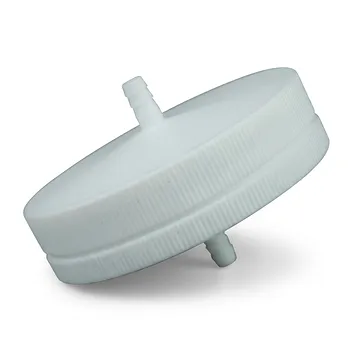
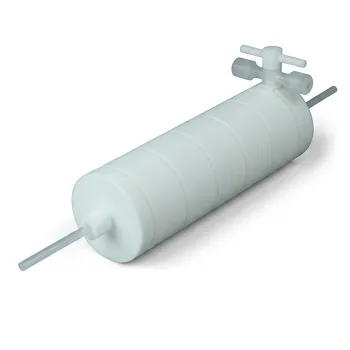
For PTFE vent filters, sample-preparation filters, and tubular filtration components, consistent bubble point values help confirm predictable barrier performance and permeability between production batches or laboratory tests.
Understanding the Trade-offs
Smaller Pores Increase Retention
Smaller-pore PTFE media generally provide greater particle and microbial retention. Their higher bubble point reflects the greater pressure required to displace the wetting liquid from the smaller pores.
The trade-off is typically lower flow capacity and higher pressure drop under comparable operating conditions.
Larger Pores Increase Throughput
Larger pores generally permit higher flow rates and lower resistance. However, they provide less fine-particle retention and produce a lower bubble point pressure.
The correct pore rating must therefore balance retention requirements against acceptable flow and differential pressure.
Test Conditions Affect the Result
Bubble point pressure is not a universal material constant. It depends on the wetting liquid’s surface tension, the liquid’s interaction with PTFE, temperature, pressure-increase rate, sample condition, and test apparatus.
Results should be compared only when the testing conditions and procedure are controlled consistently.
Hydrophobicity Requires Careful Wetting
Because untreated PTFE is hydrophobic, water may not wet the pores reliably without an appropriate treatment or surfactant. A low-surface-tension liquid such as isopropyl alcohol is commonly selected to ensure that the pores are filled before pressure is applied.
Making the Right Choice for Your Goal
Use the bubble point result as a controlled verification measurement, while interpreting it alongside the filter’s specified retention, flow, and operating requirements.
- If your primary focus is maximum pore-size verification: Fully wet the PTFE media, increase gas pressure incrementally, and calculate or correlate the maximum pore size from the pressure at the first continuous bubble stream.
- If your primary focus is filter integrity: Compare the measured bubble point with the accepted specification and investigate premature bubbling for membrane damage, poor wetting, defective seals, or system leaks.
- If your primary focus is filtration performance: Select a pore rating that provides the required retention while maintaining sufficient flow and an acceptable pressure drop.
A properly controlled bubble point test converts the pressure needed to clear the largest wetted pore into a practical measure of PTFE filter performance and integrity.
Summary Table:
| Aspect | Details |
|---|---|
| Test Name | Bubble Point Test |
| Standard | ASTM F316 |
| Wetting Liquid | Isopropyl alcohol (low surface tension) |
| Measurement | Pressure at first continuous bubble stream |
| Principle | Young-Laplace equation: d_max = 4γcosθ/ΔP |
| Interpretation | Higher pressure → smaller max pore size |
| Primary Use | Quality control, integrity verification |
| Limitations | Not a full pore size distribution; requires controlled conditions |
Need Reliable PTFE Filtration Components?
At KINTEK, we specialize in high-performance PTFE and PFA lab supplies, including filters, membranes, and custom-machined components. Our products are designed for precise filtration and durability, backed by end-to-end CNC machining capabilities.
Ensure your lab's accuracy with our validated PTFE media – contact us today to discuss your application and get a tailored solution!
Related Products
- High Temperature Resistant Insulating TFM Separator and Ultra Clean Laboratory PTFE Baffle Plate with Customizable Pore Size and Hole Configuration
- PTFE PFA Vacuum Filtration System Corrosion Resistant Customizable Shatterproof Laboratory Device
- Custom PTFE Vacuum Filter with Integrated Sieve Plate and Corrosion Resistant Particle Free Design for High Purity Water Quality Analysis
- Corrosion Resistant PTFE Buchner Funnel Vacuum Filtration Device for Solid Liquid Separation Shatterproof Customizable Laboratory Apparatus
- Custom Corrosion Resistant PTFE Vacuum Filtration System with Teflon Buchner Funnel for Research Laboratories
People Also Ask
- What are the limitations of pure PTFE in high temperature applications? Understanding the 200°C Ceiling
- Are Teflon parts capable of withstanding high temperatures? Understanding the 260°C Limit for Performance
- What future advancements are expected in temperature-resistant PTFE seals? Discover Smarter, Tougher Sealing Solutions
- What is porous PTFE used for? Advanced Filtration for Harsh Chemical & High-Temp Environments
- What are the benefits of porous PTFE? Unlock Superior Filtration and Chemical Resistance