Thermal stability determines whether a PTFE laboratory vessel remains a reliable barrier or becomes a source of failure and contamination. At elevated temperatures, especially around 350°C, inadequately stabilized PTFE can begin releasing trace fluorides and gaseous decomposition products. This fluoride evolution signals polymer breakdown, which can reduce mechanical strength, compromise pressure performance, and contaminate samples.
The key distinction is between PTFE’s chemical inertness and its thermal operating limit: PTFE resists aggressive chemicals exceptionally well, but excessive heat can still degrade the polymer. High-stability formulations reduce fluoride outgassing and preserve vessel integrity, but the vessel must remain within its validated temperature and pressure limits.
Why Thermal Stability Matters in PTFE Vessels
Chemical resistance does not eliminate thermal limits
PTFE’s strong carbon-fluorine bonds and symmetric molecular structure give it broad resistance to concentrated acids, strong bases, and organic solvents. That chemical inertness helps prevent leaching, swelling, and chemical attack during digestion and reaction workflows.
Heat introduces a different failure mechanism. Even when the reagent cannot chemically attack PTFE, excessive temperature can cause the polymer chains to break down.
Structural integrity depends on polymer stability
A high-temperature vessel must retain sufficient strength, dimensional stability, and sealing performance throughout the process. Thermal degradation can weaken the polymer matrix, distort vessel components, or reduce the reliability of closures and pressure seals.
This matters particularly in microwave digestion vessels and autoclaves, where temperature and internal pressure may rise together. A vessel that remains chemically inert but loses mechanical integrity is not fit for the application.
Formulation and polymerization quality are important
PTFE performance is influenced by how the polymer is produced, including the selection of polymerization initiators and control of molecular-weight growth. A more stable chain structure can reduce the formation of thermally vulnerable regions.
Lower-grade or poorly stabilized material may show more pronounced outgassing under the same thermal conditions. Material grade is therefore a performance variable, not merely a purchasing detail.
How Fluoride Evolution Affects Performance
It is a warning sign of thermal breakdown
Fluoride evolution indicates that the PTFE matrix is undergoing thermal decomposition. The released species may include fluorine-containing gases or other degradation products, depending on the material formulation and exposure conditions.
The practical interpretation is straightforward: detectable or increasing fluoride release suggests that the vessel is being pushed toward, or beyond, its useful thermal range.
It can contaminate analytical samples
In trace analysis, even small quantities of vessel-derived material can affect results. Fluoride-containing products or other decomposition products may enter the reaction environment, creating background contamination or altering the measured composition of a sample.
This is especially serious in microwave digestion and elemental analysis, where the vessel is expected to contribute essentially no detectable contamination.
It can precede mechanical failure
Fluoride evolution is not only a purity concern. It can accompany molecular-chain scission and progressive loss of mechanical properties.
As degradation continues, the vessel may become less resistant to pressure, thermal cycling, impact, or deformation. Repeated exposure can therefore shorten service life even when no immediate visible damage is present.
It can affect seals and pressure control
High-temperature laboratory vessels often rely on PTFE liners, caps, gaskets, or sealing interfaces. Thermal weakening or dimensional change in these components can reduce sealing reliability.
Loss of seal performance may cause pressure leakage, process interruption, or exposure of personnel to hot and corrosive reagents.
Operating Temperature Must Be Defined Precisely
Continuous use is different from short-term exposure
A material’s short-term temperature tolerance should not be treated as its continuous operating temperature. PTFE products may tolerate brief excursions or processing temperatures that would be unsuitable for sustained service under load.
For laboratory vessels, the relevant limit is the temperature maintained during the complete cycle, including pressure, chemical exposure, heating rate, cooling rate, and the number of repeated cycles.
Temperature and pressure should be evaluated together
The mechanical strength of PTFE generally declines as temperature rises, even before obvious chemical decomposition occurs. A vessel rated for a particular pressure at room temperature may have a substantially lower pressure capability at elevated temperature.
The correct specification must therefore state the allowable temperature-pressure combination, rather than temperature alone.
Extreme-temperature claims require validation
The supplied references identify PTFE as having very high thermal resistance and compare its equilibrium weight-loss behavior favorably with PFA between approximately 400°C and 425°C. That comparison describes thermal stability under a particular test condition; it should not be interpreted as a general recommendation for continuous, pressurized laboratory-vessel operation at those temperatures.
In practical laboratory equipment, the validated service rating, vessel geometry, applied pressure, and manufacturer’s test data are more important than a polymer’s decomposition or weight-loss temperature alone.
What High-Stability PTFE Provides
Lower outgassing
Optimized PTFE formulations significantly reduce fluoride evolution and other thermal off-gassing products. This helps preserve the chemical cleanliness of the vessel environment during demanding heating cycles.
Lower outgassing is particularly valuable when samples contain trace-level analytes or when blank values must be tightly controlled.
Better dimensional and mechanical retention
A thermally stable formulation is more likely to maintain its shape, strength, and sealing behavior during repeated high-temperature operation. This supports more consistent pressure control and reduces premature replacement.
The benefit is not unlimited heat resistance; it is a larger and more dependable margin within the validated operating range.
Longer service life
Repeated thermal cycling can expose weaknesses that are not apparent during a single use. High-stability PTFE better tolerates the combination of heat, aggressive reagents, pressure, and cooling cycles.
That reliability reduces the risk of unexpected vessel failure and helps maintain consistent laboratory throughput.
Understanding the Trade-offs
PTFE remains unsuitable beyond its validated service range
PTFE is highly resistant to chemical attack, but it is not immune to thermal degradation. Operating near or above the material’s practical limit can produce off-gassing, loss of strength, deformation, and sample contamination.
A high-stability grade improves performance; it does not make an unvalidated temperature-pressure combination safe.
High temperature can reduce mechanical margin before decomposition is obvious
Visible melting or severe discoloration is not required for performance to deteriorate. Mechanical properties and sealing behavior may decline as temperature increases, even while the vessel still appears intact.
Inspection based only on appearance can therefore miss early thermal damage.
PTFE and PFA serve different design priorities
PTFE generally offers the strongest extreme-temperature stability among the two materials, while PFA provides melt-processability, high purity, and optical transparency. PFA can be attractive where visibility or complex molded geometry matters, but material selection should reflect the actual continuous temperature and pressure requirements.
Neither material should be selected solely from a maximum short-term exposure figure.
Repeated cycles and contamination control add complexity
A vessel may perform acceptably in a single test but generate unacceptable blanks after repeated thermal exposure. Qualification should consider the full process cycle and should include appropriate blank or extractable testing when analytical purity is critical.
Making the Right Choice for Your Goal
Select the vessel based on the combined thermal, mechanical, chemical, and analytical demands of the procedure.
- If your primary focus is sample purity: Choose a high-stability PTFE formulation with demonstrated low fluoride outgassing and verify performance through blank or contamination testing.
- If your primary focus is high-temperature digestion: Confirm the manufacturer’s continuous temperature and pressure rating for the complete digestion cycle, rather than relying on a polymer melting or decomposition temperature.
- If your primary focus is long service life: Select PTFE qualified for repeated thermal cycling and inspect vessels, liners, and seals for dimensional change or loss of mechanical performance.
- If your primary focus is process visibility or complex molded geometry: Evaluate PFA, but confirm that its continuous thermal and pressure performance meets the application rather than using its short-term processing tolerance as the design limit.
Reliable high-temperature PTFE performance comes from matching a stable formulation and validated operating envelope to the real thermal, pressure, chemical, and contamination requirements of the laboratory process.
Summary Table:
| Factor | Impact on Performance | Mitigation/Consideration |
|---|---|---|
| Thermal Stability | Determines structural integrity and resistance to degradation | Use high-stability PTFE formulations |
| Fluoride Evolution | Indicates breakdown; contaminates samples; precedes failure | Monitor outgassing; choose low-outgassing grades |
| Continuous vs. Short-Term Exposure | Short-term tolerance ≠ safe for continuous use | Define continuous operating temperature and pressure |
| Temperature-Pressure Coupling | Mechanical strength drops with temperature, reducing pressure capacity | Evaluate combined rating, not temperature alone |
| Material Grade (PTFE vs. PFA) | PTFE offers higher thermal stability; PFA provides clarity and moldability | Select based on actual continuous requirements |
| Repeated Cycling | Repeated heat/cool cycles degrade performance | Qualify vessels for repeated use; inspect for damage |
Upgrade to high-performance KINTEK PTFE/PFA vessels with superior thermal stability and minimal fluoride evolution, ensuring purity and reliability for your demanding high-temperature processes. Our full range of labware and custom CNC-machined parts are engineered to meet your exact specifications. Contact us today for a consultation and discover how we can enhance your lab's efficiency and accuracy. Get in touch with our experts now!
Related Products
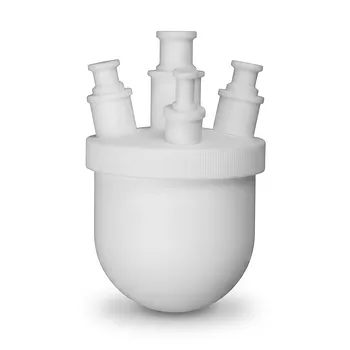
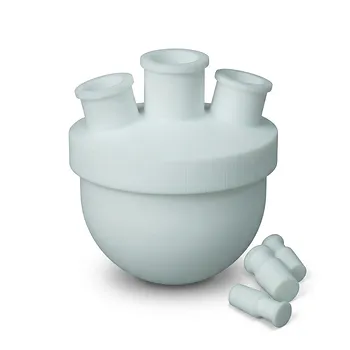
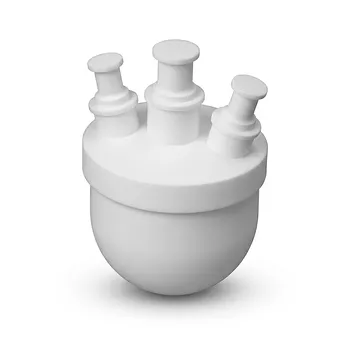
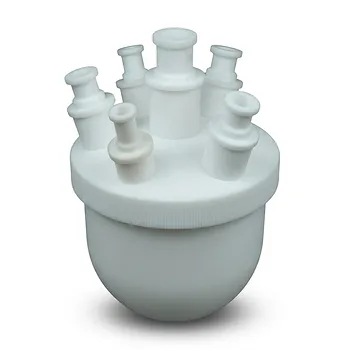
- High Temperature Corrosion Resistant PTFE Reaction Flask Custom Multi Neck Laboratory Vessel with Flat or U Bottom
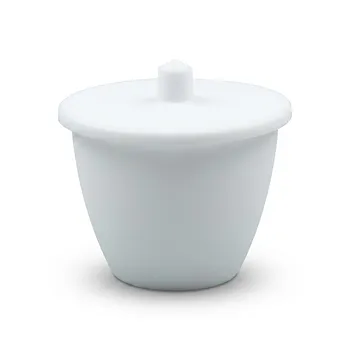
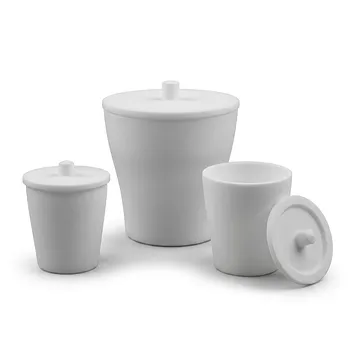
- High Temperature Corrosion Resistant Customizable PTFE Laboratory Digestion Crucible with Lid Small Volume Hot Plate Compatible Vessel
- High Temperature PTFE Reaction Flask 1000ml Single Neck Round and Flat Bottom Laboratory Bottle
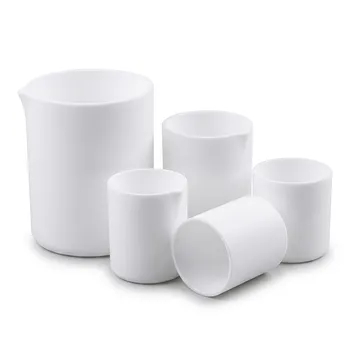
- Custom Thickened PTFE Beaker High Temperature Hot Plate Heating Resistant Precision Laboratory Labware Customizable Fluoropolymer Vessel
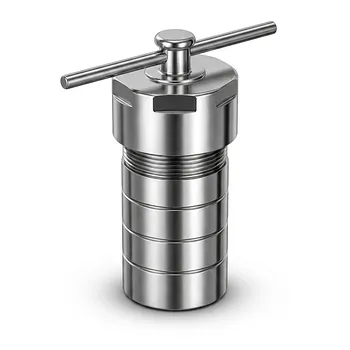
- Laboratory Hydrothermal Synthesis Autoclave Reactor PTFE PPL Lined High Temperature High Pressure Explosion Proof Reaction Vessel
People Also Ask
- What are the key steps for structural integrity in molded PTFE lab reaction vessels? Master fine powder processing.
- How do perfluorinated solvent environments influence the selection of reaction vessels and fluid handling components in nonaqueous emulsion polymerizations? Choose fluoropolymer materials.
- Why are high-purity PTFE or PFA reaction vessels recommended for the synthesis of PANI-TiC hybrid materials? - Guide
- Why are fluoroplastic (PTFE) reaction vessels recommended for Methylene Blue (MB) adsorption kinetic experiments?
- Why is a PTFE reaction vessel required for Ti3C2Tx MXene synthesis? Ensure Safe HF Etching & High Purity