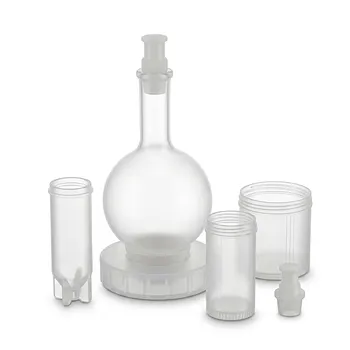
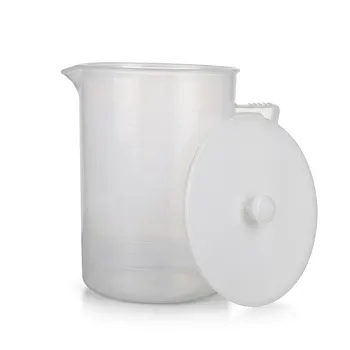
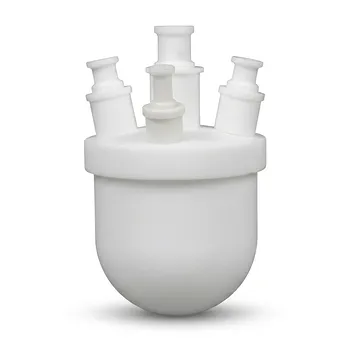
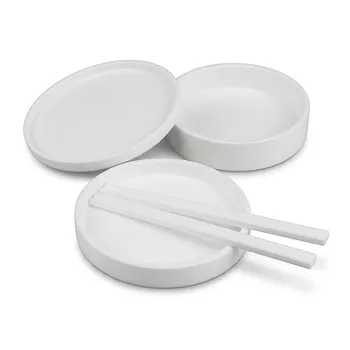
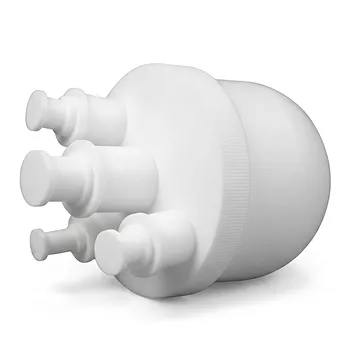
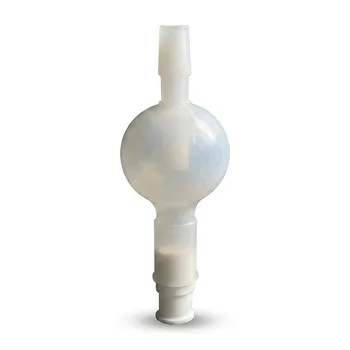
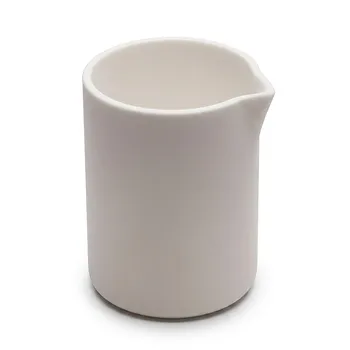
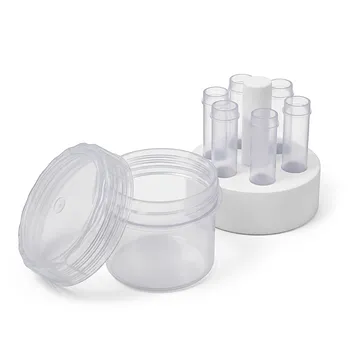
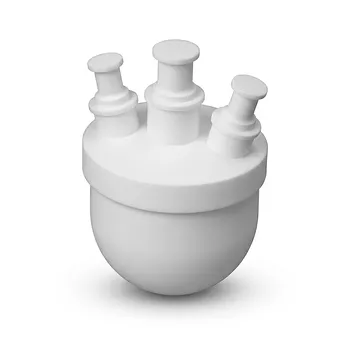
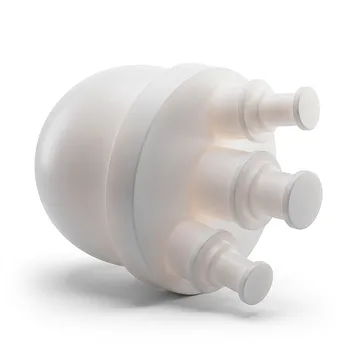
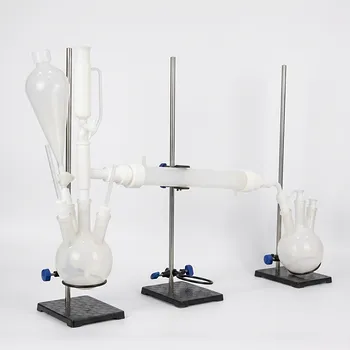
Thermal cross-linking transforms multifunctional TFVE monomers into highly resistant fluoropolymer networks. Moving from bifunctional to tri- or tetrafunctional trifluorovinyl ether (TFVE) monomers changes perfluorocyclobutane (PFCB) polymers from soluble linear thermoplastics into dense, insoluble networks. This network structure prevents dissolution in solvents such as THF, DMF, and chloroform, while producing exceptional thermal stability, including 5% weight-loss decomposition temperatures above 500 °C and glass transition temperatures above 200 °C. High-purity PTFE and PFA labware is essential because processing involves aggressive solvents and elevated temperatures that could damage ordinary vessels or contaminate the polymer.
Cross-linking improves chemical resistance by restricting polymer-chain movement and eliminating solvent-accessible dissolution pathways. The resulting materials tolerate severe thermal and chemical conditions, but their processing requires equally inert, high-purity labware to preserve sample integrity.
How Multifunctional TFVE Monomers Change the Polymer Structure
Bifunctional monomers produce linear polymers
Bifunctional TFVE monomers generally form linear PFCB chains through cyclopolymerization. These linear thermoplastics can retain enough chain mobility and intermolecular spacing to dissolve in solvents such as THF, DMF, and chloroform.
Their solubility can be useful for solution processing, coating, characterization, and reshaping. However, it also limits their resistance to solvent exposure and high-temperature mechanical stress.
Tri- and tetrafunctional monomers create network connectivity
Tri- or tetrafunctional monomers introduce more than two potential connections per molecular unit. As polymerization proceeds, these additional reactive sites connect separate chains and generate a three-dimensional network.
The result is a thermally cross-linked PFCB structure rather than an isolated linear molecule. Once sufficiently cross-linked, the material behaves as an insoluble network that cannot flow or dissolve like a conventional thermoplastic.
Heating drives additional cross-linking
Thermally controlled processing can initially produce linear perfluorocyclobutyl structures at approximately 210 °C. Further heating above roughly 325 °C promotes cross-linking through internal fluoroolefin groups.
This staged behavior matters during processing because the polymer may first develop a processable structure and then acquire its final network density during a later thermal treatment.
Why Cross-Linking Improves Chemical Resistance
Solvents cannot separate the network into individual chains
A linear polymer dissolves when solvent molecules separate and surround its chains. In a cross-linked network, the chains are chemically connected, so solvent penetration cannot convert the entire structure into a molecular solution.
The material may swell under some conditions, but it remains an insoluble network. This explains its resistance to common organic solvents, including THF, DMF, and chloroform.
Cross-Linking improves dimensional stability
Chemical resistance is not only a question of whether the polymer dissolves. The material must also retain its shape, strength, and sealing or containment function during exposure.
The network restricts chain movement, reducing flow, deformation, and loss of structural integrity under chemical or thermal stress. This is valuable for containment systems, custom reaction components, electrochemical cell bodies, and other parts exposed to harsh environments.
Fluorine reinforces the chemical barrier
The high strength of carbon-fluorine bonds contributes to the inherent chemical inertness of fluoropolymers. Fluorinated groups, including pendant -CF3 groups, can further increase resistance to aggressive organic solvents and corrosive reagents.
Cross-linking and fluorine-rich chemistry therefore work together: fluorination limits chemical attack, while network formation limits dissolution and deformation.
How Cross-Linking Improves Thermal Stability
The network resists chain motion
Thermal failure often begins when polymer chains gain enough mobility to soften, rearrange, or undergo chemical degradation. Cross-linking restricts that movement and raises the temperature required for significant structural change.
For tri- and tetrafunctional PFCB systems, reported glass transition temperatures exceed 200 °C, while the 5% weight-loss decomposition temperature exceeds 500 °C. These values indicate a material capable of retaining performance well beyond the operating range of many conventional polymers.
Decomposition occurs at higher temperatures
Fluorinated functional groups and cross-linkable architectures can produce degradation-onset temperatures in air of approximately 480 to 530 °C, depending on composition and measurement basis. The exact value depends on polymer structure, atmosphere, heating rate, and the definition used for degradation onset.
Some heavily cross-linked telechelic systems show no observable glass transition below 350 °C. This result should be treated as system-specific rather than applied universally to every multifunctional PFCB formulation.
Thermal treatment can improve, not merely test, performance
In these materials, elevated temperature may complete the network-forming reaction rather than simply expose a finished polymer to heat. Processing conditions therefore determine the final cross-link density and, consequently, the balance between thermal stability, chemical resistance, and processability.
A controlled thermal schedule is essential. Excessive or poorly controlled heating can cause premature gelation, uneven network formation, or degradation before the desired structure is achieved.
Why High-Purity Fluoropolymer Labware Is Essential
Ordinary labware can fail under combined chemical and thermal stress
Processing may involve aggressive solvent washing, post-treatment, filtration, digestion, or heating at temperatures that challenge glass, metals, plastics, or elastomers. A vessel that tolerates one condition in isolation may fail when exposed to both corrosive chemistry and elevated temperature.
PTFE and PFA labware provide the necessary combination of chemical inertness, heat resistance, and structural durability for these operations.
Labware must not become a contamination source
High-performance polymer samples may be evaluated for trace impurities, molecular structure, thermal decomposition, or electrical properties. Leaching from containers, extractables from seals, or residues left by previous experiments can compromise those measurements.
High-purity PTFE and PFA minimize contamination risk during washing, filtration, storage, and thermal treatment. This is particularly important for trace analysis and applications where even small amounts of foreign material can alter results.
The equipment must tolerate the same solvents as the sample
Because the cross-linked polymer resists solvents so strongly, aggressive solvent systems may be needed for cleaning, extraction, surface preparation, or post-processing. The labware must remain stable while those solvents contact it for extended periods.
PTFE and PFA components are well suited to digestion vessels, filtration apparatus, crucibles, reaction tubes, fluid-transfer parts, and custom containers used in these environments.
Purity begins with material selection and manufacturing
Purity is not limited to the chemical identity of the polymer. Manufacturing history, additives, machining residues, surface treatment, and storage conditions can all affect contamination risk.
High-purity labware with controlled fabrication is therefore preferable for sensitive work. Custom CNC-machined fluoropolymer parts should be selected and cleaned with the intended chemical and thermal conditions in mind.
Understanding the Trade-offs
Insolubility limits solution processing
Once a dense cross-linked network forms, the polymer generally cannot be redissolved in common organic solvents. This improves chemical resistance but removes solution-based processing options available to linear thermoplastics.
The desired cross-linking level should therefore be achieved after any required shaping, coating, or impregnation step.
High thermal stability does not mean unlimited temperature capability
A decomposition temperature above 500 °C does not mean that the polymer can be used indefinitely at that temperature. Mechanical strength, dimensional stability, atmosphere, heating duration, and thermal gradients also affect service performance.
Labware and polymer components should be evaluated against the complete processing profile rather than a single headline temperature.
Cross-link density affects performance
More cross-linking generally increases insolubility and dimensional stability, but it can also reduce melt processability and make the material more difficult to machine or modify. An excessively dense network may also limit the ability to repair, reshape, or recycle the component.
The correct formulation is therefore application-dependent. Chemical exposure, temperature, geometry, mechanical load, and manufacturing route must be considered together.
Compatibility still requires verification
Fluoropolymers are broadly resistant to corrosive chemicals and organic solvents, but resistance depends on temperature, concentration, exposure time, mechanical stress, and the specific grade or formulation.
Compatibility testing remains necessary for unusual reagents, pressurized systems, microwave digestion, and long-duration exposure.
How to Apply This to Your Project
Select the processing and containment strategy according to the primary performance requirement:
- If your primary focus is chemical resistance: Use tri- or tetrafunctional TFVE-derived networks when insolubility and resistance to aggressive solvents are more important than solution processability.
- If your primary focus is thermal stability: Use a controlled cross-linking schedule and verify decomposition and glass-transition behavior for the specific formulation and atmosphere.
- If your primary focus is sample purity: Use high-purity PTFE or PFA vessels, filters, tubes, and custom parts with controlled manufacturing and cleaning histories.
- If your primary focus is processability: Complete shaping, coating, or solution-based operations before the network reaches its final cross-link density.
- If your primary focus is reliable long-term service: Match the fluoropolymer grade and labware design to the combined effects of temperature, chemicals, pressure, duration, and mechanical load.
Understanding the relationship between monomer functionality, network formation, and labware purity enables fluoropolymer processing that is both chemically reliable and analytically trustworthy.
Summary Table:
| Aspect | Linear PFCB (Bifunctional) | Cross-linked PFCB (Tri-/Tetrafunctional) |
|---|---|---|
| Structure | Soluble linear chains | Insoluble 3D network |
| Solubility | Soluble in THF, DMF, CHCl3 | Insoluble in common solvents |
| Chemical Resistance | Lower | High, resistant to aggressive solvents |
| Thermal Stability | Moderate | Tg >200°C; 5% wt loss >500°C |
| Processability | Solution-processable | Limited; shape before final cross-linking |
| Labware Requirement | Standard labware | High-purity PTFE/PFA to prevent contamination and withstand harsh conditions |
Ensure your fluoropolymer processing meets the highest standards of purity and performance. At KINTEK, we specialize in high-purity PTFE and PFA labware and custom CNC-machined components, designed to withstand aggressive chemicals and high temperatures while preventing contamination. Whether you need standard beakers, digestion vessels, or bespoke reaction apparatus, our solutions support your advanced polymer research. Contact us today to discuss your requirements and elevate your lab's capabilities. Get in touch with our experts for reliable, high-performance fluoropolymer labware tailored to your needs.
Related Products
- Custom PFA Pear Shaped Flask High Purity Corrosion Resistant Labware Custom Molded Fluoropolymer Flask Glass Replacement Solution
- High Purity PFA Beaker with Handle and Large Capacity Washable Soak Basket Multi Spec Teflon Laboratory Labware
- Custom PTFE Flask 250ml High Purity Fluoropolymer Laboratory Vessel for Chemical Research
- Custom PTFE Petri Dish 200mm High Purity Corrosion Resistant Low Background Laboratory Ware
- High Purity PTFE Single Neck Reaction Flask Acid Resistant Customizable Fluoropolymer Laboratory Reactor
People Also Ask
- Why Use PFA Labware for MnFe2O4/rGO Precursors? Ensure Stoichiometric Precision and Purity
- Why is PFA labware recommended for CuBi2O4? Protect high-purity precursors and ensure semiconductor bandgap accuracy.
- What are the primary properties of PFA for high-performance labware? Achieve ultra-trace purity & thermal stability.
- How does PFA labware enhance the accuracy of ultra-trace element analysis? Achieving PPT Precision with Zero Leaching
- What role does PFA labware play in semiconductor manufacturing? Ensuring Ultra-Pure Yields and Zero Contamination