Bulky trifluoromethyl (-CF3) groups generally improve the processability of high-performance specialty fluoropolymers by disrupting close chain packing. Their steric bulk increases free volume, weakens interchain interactions, and suppresses crystallization, often producing amorphous polymers that dissolve in solvents such as NMP, DMAc, THF, and chloroform. This enables low-temperature solvent casting into flexible, uniform films while preserving high thermal, chemical, and electrical performance.
Core takeaway: -CF3 groups trade efficient molecular packing for greater free volume and chain disorder. The result is usually higher organic solubility, lower crystallinity, and easier formation of uniform films, although highly symmetrical structures can retain or develop partial crystallinity.
Why -CF3 Groups Change Polymer Packing
Steric bulk increases chain separation
The -CF3 group occupies substantially more space than a hydrogen or methyl substituent. When incorporated into the backbone or attached as a pendant group, it creates steric barriers that prevent neighboring chains from approaching and aligning closely.
This inefficient packing increases the polymer’s fractional free volume and reduces the strength of interchain interactions. The same structural effect can also reduce charge-transfer complex formation in aromatic fluoropolymers, supporting lower dielectric constants and improved optical transparency.
Fluorination weakens cohesive interactions
Highly fluorinated structures generally have low polarizability and do not participate in strong hydrogen-bonding networks in the same way as many non-fluorinated aromatic polymers. Adding bulky -CF3 groups therefore reduces the cohesive forces that otherwise stabilize tightly packed chains.
The polymer remains chemically robust, but its chains become less thermodynamically inclined to organize into a dense, ordered structure.
Backbone and side-group placement both matter
A -CF3 group in the main chain can interrupt backbone regularity directly, while a pendant -CF3 group creates steric congestion around the chain. Both arrangements can increase free volume, but their effects on rigidity, segmental motion, and packing depend on the surrounding monomer structure.
Rigid three-dimensional units, such as fluorene or triptycene structures, can reinforce this effect by preventing efficient planar stacking and increasing the polymer’s architectural complexity.
How -CF3 Groups Affect Solubility
Crystallization is suppressed
Crystalline regions are difficult for solvents to penetrate because they contain densely packed, ordered chains. By suppressing crystallization, bulky -CF3 groups increase the fraction of disordered amorphous material that solvent molecules can access.
This is a major reason fluoropolymers containing these groups can show substantially better solubility than otherwise similar rigid aromatic polymers.
Solvent access improves
The increased free volume gives solvent molecules more opportunities to diffuse into the polymer matrix and separate individual chains. Reduced interchain attraction then lowers the energy required for those chains to remain solvated.
Depending on the exact structure and molecular weight, these materials can dissolve in polar aprotic solvents such as NMP and DMAc, as well as less polar solvents such as THF and chloroform.
High performance is retained
Improved solubility does not necessarily require sacrificing thermal resistance. Fluorinated backbones and rigid aromatic units can maintain high glass-transition temperatures and decomposition temperatures while the -CF3 groups provide the disorder needed for organo-solubility.
Reported specialty structures combine high glass-transition temperatures, in some cases approaching 290 °C, with decomposition temperatures that can exceed 400 °C to 570 °C depending on the polymer design and measurement conditions.
How -CF3 Groups Affect Crystallinity
Most structures become predominantly amorphous
The usual outcome is a reduction in crystallinity because bulky substituents interfere with the repeated alignment required for nucleation and crystal growth. Disordered chains cannot easily form the regular unit-cell arrangements characteristic of a well-developed crystalline phase.
An amorphous morphology is especially valuable when the target is a clear, dimensionally stable coating or film rather than a highly crystalline molded article.
Lower crystallinity supports optical clarity
Reduced crystallinity minimizes light scattering from ordered and disordered domains with different refractive indices. Suppressed charge-transfer complex formation can further reduce coloration in aromatic fluoropolymers.
The resulting materials may therefore offer improved transparency alongside low dielectric behavior and chemical resistance.
Symmetry can produce an exception
The presence of -CF3 groups alone does not guarantee complete amorphization. If multiple groups are arranged with high regularity and the rest of the repeat unit is sufficiently symmetrical, the polymer may still pack into ordered domains or develop partial crystallinity.
This is an important design limitation: steric bulk disrupts packing, but molecular symmetry can restore packing efficiency.
Mixed linkages provide structural control
Copolymerization using mixed meta- and para-linkages is one way to reduce excessive symmetry and preserve solubility. The less regular architecture maintains chain disorder while allowing the designer to adjust rigidity, thermal performance, and mechanical behavior.
How -CF3 Groups Improve Film Formation
Low-temperature solvent casting becomes practical
When a fluoropolymer dissolves in a conventional organic solvent, it can be processed from solution rather than requiring extreme melt-processing temperatures. A solution can be deposited, spread, or cast and then dried to form a continuous film.
This is particularly useful for rigid, high-temperature polymers that are difficult to melt-process because their glass-transition or softening temperatures are very high.
Amorphous chains form uniform films
Amorphous polymers generally produce more homogeneous films because they do not separate into large crystalline and amorphous regions during drying. Reduced crystallization also lowers the risk of crystalline aggregates, haze, and microscale thickness variation.
With suitable solvent selection and drying control, the result can be a flexible, uniform fluoropolymer film with strong chemical and thermal resistance.
Free volume supports flexible processing
The less efficiently packed chains can rearrange during solvent removal more readily than densely crystalline chains. This helps the film consolidate without requiring the polymer to reach a high melt temperature.
The final film can remain dimensionally stable when rigid aromatic or fluorinated segments maintain a high glass-transition temperature.
Moisture resistance can improve film reliability
High fluorination and hydrophobic -CF3 surfaces typically reduce water uptake. Lower moisture absorption helps films retain more stable dielectric properties and minimizes dimensional or electrical changes in humid environments.
This is valuable in dielectric coatings, trace-analysis equipment, high-purity labware, and components exposed to aggressive fluids.
Understanding the Trade-offs
Excessive free volume can reduce mechanical cohesion
The same structural disorder that improves solubility can reduce intermolecular cohesion. If the polymer contains too much bulky substitution or an excessively open architecture, it may show lower modulus, reduced resistance to creep, or poorer resistance to plasticization.
The goal is therefore not maximum free volume, but a controlled balance between processability and mechanical integrity.
Film quality depends on solvent removal
Good solubility does not automatically produce a good film. Solvent volatility, solution viscosity, drying rate, substrate interaction, and residual solvent content all influence defects such as pinholes, cracking, warping, and thickness nonuniformity.
A slowly drying solvent may improve leveling but increase residual solvent, while a rapidly evaporating solvent may cause skin formation or internal stress.
Partial crystallinity can complicate reproducibility
Small changes in substitution pattern, molecular weight, copolymer composition, or thermal history can alter the degree of ordering. Partial crystallinity may affect transparency, solvent uptake, shrinkage, and film flexibility.
Polymer characterization should therefore include crystallinity or phase-structure analysis rather than assuming that all -CF3-containing materials are fully amorphous.
High thermal stability does not remove processing constraints
A polymer may resist decomposition above 400 °C while remaining difficult to melt-process because its glass-transition temperature is also high and its melt viscosity is substantial. Solvent processability addresses this limitation, but it introduces solvent-handling, drying, and environmental considerations.
Gas permeability may increase
Increased free volume can improve gas diffusion and raise permeability, sometimes substantially. That may benefit gas separation or fluid-transfer applications, but it can be undesirable when the film must act as a tight barrier.
Material selection should account for whether free volume is being used to improve processability or whether it could compromise barrier performance.
Making the Right Choice for Your Goal
The most suitable -CF3-containing architecture depends on the required balance of solubility, film quality, thermal endurance, and mechanical performance.
- If your primary focus is solution processing: Select a structure with bulky -CF3 groups and deliberately disrupted symmetry to maximize amorphous content and solvent accessibility.
- If your primary focus is uniform, transparent films: Favor predominantly amorphous architectures with controlled molecular weight and limited crystallization during solvent removal.
- If your primary focus is high-temperature service: Combine -CF3 groups with rigid aromatic or three-dimensional units so improved processability does not eliminate a high glass-transition temperature.
- If your primary focus is low dielectric behavior and moisture resistance: Use highly fluorinated, free-volume-rich structures that limit charge-transfer interactions and water absorption.
- If your primary focus is gas transport: Exploit the increased free volume, while verifying that the resulting permeability and selectivity match the intended application.
- If your primary focus is mechanical durability: Avoid excessive steric disruption and evaluate modulus, creep, solvent retention, and film toughness alongside solubility.
The most effective specialty fluoropolymer designs use -CF3 groups to create controlled disorder, achieving processable amorphous films without giving up the thermal and chemical resistance that defines high-performance fluoropolymers.
Summary Table:
| Property | Effect of -CF3 Groups |
|---|---|
| Solubility | Improved; dissolves in organic solvents like NMP, DMAc, THF, chloroform |
| Crystallinity | Reduced; predominantly amorphous, but symmetry can retain partial crystallinity |
| Film formation | Enhanced; uniform, flexible films cast at low temperature |
| Thermal stability | Retained; high glass-transition and decomposition temperatures |
| Optical clarity | Improved; low crystallinity and reduced charge-transfer complexes |
| Moisture resistance | Improved; hydrophobic -CF3 reduces water uptake |
| Mechanical cohesion | May be reduced if free volume is excessive |
| Gas permeability | Increased due to higher free volume (may be good or bad) |
Optimize your fluoropolymer formulations with tailored PTFE/PFA solutions from KINTEK. Whether you need high-purity labware, custom machined parts, or advanced reaction vessels, our expertise in -CF3 chemistry ensures superior processability and performance. Contact our specialists to discuss your project and get a custom quote.
Related Products
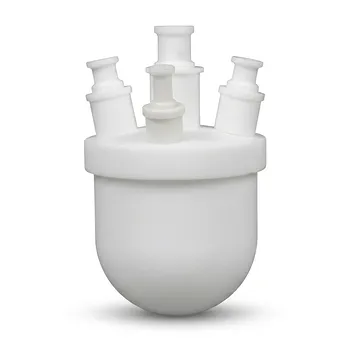
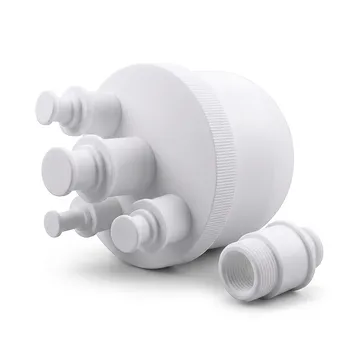
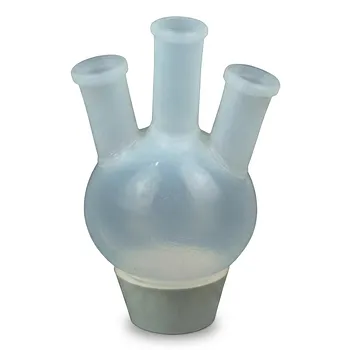
- Custom PTFE Flask 250ml High Purity Fluoropolymer Laboratory Vessel for Chemical Research
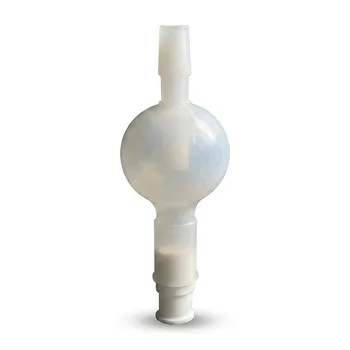
- High Purity PFA Chromatography Column with Collection Bottle Corrosion Resistant Fluoropolymer Filtration System for Trace Analysis
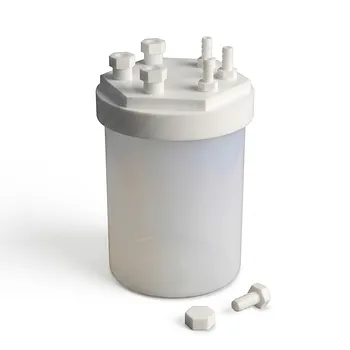
- Custom PTFE Reaction Tank Corrosion Resistant Fluoropolymer Chemical Processing Barrel 10L 20L 30L
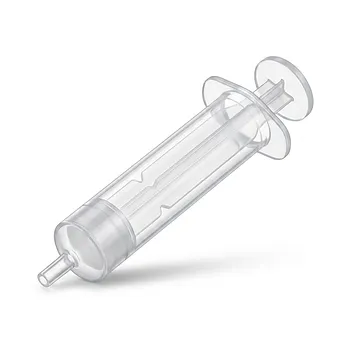
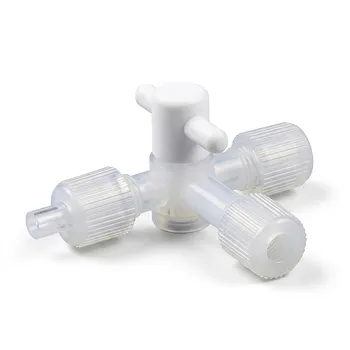
- Corrosion Resistant PFA Syringe Translucent Visual Fluoropolymer Labware 10ml Chemical Handling Tool
- Custom PFA Tubing 1/4 Inch High Purity Corrosion Resistant Fluoropolymer Tube with Welding and Machining Services
People Also Ask
- What are the key steps for structural integrity in molded PTFE lab reaction vessels? Master fine powder processing.
- Why Are High-Purity Fluoropolymer Vessels and Tubing Critical for Trace Analysis? Prevent Contamination Reliably
- Why do PTFE fluoropolymer laboratory vessels and containers exhibit superior chemical resistance against harsh solvents and corrosive acids compared to standard plastic labware? Discover the molecular secrets
- How do choice of solvent and chain transfer activity affect molecular weight during vinylidene fluoride (VDF) radical polymerization? Learn Key Factors for High-MW PVDF
- Why are fluoropolymer reaction vessels essential for SnO2/rGO synthesis? The Key to High-Performance Composites