Structural fluorination improves both thermal endurance and gas-transport control in high-performance fluoropolymers. Strong C–F bonds and fluorine-rich shielding protect the polymer from thermal, oxidative, and chemical degradation, while fluorinated side groups and linkages modify free volume, chain packing, and surface energy. These changes can increase gas permeability in some amorphous fluoropolymers, whereas highly crystalline materials such as PTFE and PFA often provide more controlled transport and strong resistance to chemical sorption.
The key principle is that fluorination does not produce one universal gas-transport behavior. Its effect depends on fluorine placement, backbone structure, crystallinity, free volume, and operating temperature; the same chemistry that improves thermal and chemical resistance can also alter permeability and selectivity.
How Fluorination Improves Thermal Stability
Strong C–F bonds protect the polymer backbone
The high bond strength of carbon–fluorine linkages makes fluorinated chains more resistant to bond scission during heating. Fluorine also creates an electron-rich protective sheath that limits attack by oxygen, acids, bases, and aggressive solvents.
This is particularly important in laboratory operations involving acid digestion, alkaline processing, microwave heating, and repeated thermal cycling.
Fully fluorinated structures provide the highest endurance
Perfluoropolymers contain no hydrogen in the polymer backbone. As a result, they avoid many degradation pathways associated with hydrogen-containing fluoropolymers, including dehydrofluorination at elevated temperatures.
Materials such as PTFE and PFA can maintain useful flexibility and dimensional stability at continuous service temperatures above approximately 300–315°C, depending on grade, load, geometry, and exposure conditions.
Fluorinated side groups can raise glass-transition temperature
Trifluoromethyl and bulky perfluoroalkyl groups restrict local chain motion and can increase the glass-transition temperature of specially designed fluorinated polymers. Reported values for advanced fluorinated structures commonly range from approximately 187°C to 316°C, with some formulations exceeding 170°C.
A high glass-transition temperature helps a component retain stiffness and dimensional accuracy during short-duration thermal excursions. It should not, however, be treated as the same property as the maximum continuous-use temperature.
Decomposition resistance extends beyond normal service temperature
Advanced fluorinated polymers can exhibit 5% weight-loss decomposition temperatures above 500°C in air, with some formulations reaching approximately 574°C. Higher fluorine content can also improve high-temperature residue or char yield relative to non-fluorinated analogues.
These values describe thermal-analysis behavior rather than a safe operating temperature. Mechanical load, oxygen exposure, heating rate, part thickness, and chemical contact still determine practical service life.
How Structural Fluorination Changes Gas Transport
Fluorine modifies fractional free volume
Gas molecules move through polymers by dissolving into the material and diffusing through transient spaces between polymer segments. Fluorination changes these spaces by altering chain rigidity, molecular shape, packing efficiency, and intermolecular interactions.
Bulky groups such as –CF₃ and perfluoroalkyl substituents can disrupt close packing and increase fractional free volume. In sufficiently amorphous materials, this may increase permeability to gases.
Permeability and selectivity can change together
Gas permeability is not determined by free volume alone. It depends on both diffusivity and gas solubility, while gas selectivity depends on how differently the polymer transports competing gases.
Fluorine can lower surface energy and polarizability while changing the polymer’s affinity for different gas species. Consequently, a fluorinated polymer may become more permeable overall without losing all discrimination between gases.
Hydrophobicity affects gas–polymer interactions
Fluorinated surfaces generally have low surface energy and strong hydrophobic character. This reduces wetting and limits uptake of water and many contaminants from laboratory environments.
That property can stabilize gas transport by reducing moisture-induced swelling or competitive sorption. It also helps minimize chemical sorption and contamination in high-purity laboratory systems.
Crystallinity can limit the apparent permeability increase
Crystalline regions are comparatively impermeable to most gases. They act as barriers within the polymer, forcing molecules to travel through amorphous regions and around ordered domains.
Therefore, the permeability effect of fluorination can be much stronger in an amorphous fluoropolymer than in a highly crystalline material. PTFE and PFA may have fluorine-rich chemistry and high chemical resistance while still providing relatively controlled bulk gas transport because of their morphology and crystallinity.
Why PTFE and PFA Behave Differently From Specialty Fluorinated Polymers
PTFE emphasizes inertness and dimensional reliability
PTFE’s fully fluorinated backbone gives it exceptional resistance to aggressive chemicals, oxidation, and high-temperature exposure. Its low surface energy also supports minimal wetting and low chemical sorption.
In laboratory vessels, liners, seals, and machined components, these characteristics are often more important than maximizing gas permeability. The result is reliable performance under harsh chemical and thermal conditions.
PFA combines fluorinated stability with processability
PFA provides the chemical inertness associated with perfluorinated materials while offering melt-processable manufacturing advantages compared with PTFE. It is used for reaction vessels, tubing, containers, and other components requiring high purity and complex shapes.
Its gas transport remains dependent on grade, crystallinity, wall thickness, temperature, and processing history. A PFA component should therefore be evaluated as a specific part and formulation, not solely by its chemical name.
Specialty amorphous fluoropolymers can favor permeability
Polymers containing bulky fluorinated linkages or trifluoromethyl groups may have greater free volume and lower dielectric constants than conventional formulations. These structures are useful where low moisture uptake, thermal endurance, electrical insulation, and controlled gas transport are needed together.
Their behavior may be better suited to membranes, sensing interfaces, insulating components, or specialized analytical assemblies than to applications requiring the lowest possible gas transmission.
What This Means in Laboratory Applications
High-temperature digestion and reaction vessels
For microwave digestion, concentrated alkaline treatment, and corrosive reagent handling, fully fluorinated materials provide the strongest combination of thermal stability, chemical inertness, and low sorption.
PTFE and PFA maintain structural integrity and help prevent extractables from contaminating high-purity samples. Their fluorinated surfaces also resist adhesion and wetting by many laboratory chemicals.
Gas-handling lines and seals
In tubing, valves, diaphragms, and seals, gas transport affects permeation losses, cross-contamination, and pressure stability. Fluorination helps maintain chemical resistance and dimensional stability, but the actual permeation rate must be checked for the specific gas and temperature.
Wall thickness and seal geometry can be as important as polymer chemistry. A thin fluoropolymer film may permit measurable gas transmission even when a thick vessel wall appears effectively impermeable.
Analytical and membrane-related components
Where gas permeability is desirable, fluorinated structures with increased free volume can provide useful transport while retaining hydrophobicity and thermal stability. This can support gas-separation, sensor, sampling, or controlled-diffusion designs.
The material must be selected according to the target gas pair, pressure range, humidity, and required selectivity rather than permeability alone.
Electrically demanding laboratory components
Some fluorinated polymers combine high thermal stability with low dielectric constants, reported in certain formulations at approximately 2.05–2.47 at 1 MHz, compared with roughly 2.9–3.2 for conventional materials.
This reduces capacitive loss and signal attenuation in high-frequency insulating components. The same low-polarizability structure can also support stable operation in hot, chemically aggressive laboratory environments.
Understanding the Trade-offs
Greater permeability can reduce barrier performance
Increasing free volume may improve gas transport, but it can also increase unwanted permeation, outgassing, or loss of volatile analytes. A material optimized for membrane throughput is not automatically suitable for a storage vessel or hermetic seal.
The design objective must distinguish between controlled transport and maximum barrier performance.
Thermal stability does not eliminate dimensional change
Fluoropolymers resist decomposition at high temperatures, but they can still expand, creep, soften, or change crystallinity under load. Thermal survival and dimensional precision are related but separate requirements.
Seals, thin walls, and machined parts require mechanical and thermal design validation in addition to chemical compatibility testing.
Fluorination can complicate processing
Highly fluorinated polymers may have demanding processing characteristics, including high melt temperatures or limited conventional solvent options. Manufacturing history can influence crystallinity, residual stress, free volume, and ultimately gas permeability.
A datasheet value from an unstressed film may not represent the behavior of a machined or thermally cycled laboratory component.
Permeability is highly condition-dependent
Gas identity, pressure, temperature, humidity, crystallinity, thickness, and orientation all influence measured transport. Permeability may also change after annealing or repeated exposure to elevated temperatures.
For critical applications, test the finished component under representative operating conditions rather than relying only on generic polymer data.
Making the Right Choice for Your Goal
Use the polymer structure and component geometry together when selecting a fluoropolymer for specialized laboratory service.
- If your primary focus is maximum thermal and chemical endurance: Prefer fully fluorinated materials such as PTFE or PFA, while verifying the actual continuous-use temperature, mechanical load, and thermal-cycle requirements.
- If your primary focus is increased gas permeability: Evaluate amorphous fluorinated structures containing bulky groups such as –CF₃ or perfluoroalkyl linkages, and measure permeability and selectivity for the target gases.
- If your primary focus is gas containment and low contamination: Favor dense, chemically inert fluoropolymer grades with suitable wall thickness, and test permeation, sorption, and seal performance under operating conditions.
- If your primary focus is high-frequency electrical insulation: Consider fluorinated materials with low dielectric constant, while confirming thermal decomposition resistance, mechanical stability, and machining tolerance.
- If your primary focus is high-purity laboratory processing: Select low-extractable PTFE or PFA components and validate cleanliness, dimensional stability, and resistance to the specific reagents used.
The best fluoropolymer is not simply the one with the most fluorine, but the one whose fluorinated structure and morphology match the required balance of heat resistance, gas transport, chemical inertness, and dimensional stability.
Summary Table:
| Property | Effect of Structural Fluorination | Example Materials |
|---|---|---|
| Thermal Stability | Strong C-F bonds, protective sheath, higher decomposition temperatures, and increased Tg in side-chain-fluorinated polymers. | PTFE, PFA, advanced fluoropolymers with -CF3 groups |
| Gas Transport | Fluorine modifies free volume, chain packing, and surface energy; can increase permeability in amorphous polymers, but crystallinity in PTFE/PFA provides more controlled transport. | Amorphous fluoropolymers, PTFE, PFA |
| Crystallinity | Crystalline regions act as barriers, limiting permeability even when fluorination increases free volume. | PTFE, PFA |
| Hydrophobicity | Low surface energy reduces moisture absorption and chemical sorption, stabilizing transport. | All fluoropolymers |
| Electrical Insulation | Low dielectric constants (2.05-2.47) reduce signal loss; beneficial for high-frequency components. | Specialty fluoropolymers |
Ready to enhance your lab's thermal stability and gas transport performance? KINTEK's PTFE and PFA labware, from beakers to custom CNC-machined parts, deliver superior chemical resistance and precision. Contact us today to find the perfect fluoropolymer solution for your specialized application! Get in touch with our experts.
Related Products
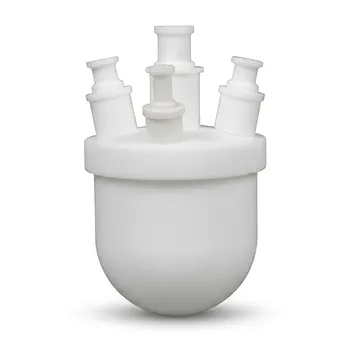
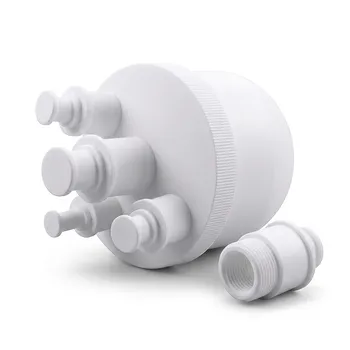
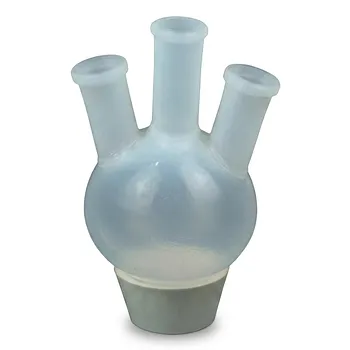
- Custom PTFE Flask 250ml High Purity Fluoropolymer Laboratory Vessel for Chemical Research
- High Purity PFA Chromatography Column with Collection Bottle Corrosion Resistant Fluoropolymer Filtration System for Trace Analysis
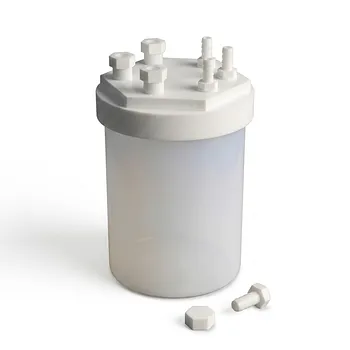
- Custom PTFE Reaction Tank Corrosion Resistant Fluoropolymer Chemical Processing Barrel 10L 20L 30L
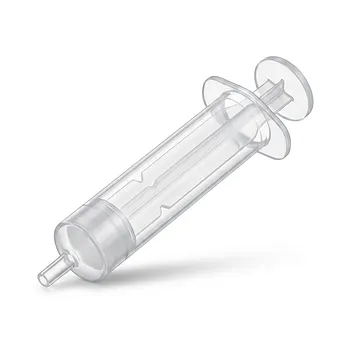
- Corrosion Resistant PFA Syringe Translucent Visual Fluoropolymer Labware 10ml Chemical Handling Tool
- Custom PFA Tubing 1/4 Inch High Purity Corrosion Resistant Fluoropolymer Tube with Welding and Machining Services
People Also Ask
- What are the key steps for structural integrity in molded PTFE lab reaction vessels? Master fine powder processing.
- What toxicological hazards and safe handling protocols must be established when PTFE fluoropolymer reaction vessels are subjected to pyrolysis temperatures? Learn essential safety measures now.
- When synthesizing TFVE monomers involving reactive organometallic reagents and aggressive polar solvents, what material performance characteristics are required? Ensure purity with PTFE/PFA.
- Why Are High-Purity Fluoropolymer Vessels and Tubing Critical for Trace Analysis? Prevent Contamination Reliably
- How does pressure management influence molar mass distribution and reaction rate in the iodine transfer emulsion polymerization of vinylidene fluoride, and how do custom fluoropolymer reaction vessels support this process?