Introducing steam improves TFE synthesis by lowering the reactant’s partial pressure without requiring a lower reactor pressure. In the reversible pyrolysis of chlorodifluoromethane, (2\ \mathrm{CHClF_2} \rightleftharpoons \mathrm{C_2F_4} + 2\ \mathrm{HCl}), steam dilution favors the product side because three gas moles form from two reactant moles. Under suitable conditions, steam-to-CHClF₂ ratios of approximately 7:1 to 10:1 can raise TFE yields from roughly 60% to 90–95%, while maintaining substantial reactant conversion.
Steam acts as a process diluent that shifts the reversible pyrolysis toward TFE formation, improving raw-material efficiency without increasing mechanical reactor pressure. The benefit depends on controlling steam ratio, temperature, and residence time together.
Why Steam Favors TFE Formation
The pyrolysis reaction produces more gas
CHClF₂ pyrolysis produces TFE and hydrogen chloride:
[ 2\ \mathrm{CHClF_2} \rightleftharpoons \mathrm{C_2F_4} + 2\ \mathrm{HCl} ]
The forward reaction increases the number of gas moles from two to three. That difference makes the equilibrium sensitive to reactant and product partial pressures.
Dilution shifts the equilibrium toward products
At approximately constant total pressure, adding steam lowers the partial pressure of CHClF₂. Le Chatelier’s principle predicts that the reaction responds by favoring the direction that restores the pressure balance, which is the direction of greater gas-mole production: TFE and HCl formation.
Steam therefore provides an effect similar to reducing reactant partial pressure through lower operating pressure, while avoiding the same degree of mechanical or vacuum-system modification.
Steam is not the same as increasing reactor pressure
Adding steam increases the gas volume and changes the composition, but it does not inherently require a higher mechanical pressure. This distinction matters because increasing total pressure would favor the side with fewer gas moles and tend to reduce TFE formation.
The process advantage comes from partial-pressure control, not from pressurization.
How the Process Becomes More Efficient
Higher TFE yield improves CHClF₂ utilization
Without sufficient dilution, TFE yield may be near 60% under some pyrolysis conditions. With steam dilution and optimized operation, reported yields rise to approximately 90–94%, with values approaching 95% under favorable conditions.
A higher yield means more TFE is obtained from the same CHClF₂ feed, reducing the amount of unreacted material and byproduct burden that must be handled.
Conversion and yield must be distinguished
High CHClF₂ conversion does not automatically mean high TFE yield. Some converted CHClF₂ can form unwanted high-boiling or perfluorocarbon byproducts rather than the desired monomer.
The objective is therefore high TFE selectivity at useful conversion, not conversion alone. Steam dilution helps equilibrium, but reactor kinetics and secondary reactions still determine the final product distribution.
The resulting monomer supports PTFE production
TFE is the feedstock for PTFE polymerization, so improving TFE yield strengthens the upstream economics and supply of the polymerization process. The TFE stream must still undergo effective separation and purification before polymerization because trace impurities can affect molecular weight, chain growth, and final PTFE quality.
Steam improves synthesis efficiency; it does not eliminate the need for downstream purification.
Operating Conditions That Control the Benefit
Steam ratio affects the equilibrium advantage
Steam-to-CHClF₂ molar ratios from approximately 3:1 to 10:1 are identified as useful operating ranges, with ratios around 7:1 to 10:1 associated with the highest reported yields.
A ratio near 8:1 can substantially increase CHClF₂ conversion at temperatures around 750–800°C compared with operation without dilution. The optimum, however, depends on reactor design, heat transfer, feed composition, and separation capacity.
Temperature must be high enough for pyrolysis
The process generally operates in the range of approximately 700–900°C, with the primary reference emphasizing 750–900°C for high-yield operation. Higher temperature can accelerate CHClF₂ conversion and TFE formation.
Temperature alone is not sufficient. Excessive temperature can also increase competing reactions and the formation of species such as hexafluoropropylene.
Residence time controls selectivity
Short contact times can improve TFE selectivity by limiting secondary reactions. At about 700°C, a reported residence time of approximately 0.17 seconds produced TFE yields around 93%, compared with roughly 84.5% at 0.64 seconds.
This reflects an important reactor principle: once TFE has formed, prolonged exposure to severe pyrolysis conditions can reduce the value of the product by promoting further reactions.
Understanding the Trade-offs
More steam increases downstream handling
Steam improves partial-pressure control, but it also increases the volume of gas that must be heated, transported, cooled, and separated. The process must therefore balance equilibrium benefits against energy consumption and equipment capacity.
Excessive dilution can make heat management and product recovery less efficient even when it improves reaction performance.
High temperature can create byproducts
Operating above approximately 850–900°C may improve conversion, but it can also promote side reactions, including formation of HFP and other unwanted products. These compounds complicate purification and can be harmful to subsequent PTFE polymerization.
The highest temperature is not necessarily the best operating temperature.
Longer residence time can lower TFE selectivity
A reactor designed only to maximize CHClF₂ conversion may hold the gas too long at pyrolysis temperature. That can increase high-boiling byproducts and reduce the fraction of converted feed appearing as TFE.
Residence time should be optimized together with temperature and steam ratio rather than treated as an independent throughput setting.
Steam requires corrosion and separation control
The reaction produces HCl, and the presence of high-temperature water vapor creates a demanding chemical environment. Reactor materials, quench design, acid handling, and steam removal must be engineered for the combined effects of temperature, HCl, and fluorinated compounds.
These considerations are especially important because TFE is a hazardous, highly reactive monomer, and its downstream polymerization is strongly exothermic.
Making the Right Choice for Your Goal
The practical objective is to optimize the complete process rather than maximize a single reaction variable.
- If your primary focus is TFE yield: Use steam dilution in the approximate 7:1–10:1 molar range and tune temperature to favor TFE without accelerating excessive side reactions.
- If your primary focus is CHClF₂ utilization: Increase conversion through appropriate dilution and temperature, but verify that converted feed is forming TFE rather than unwanted byproducts.
- If your primary focus is monomer purity: Use short, controlled residence times and limit high-temperature exposure, followed by rigorous separation and purification.
- If your primary focus is operating efficiency: Choose the lowest steam ratio and temperature combination that delivers the required yield and selectivity while keeping heating, cooling, and separation loads manageable.
Steam dilution is most effective when treated as one part of a coordinated equilibrium, kinetic, and purification strategy for producing high-quality TFE for PTFE manufacturing.
Summary Table:
| Factor | Without Steam | With Steam (7:1–10:1) |
|---|---|---|
| TFE Yield | ~60% | 90–95% |
| Partial Pressure of CHClF2 | High | Reduced |
| Equilibrium Shift | Toward reactants | Toward products |
| Reactor Pressure | Same | Same |
| Downstream Handling | Less gas | More gas to treat |
| Temperature Range | 700–900°C | 750–900°C optimized |
Optimize your TFE synthesis for higher yields and lower costs. At KINTEK, we offer high-performance PTFE and PFA labware, reactors, and custom machining to support your fluoropolymer processes. Contact our experts today to discuss your needs and get a tailored solution. Contact us now.
Related Products
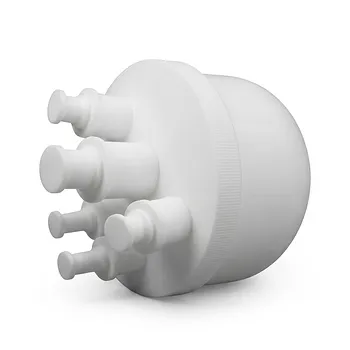
- Custom PTFE Continuous Reaction Bottles Virgin Fluoropolymer High Purity Low Background Synthesis Vessels
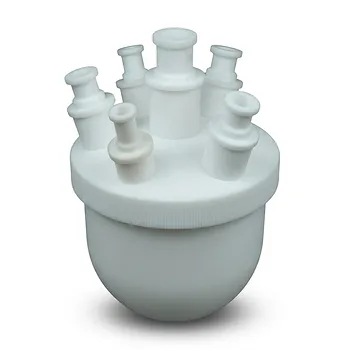
- Custom Multi Neck PTFE Round Bottom Flask for Chemical Synthesis and High Purity Laboratory Research
- High Pressure Custom TFM Reactor Stainless Steel Outer Vessel PTFE Inner Cup for Corrosive Synthesis
- Laboratory Hydrothermal Synthesis Autoclave Reactor PTFE PPL Lined High Temperature High Pressure Explosion Proof Reaction Vessel
- High Purity PTFE Multi Neck Reaction Flask for Corrosive Chemical Processing and Custom Industrial Laboratory Synthesis
People Also Ask
- What reaction vessel and fluid handling considerations are necessary for living cationic polymerization of fluorinated monomers involving Lewis acid catalysts? Key design and safety tips
- Ion Activation Reaction Vessel Requirements: Why PTFE is Critical for Membrane Performance
- How do perfluorinated solvent environments influence the selection of reaction vessels and fluid handling components in nonaqueous emulsion polymerizations? Choose fluoropolymer materials.
- Why are high-purity PTFE or PFA reaction vessels recommended for the synthesis of PANI-TiC hybrid materials? - Guide
- Why are fluoroplastic (PTFE) reaction vessels recommended for Methylene Blue (MB) adsorption kinetic experiments?