Perfluorinated building blocks generally make high-performance polymers more thermally stable and less wettable. Strong carbon–fluorine bonding and fluorine-rich molecular environments can raise thermal decomposition temperatures above 400–460 °C and, depending on the polymer core, increase glass transition temperatures toward 200 °C or higher. At the same time, fluorine lowers surface energy, producing higher water and hydrocarbon contact angles and improving both hydrophobicity and oleophobicity.
The central effect is a combination of thermal endurance and low surface wettability: fluorinated structures resist chain degradation while presenting a low-energy, chemically shielded surface that liquids are less likely to spread across.
Why Fluorination Improves Thermal Stability
Strong carbon–fluorine bonding
The carbon–fluorine bond is highly resistant to thermal and chemical cleavage. In a polymer backbone, extensive fluorine substitution helps shield the carbon framework from attack by heat, oxygen, acids, bases, and oxidizing environments.
This shielding contributes to high decomposition temperatures and strong resistance to thermal and oxidative degradation. Fully fluorinated polymers such as PTFE and PFA represent the most pronounced example of this behavior.
Backbone rigidity and molecular architecture
Perfluorinated or semi-fluorinated linkages can increase thermal stability through more than bond strength alone. The effect also depends on whether the fluorinated unit is incorporated into a rigid aromatic backbone, a cyclic structure, or a flexible side group.
Rigid bisphenol, aromatic, and perfluorocycloalkenyl structures can produce high glass transition temperatures while maintaining high decomposition resistance. Reported values include Td5% above 400–460 °C and Tg values approaching 200 °C, with some specialized fluorinated aromatic systems reaching substantially higher Tg values.
Reduced intermolecular interactions
Bulky groups such as trifluoromethyl (-CF3) and hexafluoroisopropylidene units can disrupt close chain packing and hydrogen bonding. This can increase free volume and improve solubility without necessarily sacrificing thermal endurance.
The result is a useful design balance: the polymer can remain rigid and heat-resistant while becoming easier to process or dissolve than a tightly packed, non-fluorinated analog.
How Fluorination Lowers Surface Energy
Fluorine creates a low-energy outer surface
Fluorine has low polarizability, and fluorinated groups interact relatively weakly with many liquids. When these groups preferentially occupy the polymer-air interface, they reduce the energetic cost of maintaining that surface.
Surface energy can therefore fall substantially. The primary reference reports values down to approximately 26.4 mJ/m², although the exact value depends on fluorine content, surface composition, crystallinity, processing history, and measurement method.
Surface composition matters more than bulk fluorine alone
Adding fluorinated groups to the bulk polymer does not automatically produce the same degree of surface fluorination. During processing, fluorinated segments may migrate or orient toward the interface, but this behavior depends on molecular architecture and thermal history.
A polymer with a modest fluorine content can sometimes show a strongly fluorinated surface if the relevant groups segregate efficiently. Conversely, a highly fluorinated formulation may show a smaller surface-energy change if its fluorinated groups remain buried or if the surface is altered during processing.
Hydrophobicity and oleophobicity are related but distinct
Fluorination typically reduces attraction to water and many hydrocarbon liquids. This produces both hydrophobicity, or resistance to water wetting, and oleophobicity, or resistance to oil-like liquids.
Oleophobicity is usually more difficult to achieve than hydrophobicity because low-surface-tension hydrocarbons can spread on surfaces that readily repel water. Fluorinated surfaces are effective because they reduce interactions with both polar water and many nonpolar liquids.
How Contact Angles Change
Water contact angles increase
The primary reference describes water contact angles increasing from approximately 73° to more than 103° after fluorinated building blocks are incorporated. A larger water contact angle generally indicates that water spreads less readily and that the surface is more hydrophobic.
A contact angle above 90° is commonly associated with a non-wetting tendency, but it should not be interpreted as complete liquid repellency. Surface roughness, contamination, droplet volume, temperature, and measurement timing can all affect the result.
Hydrocarbon contact angles also increase
Hexadecane contact angles are reported to rise from approximately 21° to 35°. This increase is smaller in absolute terms than the water-angle change, but it is meaningful because hexadecane has a much lower surface tension than water.
The result indicates improved resistance to hydrocarbon wetting. However, a 35° hexadecane angle still represents partial spreading, so the material should be described as more oleophobic rather than universally oil-repellent.
Contact angle is a practical surface indicator
Contact-angle measurements provide a convenient way to compare surface wetting before and after fluorination. They are particularly useful for evaluating coatings, molded components, membranes, and laboratory equipment exposed to water or organic liquids.
They do not, by themselves, fully define chemical resistance, adhesion, permeability, or long-term contamination behavior. Those properties require separate testing under the intended thermal and chemical conditions.
What Controls the Size of the Effect
Degree of fluorination
Increasing fluorine content often strengthens the low-surface-energy and chemical-resistance effects, especially when fluorine forms a continuous or preferentially oriented surface layer. Partial fluorination can still provide substantial benefits, but the response is not necessarily linear with composition.
Location of the fluorinated unit
A fluorinated side group, a bulky pendant group, and a perfluorinated backbone segment affect the polymer differently. Backbone fluorination can strongly influence thermal and chemical stability, while surface-active side groups may have a larger effect on surface energy and contact angles.
The non-fluorinated core
The bisphenol, aromatic, cyclic, or other core structure remains important. It controls chain rigidity, packing, free volume, and glass transition behavior.
Consequently, two polymers with similar fluorine contents can show different Tg, decomposition temperatures, surface energies, and contact angles.
Understanding the Trade-offs
Low surface energy can reduce adhesion
A low-energy fluorinated surface is useful for non-wetting, release, and chemical-resistance applications. The same property can make paints, adhesives, coatings, and deposited films difficult to bond to without surface treatment.
Increased free volume can affect transport
Bulky fluorinated groups can disrupt chain packing and increase fractional free volume. This may improve solubility and, in some systems, increase gas permeability.
That trade-off matters in membranes and barrier components: fluorination can improve chemical and thermal durability while changing the rate at which gases or vapors pass through the material.
Thermal stability is not unlimited
A high Td5% does not mean a component can operate indefinitely at that temperature. Long-term service temperature, mechanical load, thermal cycling, oxidation, crystallinity, and the surrounding atmosphere all influence practical performance.
Tg also marks a transition in polymer mobility; it is not a direct maximum-use temperature. Designs should use application-specific aging and dimensional-stability data.
Surface measurements can be misleading
Contact angles may vary with roughness, cleaning, aging, fluorinated-group orientation, and test-liquid purity. Static measurements can also miss hysteresis and dynamic behavior, such as advancing and receding angles.
For demanding applications, contact-angle data should be paired with surface-energy analysis, chemical exposure testing, thermal aging, and dimensional measurements.
Making the Right Choice for Your Goal
Fluorinated building blocks should be selected according to the required balance between thermal endurance, wetting behavior, processability, and mechanical performance.
- If your primary focus is high-temperature stability: Choose a rigid fluorinated backbone or aromatic architecture and evaluate both Td5% and long-term thermal aging, rather than relying on Tg alone.
- If your primary focus is water repellency: Favor fluorinated structures that enrich the outer surface and verify performance through water contact-angle measurements after processing and aging.
- If your primary focus is oil or solvent resistance: Assess hydrocarbon contact angles and chemical exposure directly, because water repellency does not guarantee strong oleophobicity.
- If your primary focus is non-wetting laboratory equipment: Use fluoropolymer systems such as PTFE or PFA where chemical inertness, low sorption, and thermal resistance are central requirements.
- If your primary focus is adhesion or coating durability: Account for the low surface energy during joining and specify an appropriate surface-treatment or bonding strategy.
- If your primary focus is membrane or barrier performance: Balance fluorine-driven chemical stability against possible increases in free volume and gas permeability.
Perfluorinated building blocks are most valuable when their strong thermal resistance and low surface energy are matched deliberately to the polymer architecture and the intended service environment.
Summary Table:
| Property | Effect of Fluorination | Evidence |
|---|---|---|
| Thermal Stability | Increased decomposition temperature (Td5%) and glass transition (Tg) | Td5% >400-460°C; Tg up to ~200°C |
| Surface Energy | Decreased surface energy leading to lower wettability | Surface energy as low as 26.4 mJ/m² |
| Water Contact Angle | Increased hydrophobicity | Water angle increased from ~73° to >103° |
| Hydrocarbon Contact Angle | Increased oleophobicity | Hexadecane angle increased from ~21° to 35° |
Enhance your lab's performance with KINTEK's fluoropolymer solutions. Our PTFE and PFA labware, custom components, and CNC machining services are designed for maximum thermal and chemical resistance. Contact us today to discuss your requirements and discover how we can support your research and production needs.
Related Products
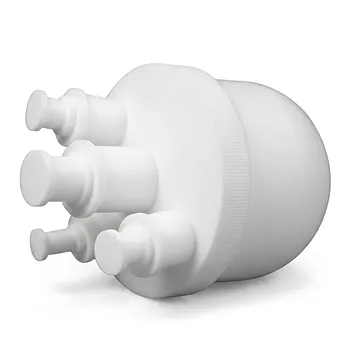
- PFA Chemical Reaction Tank with Customizable Fittings for Corrosive Solvent Synthesis and High Purity Lab Applications
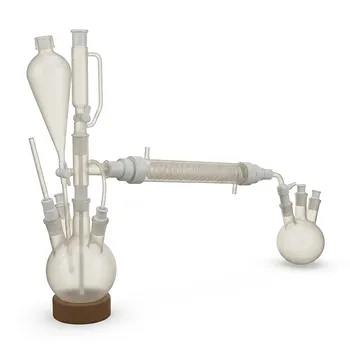
- PTFE Distillation Condensation Apparatus High Temperature Hydrofluoric Acid Resistant Fluorination Reaction Flask
- High Purity PFA Chromatography Column with Collection Bottle Corrosion Resistant Fluoropolymer Filtration System for Trace Analysis
- Custom PTFE Flask 250ml High Purity Fluoropolymer Laboratory Vessel for Chemical Research
- Custom PTFE Condenser Tube 100ml Serpentine and Straight Fluoropolymer Laboratory Heat Exchanger with Flask Adapters
People Also Ask
- How does the molecular structure of fluorinated polymers contribute to the extreme thermal stability and chemical resistance required for high-performance laboratory reaction vessels and digestion containers? Discover the science behind PTFE and PFA for your lab.
- How can re-entrant surface geometry enable fluoropolymer vessels to repel organic solvents? Learn the design rules for stable, low-adhesion surfaces that resist wetting and contamination.
- What are the key material and operational challenges for fluoropolymer vessels in direct gas fluorination?
- How do choice of solvent and chain transfer activity affect molecular weight during vinylidene fluoride (VDF) radical polymerization? Learn Key Factors for High-MW PVDF
- What are the thermodynamic properties and heat of polymerization of tetrafluoroethylene (TFE), and how do they influence fluoropolymer reaction vessel design? Discover key design principles for safe and efficient TFE polymerization reactors.