Fluoroalkene selection directly affects a fluoropolymer’s decomposition temperature, thermal endurance, and reliability in elevated-temperature labware. Highly fluorinated monomers generally produce backbones with strong C–F bonding and low hydrogen content, improving resistance to thermal breakdown. Among the monomer families identified here, hexafluoropropylene (HFP)-based structures typically provide greater thermal stability than chlorotrifluoroethylene (CTFE)- or perfluoromethyl vinyl ether (PMVE)-based structures, with alternating fluorinated copolymers often showing 10% weight-loss decomposition temperatures above 270 °C in air.
The best choice is not determined by decomposition temperature alone. Select a highly fluorinated, thermally stable backbone for extreme heat, then verify its actual continuous service temperature, mechanical behavior, atmosphere, pressure, and potential emissions under the intended laboratory conditions.
Why the Fluoroalkene Building Block Matters
Monomer chemistry becomes backbone chemistry
A fluoroalkene is not merely a processing ingredient; it contributes directly to the polymer’s repeating structure. Its fluorine content, hydrogen content, chlorine substitution, and functional groups influence how easily the chain undergoes bond scission or releases volatile decomposition products.
Highly fluorinated backbones benefit from the strength and chemical stability of carbon–fluorine bonds. They also contain little or no hydrogen, reducing degradation pathways associated with hydrogen-containing polymer chains.
HFP-based structures generally offer stronger thermal endurance
The primary reference identifies HFP-based fluoropolymers as more thermally stable than comparable CTFE- or PMVE-based structures. This makes HFP an attractive structural choice when labware must tolerate severe thermal exposure while retaining chemical resistance.
The precise decomposition behavior still depends on copolymer composition, molecular weight, processing history, additives, and test atmosphere. Monomer selection establishes an important baseline, but it does not determine every aspect of final-part performance.
CTFE and PMVE can change the thermal balance
CTFE introduces chlorine into the polymer structure, while PMVE introduces a perfluoroalkyl ether group. These substitutions can provide useful processing or flexibility characteristics, but the reference indicates lower thermal stability relative to HFP-based structures.
This does not make CTFE- or PMVE-containing materials unsuitable for laboratory use. It means their thermal limits should be evaluated more carefully when the application approaches the material’s decomposition or long-term service range.
Decomposition Temperature Versus Working Temperature
A decomposition temperature is not a safe operating temperature
A 10% weight-loss decomposition temperature, or (T_{d,10%}), describes when a defined amount of mass loss occurs during a particular thermal test. It is a comparative material property, not a recommended continuous-use temperature for a machined vessel or seal.
A component can lose useful mechanical performance well before it reaches its measured decomposition temperature. For labware, dimensional stability, creep, pressure resistance, sealing behavior, and contamination risk may matter more than the first detectable chemical mass loss.
Continuous service limits are usually lower
High-performance fluoropolymers such as PTFE and PFA are commonly associated with continuous upper service limits around 260 °C, depending on grade, design, load, and operating environment. Some fully fluorinated materials are reported to support continuous service above 300–315 °C, but such values should not be generalized across all products or geometries.
The practical limit must come from the specific resin, component design, manufacturer data, and application conditions. A thin liner, pressure vessel, valve seat, and thick machined block may not tolerate the same temperature even when made from the same polymer family.
Test atmosphere changes the result
Fluoropolymers can show decomposition onset temperatures around 550 °C under inert nitrogen conditions, while measurements in air may produce different results. Oxygen, heating rate, sample size, pressure, and test method all influence the reported temperature.
For this reason, thermal data should be compared only when the test conditions are comparable. An inert-atmosphere decomposition result should not be treated as a direct prediction of performance in an oxygen-containing laboratory process.
How Fluorination Improves Thermal Stability
Fully fluorinated backbones reduce hydrogen-driven degradation
Fully fluorinated polymers contain no hydrogen in the main chain. This generally improves resistance to high-temperature degradation compared with partially fluorinated polymers that retain hydrogen in their backbones.
Hydrogen-containing fluoropolymers can be more susceptible to dehydrofluorination, particularly in the presence of metal oxides. That pathway can reduce long-term thermal reliability even when the material is nominally classified as a fluoropolymer.
Higher fluorine content can increase residual stability
The supplementary information indicates that increasing fluorine content can increase high-temperature char yield, rising from approximately 55% in non-fluorinated polymers to about 75% at 700 °C in fluorinated copolymers. Greater residual char can support flame resistance and limit mass loss during severe thermal exposure.
Char formation does not mean the component remains serviceable. A material can retain a carbonaceous residue while losing strength, flexibility, purity, or dimensional accuracy.
Chain architecture is not the only deciding variable
Molecular-dynamics assessments indicate that fluorinated chain segments maintain higher bulk density than hydrogenated counterparts. The density decreases approximately linearly as temperature rises from 300 K to 600 K, while changes in internal segment length or chain topology have comparatively limited influence on overall bulk density.
This predictable response supports dimensional consistency during heating. However, bulk-density behavior should not be confused with resistance to chemical decomposition or mechanical creep.
What This Means for Elevated-Temperature Labware
Reaction vessels need both chemical and thermal endurance
High-temperature reaction vessels may experience simultaneous heat, corrosive reagents, pressure, and mechanical loading. A highly fluorinated backbone can help resist chemical attack and thermal degradation, but the vessel must also be designed for creep resistance and safe pressure operation.
HFP-based structures are particularly relevant when decomposition resistance is a priority. The final selection should still consider whether the vessel is exposed to air, an inert gas, microwave energy, metal oxides, or aggressive reaction intermediates.
Microwave digestion vessels face concentrated thermal stress
Microwave digestion can create rapid and localized heating, pressure excursions, and chemically aggressive environments. Material selection should therefore emphasize the maximum recommended operating temperature, not only a laboratory-measured (T_d).
PTFE and PFA can be suitable for many digestion and high-temperature chemical applications, but exceeding their specified limits can cause deformation, loss of integrity, and contamination from decomposition products.
Fluid-handling components require dimensional control
Tubing, valves, gaskets, fittings, and custom-machined components may remain chemically intact while becoming too soft or dimensionally unstable for reliable service. Linear thermal expansion and density changes are useful design considerations, but load-bearing behavior and creep must also be checked.
The relevant question is not simply whether the polymer decomposes. It is whether the component continues to seal, flow, withstand pressure, and maintain tolerances throughout the complete thermal cycle.
Clean processing can be as important as heat resistance
Near the degradation limit, fluoropolymers may release gaseous byproducts, particulates, or residual processing species. These emissions can contaminate samples and create laboratory safety concerns.
High-purity resin, controlled thermal history, adequate ventilation, and operation below the recommended temperature limit are essential when sample integrity matters.
Understanding the Trade-offs
Maximum fluorination does not solve every design problem
Highly fluorinated materials generally improve thermal and chemical resistance, but they may involve trade-offs in flexibility, processability, cost, and mechanical behavior. A material optimized for extreme heat may not be the easiest to machine, seal, weld, or fabricate.
The correct choice balances thermal endurance with the component’s actual function. A rigid reaction vessel, flexible transfer tube, and low-friction valve seat may require different formulations or polymer families.
Decomposition data can be misinterpreted
Comparing a (T_{d,10%}) value from one material with a continuous service limit from another is misleading. The values describe different failure criteria and may be measured under different atmospheres and heating rates.
Use decomposition temperature to understand chemical margin, but use application-specific service data to establish operating limits.
Fully fluorinated does not mean failure-proof
PTFE, PFA, and related materials offer exceptional thermal resistance, but they can still soften, creep, deform, or generate hazardous products if overheated. Pressure, mechanical restraint, thermal cycling, and local hot spots can cause failure before obvious decomposition occurs.
Laboratory systems should include appropriate temperature control, pressure protection, ventilation, and inspection procedures.
Additives and manufacturing history matter
The polymer’s nominal monomer composition does not describe every finished component. Fillers, pigments, processing aids, residual fluorosurfactants, contamination, annealing, and machining can influence thermal behavior and emissions.
For critical applications, specify the resin grade, purity requirements, maximum operating temperature, and applicable thermal test data rather than ordering only by a broad polymer name.
Making the Right Choice for Your Goal
The practical selection process should begin with the full thermal and mechanical duty cycle, not with a decomposition number in isolation.
- If your primary focus is maximum thermal stability: Prefer a highly fluorinated backbone, with HFP-based structures favored over CTFE- or PMVE-based structures where the available data and application requirements support that choice.
- If your primary focus is continuous high-temperature operation: Use the manufacturer’s service-temperature limit for the specific grade and component, and keep it well below the measured decomposition threshold.
- If your primary focus is microwave digestion or severe chemical processing: Evaluate temperature, pressure, heating rate, chemical compatibility, and ventilation together; do not rely on (T_{d,10%}) alone.
- If your primary focus is dimensional accuracy: Examine thermal expansion, density change, creep, sealing performance, and thermal cycling in the actual component geometry.
- If your primary focus is sample purity: Select high-purity fluoropolymer resin, control additives and processing residues, and prevent operation near the degradation limit.
Fluoroalkene selection establishes the thermal-resistance baseline, but reliable elevated-temperature labware comes from matching that chemistry to the real operating temperature, atmosphere, mechanical load, and contamination requirements.
Summary Table:
| Fluoroalkene | Thermal Stability | Typical Decomposition Temp (Td,10%) | Considerations |
|---|---|---|---|
| HFP-based | High | >270°C in air | Best for extreme heat; verify continuous service limits |
| CTFE-based | Moderate | Lower than HFP | Chlorine reduces stability; evaluate carefully |
| PMVE-based | Moderate | Lower than HFP | Ether group offers flexibility but lower stability |
| Fully fluorinated (no H) | High | ~550°C in inert gas | Reduced degradation pathways; high char yield |
| Partially fluorinated (with H) | Lower | Lower | Susceptible to dehydrofluorination |
Choose the right fluoropolymer for your high-temperature labware. At KINTEK, we offer a comprehensive range of PTFE and PFA products, from standard labware to custom CNC-machined components, ensuring optimal thermal and chemical performance. Our experts can guide you in material selection for your specific application. Contact us today to discuss your requirements and get a tailored solution. Get in touch now and benefit from our high-purity materials, custom fabrication, and reliable supply for your lab's elevated-temperature needs.
Related Products
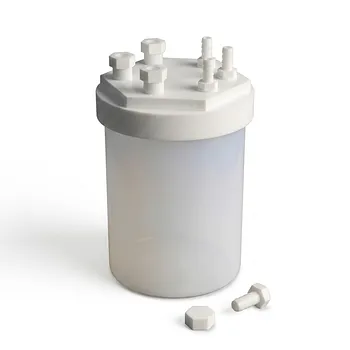
- PFA Chemical Reaction Tank with Customizable Fittings for Corrosive Solvent Synthesis and High Purity Lab Applications
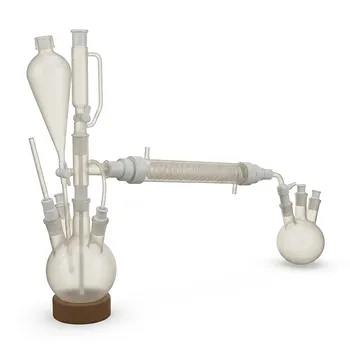
- PTFE Distillation Condensation Apparatus High Temperature Hydrofluoric Acid Resistant Fluorination Reaction Flask
- High Purity PFA Chromatography Column with Collection Bottle Corrosion Resistant Fluoropolymer Filtration System for Trace Analysis
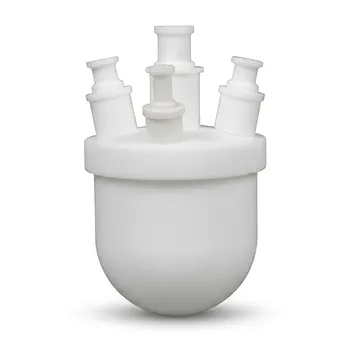
- Custom PTFE Flask 250ml High Purity Fluoropolymer Laboratory Vessel for Chemical Research
- Custom PTFE Condenser Tube 100ml Serpentine and Straight Fluoropolymer Laboratory Heat Exchanger with Flask Adapters
People Also Ask
- How does the molecular structure of fluorinated polymers contribute to the extreme thermal stability and chemical resistance required for high-performance laboratory reaction vessels and digestion containers? Discover the science behind PTFE and PFA for your lab.
- How can re-entrant surface geometry enable fluoropolymer vessels to repel organic solvents? Learn the design rules for stable, low-adhesion surfaces that resist wetting and contamination.
- How do choice of solvent and chain transfer activity affect molecular weight during vinylidene fluoride (VDF) radical polymerization? Learn Key Factors for High-MW PVDF
- What are the thermodynamic properties and heat of polymerization of tetrafluoroethylene (TFE), and how do they influence fluoropolymer reaction vessel design? Discover key design principles for safe and efficient TFE polymerization reactors.
- What role do low-surface-energy fluoropolymer reaction vessels play in preventing fouling during particle synthesis and emulsion polymerization?