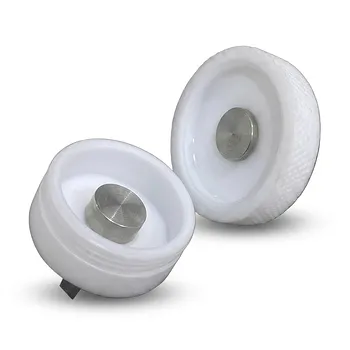
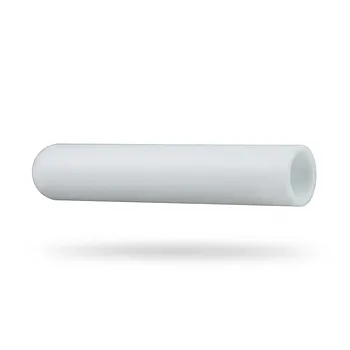
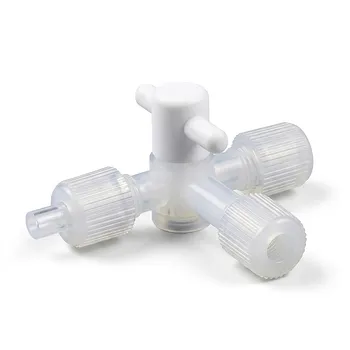
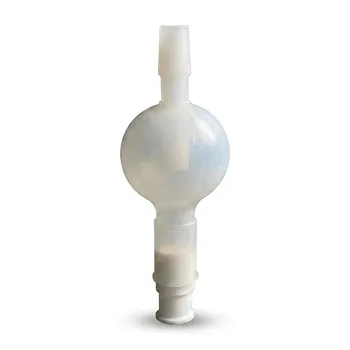
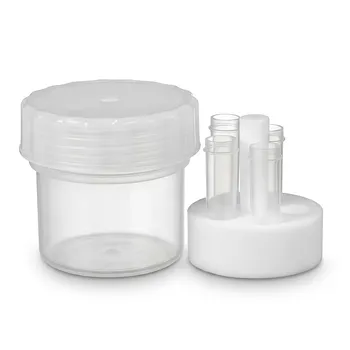
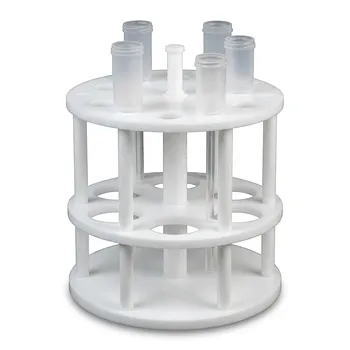
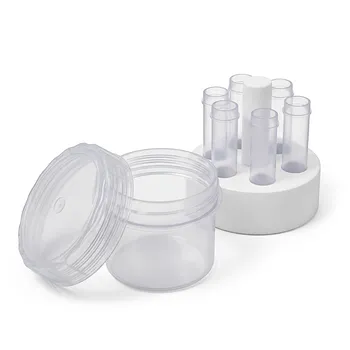
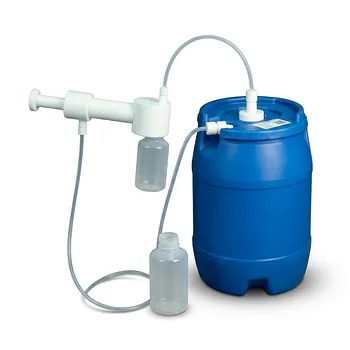
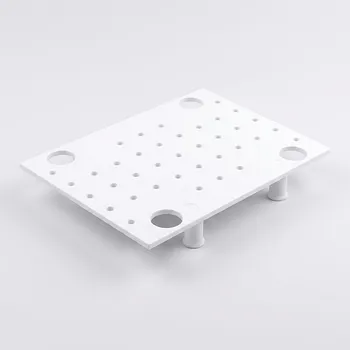
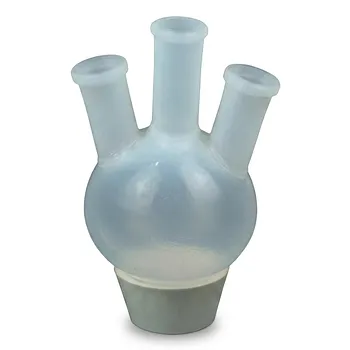
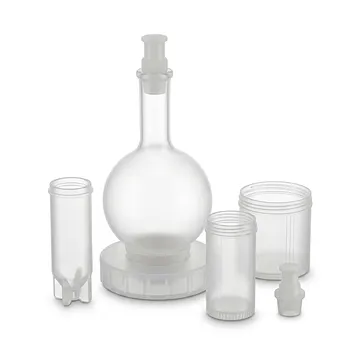
Super-acidic fluoroalkyl sulfonate side chains improve low-humidity proton conductivity by making proton dissociation easier within fluorinated poly(arylene ether) ionomers. The strong electron-withdrawing effect of fluorine helps generate mobile protons with less water than less-acidic aryl or alkyl sulfonate groups require. During evaluation, high-purity PTFE and PFA cells, membrane holders, and tubing provide chemically inert, thermally stable test environments that preserve measurement accuracy under acidic, high-temperature, and controlled-humidity conditions.
The central advantage is efficient proton generation when water is scarce. Fluorinated sulfonate chemistry reduces the membrane’s dependence on extensive hydration, while inert fluoropolymer testing components prevent contamination, degradation, and uncontrolled changes to the electrochemical test environment.
Why Low Humidity Limits Proton Conductivity
Water normally enables proton transport
Protons move efficiently through ionomer membranes when water hydrates the acidic groups and connects ionic domains into continuous conduction pathways. As relative humidity decreases, these hydrated pathways shrink or become less continuous.
The effect can be substantial. In fluoropolymer ionomers, reducing humidity from fully humidified conditions to approximately 20% RH at elevated temperature can produce a many-fold conductivity loss, with reported decreases of up to about 25 times under some conditions.
Low humidity changes membrane morphology
Fluorinated ionomers contain hydrophilic ionic regions within a hydrophobic fluoropolymer framework. Increasing humidity expands the ionic regions and improves connectivity, while drying reduces their volume and disrupts proton-transfer pathways.
The PTFE-like domains still provide mechanical structure and dimensional stability during this process. However, structural integrity alone does not maintain high conductivity if the ionic domains lack sufficient water or charge-carrier mobility.
How Super-Acidic Fluoroalkyl Sulfonates Help
Fluorine strengthens sulfonate acidity
Fluorine atoms exert a strong electron-withdrawing effect along the fluoroalkyl chain. This stabilizes the conjugate base formed after proton release, making the sulfonic acid group more effective at dissociating than less-acidic aryl or alkyl sulfonate groups.
The result is a larger population of mobile protons at a given hydration level. Proton generation therefore becomes less dependent on large amounts of absorbed water.
Proton transport requires less hydration
Super-acidic fluoroalkyl sulfonate chains do not eliminate the role of water. Water remains important for proton hydration and for maintaining connected ionic transport channels.
Their contribution is that they lower the water requirement for useful proton dissociation. This allows fluorinated poly(arylene ether) membranes to retain high proton conductivity at relative humidities as low as approximately 20%, where conventional acidic side chains may experience a sharper performance decline.
Side-chain chemistry and ion concentration work together
Acidity determines how readily protons are released, while the membrane’s equivalent weight determines how many acidic groups are present per unit mass. Lowering equivalent weight generally increases the concentration of ionic charge carriers and can substantially raise conductivity across humidity conditions.
These variables are complementary. A highly acidic side chain improves proton availability, while a lower equivalent weight increases the number of available acid sites; neither parameter alone fully determines the membrane’s performance.
Why Fluoropolymer Components Matter During Evaluation
They resist aggressive acidic environments
Conductivity and electrochemical testing can expose the cell assembly to strong acid groups, water, elevated temperature, and electrochemical potentials. High-purity PTFE and PFA resist chemical attack under these conditions, reducing the risk that the test hardware will degrade or release contaminants.
This is especially important when evaluating subtle differences in membrane chemistry. A component that reacts with the membrane or test fluids can introduce changes that are incorrectly attributed to the ionomer.
They prevent trace-metal contamination
Trace metals can interfere with electrochemical measurements and may catalyze unwanted side reactions. They can also alter the apparent conductivity or durability of an acidic membrane.
Using high-purity fluoropolymer cells, holders, and fluid-transfer tubing minimizes this contamination pathway. The measured response is therefore more likely to reflect the membrane’s intrinsic proton-transport behavior.
They maintain thermal and dimensional stability
Testing may reach temperatures up to approximately 120 °C. PTFE and PFA components provide the required thermal resistance and maintain their dimensions sufficiently for repeatable membrane contact, fluid routing, and sealing.
Stable geometry matters because small changes in compression, contact area, or leakage can affect the apparent resistance of the membrane. Chemically resistant materials are useful only when they also preserve the physical conditions of the measurement.
They support controlled humidity
Accurate humidity-dependent measurements require the test environment to remain stable at the intended temperature and RH. Fluoropolymer tubing and cell components help prevent moisture loss, chemical absorption, and contamination in the gas or liquid path.
Reliable sealing is equally important. A nominally controlled 20% RH test is not meaningful if the cell assembly leaks, absorbs water unpredictably, or allows external moisture to enter.
What the Testing Components Actually Control
The membrane chemistry controls proton generation
The super-acidic fluoroalkyl sulfonate chain primarily determines how readily protons dissociate at low hydration. It is the chemical feature responsible for reducing the membrane’s dependence on water for proton availability.
Testing hardware cannot compensate for weak acid chemistry. Its role is to ensure that the membrane’s chemical performance is measured without avoidable interference.
The membrane morphology controls pathway continuity
The membrane’s phase-separated structure determines whether hydrated ionic regions form connected transport routes. Hydrophobic fluoropolymer domains preserve the physical framework, while ionic domains respond to humidity and carry the protons.
Temperature, RH, equivalent weight, and membrane history can all influence this morphology. The cell must therefore hold these conditions steady so that conductivity changes can be interpreted correctly.
The test assembly controls measurement reliability
PTFE and PFA components establish a stable boundary around the membrane and its fluids. They reduce chemical, metallic, thermal, dimensional, and humidity-related artifacts.
Their contribution is methodological rather than catalytic: they do not increase the ionomer’s intrinsic conductivity, but they make the measured value more trustworthy and reproducible.
Understanding the Trade-offs
Low humidity still imposes a conductivity penalty
Super-acidic side chains improve performance under dry conditions, but they do not make proton conductivity independent of RH. Reduced hydration still lowers proton mobility and can disrupt ionic-domain connectivity.
Conductivity commonly increases strongly as RH rises from very dry to fully humidified conditions. The practical benefit is improved retention of performance, not the removal of humidity sensitivity.
Strong acidity can increase chemical demands
Highly acidic membranes may place greater demands on all materials that contact them. Inadequate cell materials, seals, fittings, or tubing can corrode, contaminate the test, or change dimensions during extended operation.
The entire wetted and heated test path must therefore be reviewed, not only the membrane holder. Selecting PTFE or PFA for one component does not protect an incompatible metal or polymer elsewhere in the assembly.
Higher ionic content can affect dimensional behavior
Lower equivalent weight increases the concentration of acid groups and can improve conductivity, potentially by several-fold. However, increased ionic content can also change water uptake, swelling, and the balance between mechanical stability and transport performance.
Membrane selection should therefore consider conductivity at the target RH together with dimensional stability, temperature, and durability requirements.
Poor environmental control can obscure real trends
Humidity fluctuations, leaks, inconsistent compression, and contaminated fluids can produce apparent conductivity changes unrelated to side-chain acidity. These errors are particularly problematic when comparing membranes with modest performance differences.
Testing should use calibrated temperature and RH control, consistent membrane conditioning, stable contact pressure, and chemically inert fluid-path materials.
Making the Right Choice for Your Goal
The appropriate design and testing priorities depend on what the membrane must accomplish in service.
- If your primary focus is low-humidity conductivity: Use strongly electron-withdrawing fluoroalkyl sulfonate side chains and evaluate them at controlled RH values near the intended operating condition.
- If your primary focus is maximum conductivity: Consider lower equivalent weight to increase acid-site concentration, while checking the resulting swelling and dimensional behavior.
- If your primary focus is measurement accuracy: Use high-purity PTFE and PFA cells, membrane holders, tubing, and compatible seals to limit chemical attack, trace-metal contamination, and humidity leakage.
- If your primary focus is high-temperature operation: Verify thermal stability and dimensional retention of every component in contact with the acidic membrane or test fluids, up to the intended temperature.
- If your primary focus is long-term durability: Separate intrinsic membrane degradation from test-fixture effects by using inert materials and maintaining stable temperature, humidity, fluid composition, and mechanical compression.
Super-acidic fluoroalkyl sulfonate chains improve low-humidity proton transport by sustaining proton dissociation with less water, while inert fluoropolymer testing components ensure that this chemistry is evaluated under controlled and credible conditions.
Summary Table:
| Factor | Influence on Proton Conductivity | Role of Fluoropolymer Testing Components |
|---|---|---|
| Super-acidic fluoroalkyl sulfonate chains | Enhance proton dissociation under low RH due to electron-withdrawing fluorine atoms | Provide chemically inert, contamination-free environment to accurately measure acidity effects |
| Equivalent weight (acid site concentration) | Lower EW increases ion exchange capacity and can significantly raise conductivity | N/A (membrane property, but test hardware must not alter it) |
| Humidity level | Higher RH improves pathway connectivity; low RH reduces conductivity | PTFE/PFA tubing and cells maintain controlled humidity, preventing leakage and moisture absorption |
| Temperature | Elevated temperatures can increase conductivity but may degrade materials | PTFE/PFA withstand up to ~120°C, maintaining dimensional stability for reliable measurements |
| Trace metal contamination | Can catalyze side reactions and skew results | High-purity fluoropolymers minimize metal leaching, preserving measurement integrity |
| Test fixture stability | Compression, sealing, and geometry affect apparent resistance | Inert, dimensionally stable components ensure repeatable contact and sealing |
Optimize your ionomer research with high-purity PTFE and PFA labware. Our custom electrochemical cells, membrane holders, and fluid handling components are designed for low-humidity conductivity testing. Trust KINTEK for chemically inert, thermally stable, and precision-machined fluoropolymer solutions that enhance measurement accuracy. Contact us today to discuss your requirements.
Related Products
- Corrosion Resistant PTFE Coin Cell Battery Testing Clamps and Acid Proof Custom Fluoropolymer Battery Fixtures
- Custom PTFE Test Tubes Corrosion Resistant Low Background Fluoropolymer Labware 50ml 30ml
- Corrosion Resistant High Purity PFA Valve and Weldable Transparent Tubing for Semiconductor Fluid Transfer
- High Purity PFA Chromatography Column with Collection Bottle Corrosion Resistant Fluoropolymer Filtration System for Trace Analysis
- Corrosion Resistant PTFE Support with PFA Transparent Reaction Tank and High Purity PFA Sampling Tube for Trace Analysis
People Also Ask
- What is the thermal operating range for PTFE battery clamps in electrochemical research? Stability from -200°C to +260°C
- What are the primary functions and material compositions of PTFE battery clamps? Ensure Precision & Chemical Resistance
- How do coin cell testing fixtures evaluate ZIF-derived LCO cycling stability? Ensure Battery Research Precision
- What are the electrical insulation and signal integrity advantages of using PTFE battery clamps? Ensure Data Accuracy
- How does the chemical inertness of PTFE benefit laboratory-scale battery testing? Ensure high-purity research results.