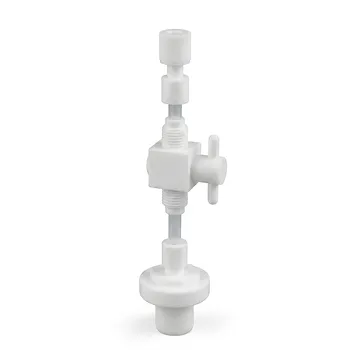
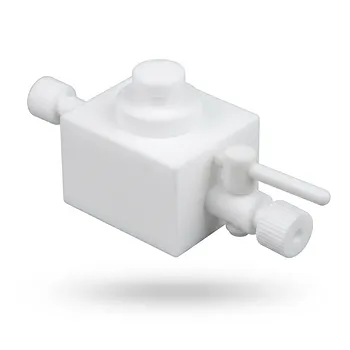
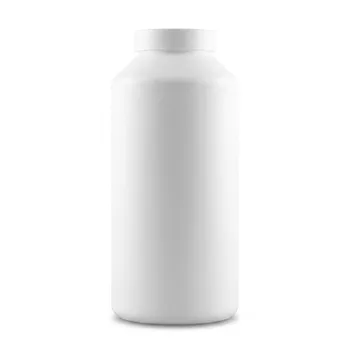
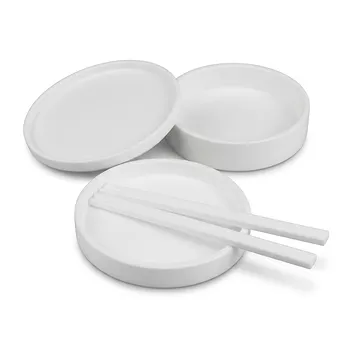
Standard structural fluoropolymers such as PTFE and PFA are effectively insoluble in virtually all solvents at room temperature, while certain amorphous fluoropolymers dissolve in specialized fluorinated solvents. This difference determines how they are processed and used: standard PTFE and PFA form durable, free-standing laboratory components, whereas soluble amorphous grades are particularly useful for thin, continuous coatings and films. For long-term containment of aggressive laboratory fluids, solid molded, welded, or machined PTFE and PFA generally provide the stronger mechanical and containment solution.
Solubility enables processing, but it does not automatically make a material better for containment. Amorphous fluoropolymers can be dissolved and applied as protective films, while structural PTFE and PFA provide the thickness, rigidity, and dimensional stability required for laboratory vessels, tubing, fittings, and other fluid-handling components.
Why the Polymer Structure Matters
Crystallinity Makes PTFE and PFA Insoluble
PTFE and PFA contain highly stable carbon-fluorine bonds and substantial crystalline structure. Their ordered polymer regions resist penetration by solvent molecules, making these materials insoluble in virtually all solvents under ordinary laboratory conditions.
This insolubility is beneficial when a component must maintain its shape and avoid dissolving, softening, or releasing polymer into a fluid. It supports the use of PTFE and PFA in reaction vessels, storage containers, tubing, valves, fittings, and machined laboratory parts.
Bulky Cyclic Groups Enable Amorphous Solubility
Amorphous fluoropolymers incorporate bulky monomer structures that disrupt regular chain packing and prevent extensive crystallization. Certain perfluorinated amorphous grades can therefore dissolve in specialized fluorinated solvents, such as hexafluorobenzene.
The relevant distinction is not that all amorphous fluoropolymers dissolve in all solvents. Solubility depends on the specific polymer formulation, solvent, temperature, and exposure conditions.
How Solubility Changes Manufacturing
PTFE Requires Solid-State Processing
Standard PTFE has extremely high melt viscosity and cannot normally be processed through conventional melt-flow techniques. It is typically cold-molded and sintered, or produced through precision machining.
These methods are well suited to thick, robust parts. They support structural components that must withstand pressure, repeated handling, elevated temperatures, and prolonged chemical exposure.
PFA Allows Melt Processing
PFA retains the chemical resistance associated with perfluorinated materials while being melt-processable. It can be molded, extruded, thermally welded, and formed into complex geometries.
That processing flexibility is valuable for leak-tight tubing, valves, fittings, and low-dead-volume fluid paths. It also makes PFA practical where a laboratory system requires welded joints or continuous tubing rather than only machined parts.
Amorphous Grades Support Liquid-Phase Coating
Soluble amorphous fluoropolymers can be deposited through techniques such as dip-coating or spin-coating. These methods can produce thin, continuous, and highly uniform films that would be difficult to manufacture from insoluble PTFE or PFA.
The result is useful when the design requires a fluoropolymer surface layer rather than a fully fluoropolymer structural component. Typical roles include barrier layers, optical films, and specialized protective coatings.
What This Means for Fluid Containment
Solid PTFE and PFA Provide Structural Integrity
For solvent bottles, reaction vessels, transfer tubing, fittings, and heavy-duty chemical apparatus, the material must do more than resist chemical attack. It must also retain its dimensions, resist mechanical damage, and maintain leak-tight containment.
Thick molded or machined PTFE and PFA parts are generally better suited to these demands than thin fluoropolymer films. Under ambient conditions, thick molded labware typically shows very small solvent-related weight changes, often below approximately 0.2% to 0.5% in the referenced comparisons.
Amorphous Films Protect Surfaces
Amorphous fluoropolymer coatings can provide low swelling and strong chemical stability when used as surface treatments. Their value is concentrated at the interface, where a thin film can protect an underlying substrate or create a specialized barrier.
A coating, however, does not replace the mechanical function of the substrate. The underlying material still determines much of the component's stiffness, strength, pressure resistance, and dimensional stability.
Optical Transparency Can Be an Additional Advantage
Amorphous fluoropolymers are nearly non-crystalline and can offer exceptional optical clarity, with visible-light transmission exceeding 95% in some grades. Their low refractive indices, commonly around 1.29 to 1.31, also support specialized optical and analytical designs.
PTFE and PFA are typically opaque or translucent because of their crystalline domains. For ordinary fluid containment this is usually acceptable, but it can be a disadvantage when visual inspection, optical measurement, or UV-to-near-infrared transmission is central to the application.
Chemical Exposure Is Not the Same as Dissolution
Compatibility Depends on Geometry and Exposure
A thin film and a thick molded component made from related fluoropolymer chemistry may respond differently to the same fluid. Thin films have a higher surface-area-to-volume ratio and less material available to maintain mechanical rigidity after absorption or swelling.
Aromatic hydrocarbons and ketones can cause some thin fluoropolymer films to swell, cloud, become more flexible, and gain approximately 2.4% to 5.17% in weight. These effects may compromise coating performance even when the polymer does not dissolve completely.
PFA Performs Well With Aggressive Polar Solvents
PFA provides broad chemical compatibility with aggressive polar organic solvents, including THF and acetone, and can maintain structural integrity at temperatures approaching the boiling point of those solvents.
This makes PFA a strong choice for high-purity fluid transfer, reaction vessels, and tubing exposed to harsh solvents. Compatibility must still be checked against the actual temperature, concentration, pressure, exposure duration, and stress state.
Do Not Generalize From PFA to Every Fluoropolymer
Fluoropolymer chemistry varies substantially. PVDF, for example, has important limitations with ketones and can be severely attacked by room-temperature acetone.
The practical lesson is to evaluate the exact resin, not merely the broad label “fluoropolymer.” A solvent-compatible PFA component and a PVDF component should not be treated as interchangeable.
Understanding the Trade-offs
Solubility Is Useful but Can Reduce Containment Margin
Solubility gives amorphous fluoropolymers a processing advantage, especially when a defect-free coating or ultra-thin film is required. The same film format can have less resistance to swelling, clouding, solvent uptake, and loss of rigidity than a thick structural part.
For containment, the relevant question is whether the material must form the container or merely protect its surface. Structural containment usually favors solid PTFE or PFA.
Insolubility Limits Processing Options
PTFE's insolubility and high melt viscosity make it difficult to form into complex shapes using conventional manufacturing methods. Custom machining, molding, and sintering can increase cost and limit design flexibility.
PFA reduces this constraint through melt processing, but it may not provide the same processing or mechanical characteristics as every PTFE grade. The manufacturing route should be selected alongside the chemical and mechanical requirements.
Thin Coatings Are Not Automatically More Chemical-Resistant
A thin amorphous film may deliver excellent resistance to particular vapors, liquids, or reagents, but its performance depends on adhesion, thickness, defects, substrate movement, and solvent absorption. A small amount of swelling can be significant when the coating is responsible for optical accuracy or barrier performance.
For storage and transfer, a coating should be treated as a surface-engineering solution rather than a substitute for a robust fluoropolymer vessel or fluid path.
Making the Right Choice for Your Goal
Select the material based on whether your primary need is structural containment, manufacturing flexibility, or a specialized surface property.
- If your primary focus is long-term containment of aggressive laboratory fluids: Choose solid PTFE or PFA components, with PFA favored when melt processing, extrusion, welding, or complex fluid paths are important.
- If your primary focus is a thin protective or barrier coating: Consider a compatible amorphous fluoropolymer that can be dissolved and applied through a liquid-phase coating process.
- If your primary focus is optical inspection or transparent analytical components: Evaluate amorphous fluoropolymers for their high optical clarity, while confirming solvent exposure and mechanical requirements.
- If your primary focus is high-temperature polar-organic handling: Assess PFA first, particularly for THF, acetone, and similar demanding fluids, and verify the complete application conditions.
- If your primary focus is minimizing solvent uptake and dimensional change: Prefer thick molded, welded, or machined PTFE or PFA over thin fluoropolymer films.
The decisive principle is simple: use amorphous fluoropolymers when solubility enables the required coating or film, and use solid PTFE or PFA when the fluoropolymer itself must provide durable laboratory containment.
Summary Table:
| Property | Standard (PTFE/PFA) | Amorphous |
|---|---|---|
| Solubility | Insoluble in virtually all solvents | Soluble in some fluorinated solvents |
| Processing | Molded, machined, or melt-processed (PFA) | Liquid-phase coating |
| Structure | Crystalline | Non-crystalline |
| Mechanical strength | High (structural) | Lower (films) |
| Optical clarity | Opaque/translucent | >95% transparent |
| Best for | Vessels, tubing, fittings | Thin protective coatings |
For durable laboratory containment, choose KINTEK's high-performance PTFE and PFA products. Our extensive range includes labware, tubing, fittings, and custom CNC-machined parts, backed by end-to-end expertise. Contact us today to find the perfect solution for your fluid handling needs. Get in touch with us!
Related Products
- High Purity PFA Chromatography Column with Collection Bottle Corrosion Resistant Fluoropolymer Filtration System for Trace Analysis
- Custom PTFE Flask 250ml High Purity Fluoropolymer Laboratory Vessel for Chemical Research
- Custom PFA Tubing 1/4 Inch High Purity Corrosion Resistant Fluoropolymer Tube with Welding and Machining Services
- Corrosion Resistant PFA Syringe Translucent Visual Fluoropolymer Labware 10ml Chemical Handling Tool
- Custom PTFE Reaction Tank Corrosion Resistant Fluoropolymer Chemical Processing Barrel 10L 20L 30L
People Also Ask
- What are the primary functional and temperature differences between PFA and FEP when selecting melt-processible fluoropolymers for custom laboratory apparatus?
- How does PPVE modify PTFE to make melt-processable PFA? Discover key benefits and applications.
- Why is the chemical stability of polymer endgroups critical when selecting melt-processible fluoropolymers like PFA for high-purity laboratory apparatus? Choose Stable Endgroups for Reliable Performance
- What are the characteristics of PFA material? A Guide to Its High-Performance Balance
- Why is Perfluoroalkoxy alkane (PFA) preferred over glass or stainless steel in pharmaceutical process development? Pure Yield