Perfluorinated polymer structures achieve chemical resistance and low outgassing by surrounding a stable carbon backbone with a dense, highly inert fluorine shield. In materials such as PFA and FFKM, replacing carbon-hydrogen bonds with strong carbon-fluorine bonds reduces the number of chemically vulnerable sites and limits thermal decomposition. Their low volatility, high thermal stability, and appropriately controlled formulations also minimize gas release, leaching, and contamination in high-purity fluid handling and sealing systems.
The key advantage is structural: a fully fluorinated backbone resists chemical attack and remains stable under heat and vacuum, while clean, low-extractable formulations reduce the molecules available to escape, decompose, or contaminate a process.
Why Full Fluorination Improves Chemical Resistance
Fluorine Shields the Polymer Backbone
Perfluorinated polymers replace backbone C-H bonds with C-F bonds. The resulting fluorine-rich sheath makes it difficult for acids, bases, organic solvents, oxidizers, and reactive gases to reach or react with the carbon chain.
The high strength and low polarizability of C-F bonds also reduce the polymer's chemical reactivity. This is why PFA and PTFE can remain stable in environments where conventional hydrocarbons or partially fluorinated polymers would swell, crack, dissolve, or degrade.
Strong Bonds Resist Thermal Decomposition
Chemical resistance and thermal stability reinforce each other. When a polymer is heated, degradation often begins through bond scission followed by formation of volatile fragments.
The strong C-F framework in perfluorinated materials raises the energy required for these reactions. As a result, properly selected grades can maintain chemical integrity during elevated-temperature fluid transfer, digestion, reaction processing, and vacuum operations.
Low Surface Reactivity Limits Contamination
Fluorine's low polarizability and the low surface energy of fluoropolymers produce weak interactions with many liquids and solids. This gives surfaces strong hydrophobic and oleophobic behavior and reduces the tendency of chemicals to adhere to or react with the material.
For trace analysis, this matters because a chemically resistant surface is not merely less likely to fail. It is also less likely to retain residues that can later desorb into a sample stream.
Why These Structures Produce Low Outgassing
Fewer Reactive Sites Mean Fewer Decomposition Products
Outgassing can result from residual processing chemicals, absorbed species, trapped moisture, additives, or thermal decomposition of the polymer itself. A fully fluorinated backbone has relatively few chemically reactive sites available for decomposition under normal service conditions.
This does not mean that perfluorinated polymers produce no gas. Rather, their intrinsic molecular stability reduces gas generation compared with less fluorinated materials exposed to the same heat, chemicals, or vacuum.
Low Volatility Supports Vacuum Stability
PFA and related fluoropolymers are high-molecular-weight solids with very low volatility under their intended operating conditions. Their stable molecular chains do not readily evaporate into a vacuum environment.
For high-purity laboratory and semiconductor applications, this helps protect vacuum chambers, analytical instruments, and process fluids from volatile organic contamination. The practical result depends on temperature, vacuum level, surface area, exposure time, and the material's processing history.
Clean Formulations Reduce Extractables
High-purity components are commonly specified without plasticizers and with tightly controlled stabilizer, pigment, filler, and processing-residue content. This reduces the reservoir of low-molecular-weight species that can leach into fluids or leave a component under vacuum.
The formulation must be evaluated as carefully as the polymer family. A perfluorinated base resin does not automatically guarantee low extractables if the finished component contains unsuitable additives, contamination, or residual manufacturing residues.
How PFA and FFKM Serve Different Functions
PFA Provides Rigid, High-Purity Fluid Contact
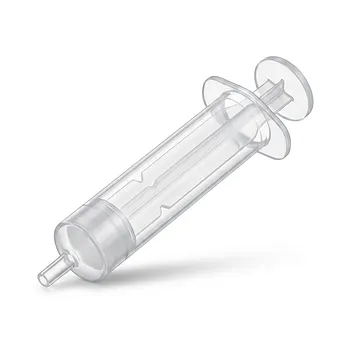
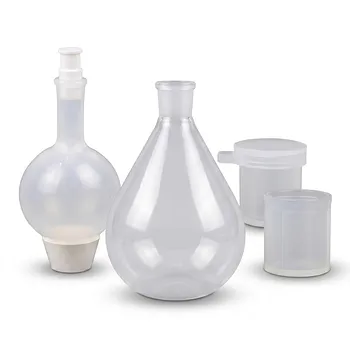
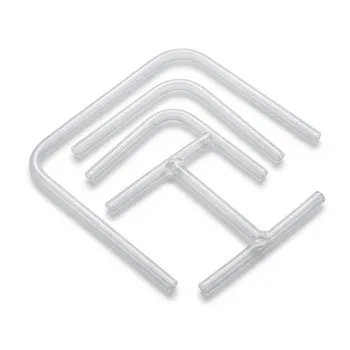
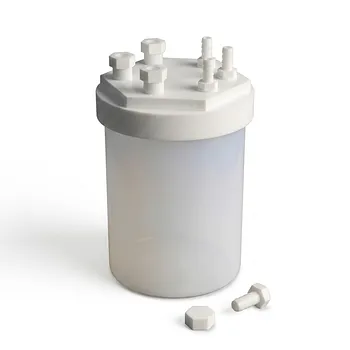
PFA is a melt-processable perfluoroplastic used for tubing, fittings, bottles, vessels, liners, and custom reaction hardware. It combines broad chemical resistance with a smooth, nonreactive surface and low extractable potential.
Its relative rigidity makes it well suited to fluid paths and vessel walls. It is less suitable than an elastomer when the component must repeatedly compress, recover, and maintain contact across dimensional tolerances.
FFKM Provides Compliant Sealing
FFKM is a perfluoroelastomer designed for O-rings and other compliant seals. Its fully fluorinated elastomer structure provides exceptional resistance to aggressive chemicals, reactive gases, and elevated temperatures while retaining the elasticity required for sealing.
The seal's performance depends on its exact compound, cure system, compression conditions, and operating temperature. FFKM therefore complements PFA fluid-contact hardware rather than serving as a direct substitute for it.
Ether Linkages Can Improve Flexibility
Some fluoropolymer structures contain ether linkages that increase chain mobility. Greater flexibility can help a material retain compliance across broad temperature ranges, including demanding low-temperature conditions.
This is a design trade-off: chain mobility can improve mechanical conformity, while the fluorinated framework preserves chemical inertness. The final balance must match the required flexibility, compression recovery, permeability, and temperature performance.
Why This Matters in High-Purity Applications
Trace Analysis Requires Chemical Inertness
In trace analysis, even small amounts of leached elements or organic residues can distort results. Perfluorinated components reduce this risk by resisting chemical attack and minimizing surface interactions with aggressive reagents and samples.
They are consequently used in fluid transfer lines, fittings, reaction vessels, digestion equipment, and sample-contact components where contamination control is as important as mechanical service life.
Reactive Fluids Need Stable Boundaries
Strong acids, concentrated bases, oxidizers, organic solvents, and reactive gases can attack ordinary polymeric materials through swelling, cracking, extraction, or decomposition. A fluorine-shielded structure provides a more stable boundary between the process fluid and the component.
This stability is especially valuable when the same system must handle multiple incompatible chemistries without introducing material-derived impurities.
Vacuum Systems Need Controlled Material Behavior
Low outgassing helps preserve vacuum quality and reduces contamination of sensors, analytical surfaces, and semiconductor test environments. Perfluorinated components are useful because they combine low volatility with resistance to thermal and chemical degradation.
However, vacuum performance must be verified on the finished component. Machining, cleaning, packaging, storage, and assembly can influence outgassing as much as the nominal resin family.
Understanding the Trade-offs
Chemical Resistance Does Not Eliminate Permeation
A material may resist chemical attack while still allowing some gases or low-molecular-weight species to permeate through it. Permeation is a transport phenomenon, not necessarily evidence of polymer degradation.
For volatile or reactive gases, specify wall thickness, pressure differential, temperature, exposure duration, and the relevant permeation data rather than relying on a general statement of chemical compatibility.
High Purity Depends on Processing
A clean base polymer can be compromised by molding residues, machining fluids, poorly controlled cleaning, packaging materials, or contact with contaminated tools. FFKM compounds may also contain cure-related ingredients or other formulation components that affect extractables and outgassing.
Supplier qualification should therefore cover the finished part, manufacturing controls, cleaning process, and required analytical limits.
Mechanical Properties Remain Application-Specific
Perfluorinated materials are chemically robust, but they are not universally ideal mechanically. PFA can exhibit creep under sustained load, while FFKM seals must be checked for compression set, extrusion, swelling, and permeation at the actual operating conditions.
A chemically compatible material can still fail if the seal geometry, compression, pressure, temperature, or installation method is unsuitable.
Temperature Ratings Have Boundaries
Perfluorinated polymers tolerate demanding temperatures, but the usable limit varies by grade and application. Long-term exposure, rapid thermal cycling, mechanical stress, and reactive environments can reduce performance even when short-term compatibility appears acceptable.
The design should use manufacturer data for continuous service, excursions, vacuum exposure, and the specific chemical environment.
Making the Right Choice for Your Goal
Select the polymer and finished-component specification according to the dominant risk in the system.
- If your primary focus is maximum chemical resistance: Use a fully fluorinated material such as PFA or an appropriately specified FFKM compound, then verify compatibility against the exact reagents, concentration, temperature, and exposure time.
- If your primary focus is low outgassing: Specify a high-purity grade and qualify the finished component's vacuum performance, including cleaning, curing, packaging, and thermal preconditioning.
- If your primary focus is trace contamination control: Require additive and extractables information, controlled manufacturing, validated cleaning, and materials testing using the actual process fluids.
- If your primary focus is reliable sealing: Use FFKM where elastic compliance is required and evaluate compression set, pressure, temperature, permeation, and compound-specific compatibility.
- If your primary focus is a clean fluid path: Use PFA for tubing, fittings, vessels, or liners where a nonreactive, low-extractable wetted surface is required.
Perfluorinated polymers deliver their strongest advantage when molecular stability, formulation purity, component design, and manufacturing controls are specified as one integrated system.
Summary Table:
| Aspect | PFA | FFKM |
|---|---|---|
| Type | Thermoplastic | Elastomer |
| Chemical Resistance | Excellent | Excellent |
| Outgassing | Low (when high-purity grade) | Low (when formulated properly) |
| Key Applications | Tubing, fittings, vessels, liners | O-rings, seals |
| Mechanical Property | Rigid, some creep | Elastic, good compression recovery |
| Suitability for Moving Parts | Limited | Excellent |
| Typical Use | Fluid contact and containment | Sealing applications |
Unlock Superior Performance with KINTEK's High-Purity Fluoropolymers
Elevate your high-purity fluid handling and sealing systems with our precision-engineered PTFE and PFA components. As a dedicated manufacturer of advanced fluoropolymer labware and custom parts, we ensure outstanding chemical resistance and low outgassing for your most demanding applications. From PFA tubing and fittings to custom CNC-machined components, our solutions are crafted to minimize contamination and maximize reliability.
- For Lab Managers & Analysts: Achieve trace-level accuracy with our low-extractable products.
- For Equipment Manufacturers: Integrate durable, chemically inert components that withstand harsh reagents.
- For Distributors: Access reliable supply, OEM/ODM support, and high-quality products that satisfy your customers' rigorous standards.
Let's discuss your specific needs — contact us today for tailored solutions that drive your success!
Related Products
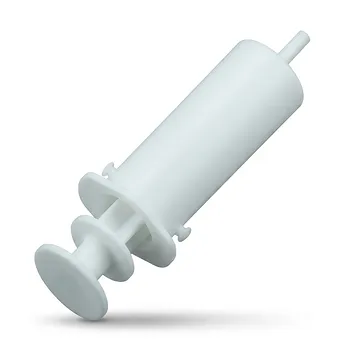
- Corrosion Resistant PFA Syringe Translucent Visual Fluoropolymer Labware 10ml Chemical Handling Tool
- Custom PFA Tubing 1/4 Inch High Purity Corrosion Resistant Fluoropolymer Tube with Welding and Machining Services
- Corrosion Resistant High Purity PFA Valve and Weldable Transparent Tubing for Semiconductor Fluid Transfer
- PFA Eggplant Flask Custom Molded Pear Shaped Laboratory Flask Corrosion Resistant Glass Alternative
- High Purity 4L PFA Reaction Tank for Proton Exchange Membrane Electrolysis Water Oxygen Separation Systems
People Also Ask
- How does the incorporation of comonomers such as perfluoropropyl vinyl ether (PPVE) alter the molecular structure and processing characteristics of TFE-based fluoropolymers like PFA compared to standard PTFE?
- Why do PFA fluoropolymer laboratory products offer different melt-processability and structural toughness compared to standard PTFE labware?
- PFA vs FEP: Which is Better for High-Temperature Lab Equipment?
- How does the removal of C8 (APFO) processing aids impact the chemical purity of solid fluoropolymer laboratory tools and fluid handling products? Discover the key benefits of C8-free PTFE, PFA, and FEP for trace analysis and high-purity applications.
- How does increasing fluorine content affect the physical and chemical performance of fluoropolymer laboratory supplies and components?