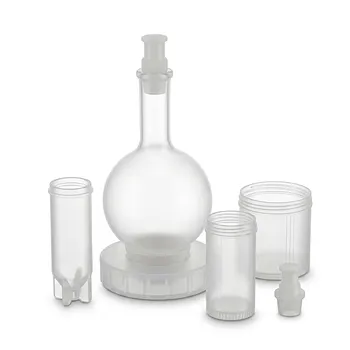
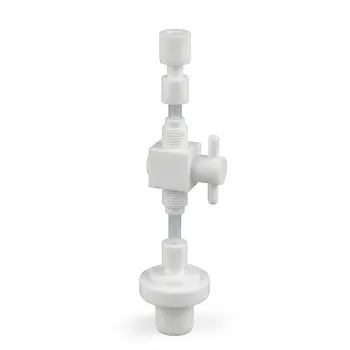
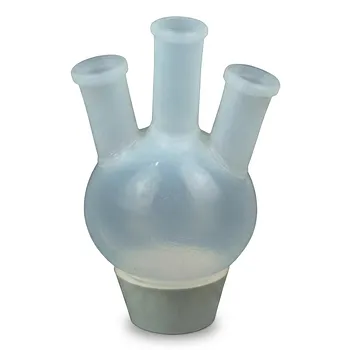
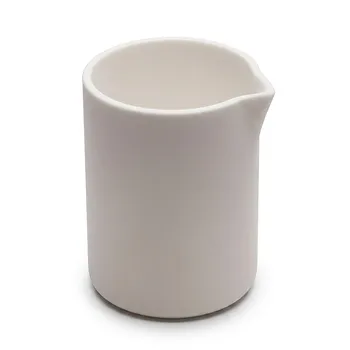
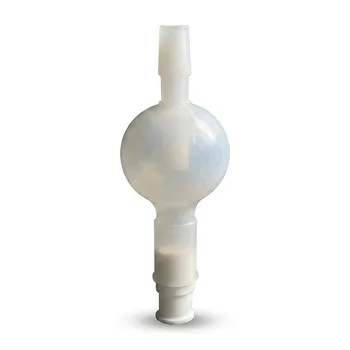
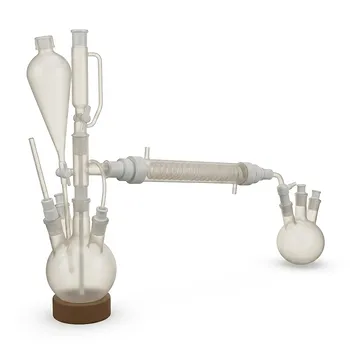
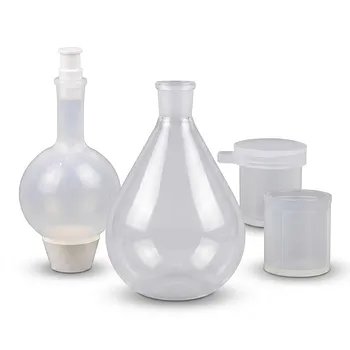
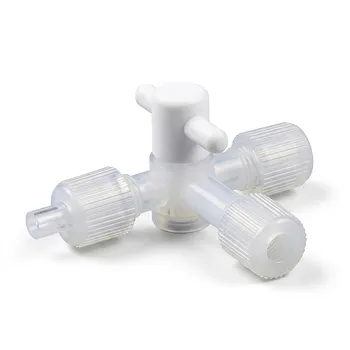
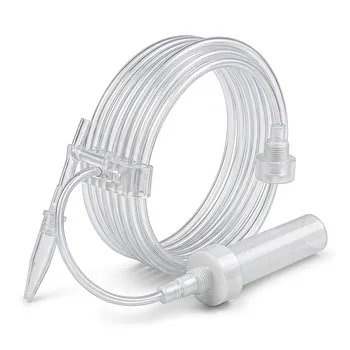
PFA is easier to process into complex, seamless components, while PTFE remains the more fabrication-constrained material. Standard PTFE has extremely high melt viscosity, so it cannot be processed like an ordinary thermoplastic; manufacturers generally use paste extrusion, compression molding, sintering, or machining. PFA retains comparable chemical inertness and thermal stability but can be injection molded, melt-extruded, thermoformed, and heat-welded, making it particularly suitable for high-purity laboratory vessels, tubing, fittings, and valves.
The central distinction is processing, not basic chemical resistance: PTFE is excellent for robust stock shapes and machined labware, while PFA is usually better for intricate, seamless, transparent, low-dead-volume, and leak-tight fluid-handling components.
Why PTFE and PFA Process Differently
PTFE’s high melt viscosity limits fabrication
PTFE’s molecular structure gives it exceptional chemical and thermal performance, but its melt viscosity is too high for conventional injection molding and extrusion. It must instead be shaped through processes such as compression molding, sintering, paste extrusion, or CNC machining.
These methods work well for solid stock shapes, tubes, gaskets, and custom apparatus. They are less convenient when a design requires intricate internal passages, integrated fittings, or welded assemblies.
PFA is a melt-processable fluoropolymer
PFA is a copolymer of tetrafluoroethylene and a perfluoroalkoxy vinyl ether. The modified structure reduces crystallinity and enables the resin to flow when heated.
Manufacturers can therefore use conventional thermoplastic techniques, including injection molding, melt extrusion, thermoforming, and heat welding. This expands the range of geometries that can be produced economically and consistently.
Processing affects component design
PTFE components are often assembled from molded pieces, machined from stock, or joined through specialized methods. Each additional interface can introduce dimensional variation, dead volume, or a potential leakage path.
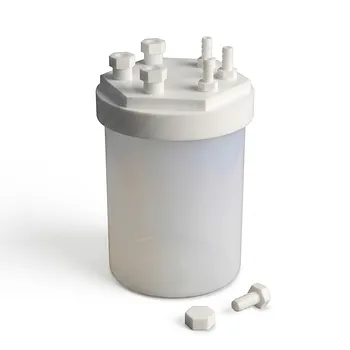
PFA can be formed into more integrated geometries. That is valuable when a laboratory system requires smooth-bore tubing, molded fittings, valves, vessel nozzles, or complex digestion vessels with minimal internal discontinuities.
Why PFA Suits High-Purity Laboratory Applications
Smooth, non-porous surfaces support trace analysis
Melt processing can produce highly smooth, void-free PFA surfaces when the resin, tooling, and processing conditions are properly controlled. These surfaces reduce locations where contaminants can lodge or where residues can remain after cleaning.
PTFE can also be manufactured into high-quality, chemically resistant laboratory components. However, sintered or assembled PTFE parts require careful control of molding, sintering, machining, and joining to prevent surface defects, voids, or contamination traps.
Optical clarity improves inspection
PFA commonly offers substantially better optical clarity than standard PTFE. Users can inspect liquid levels, particulates, color changes, precipitates, and residue without opening the vessel or interrupting the process.
This is useful for trace-analysis bottles, reagent containers, digestion vessels, and transparent tubing. PTFE’s opacity is not a chemical limitation, but it makes visual inspection more difficult.
Integrated geometries reduce dead volume
Melt-molded PFA can incorporate complex ports, channels, fittings, and other features into a single component. These designs can reduce crevices and dead legs where small amounts of sample or reagent might remain.
That matters in ultra-trace workflows, where carryover and contamination control may be more important than the material’s nominal chemical resistance alone.
Weldability enables sealed fluidic assemblies
PFA can be thermally welded to create fluid-handling assemblies with fewer mechanical joints. Proper welding can support leak-tight construction for tubing networks, vessels, valves, and custom fittings.
PTFE is not conventionally melt-weldable in the same practical manner. PTFE systems therefore more often depend on mechanical joints, machined interfaces, or specialized assembly techniques.
High purity depends on the complete manufacturing process
PFA is often selected for high-purity service because it can be fabricated with smooth surfaces and few joints. That does not mean every PFA component automatically has lower contamination or leachables than every PTFE component.
Purity depends on resin grade, additives, tooling, processing history, cleaning, packaging, and supplier controls. The specification should address extractables, trace metals, surface condition, and cleanliness rather than relying on the polymer name alone.
Where PTFE Remains the Better Choice
Heavy-duty custom labware
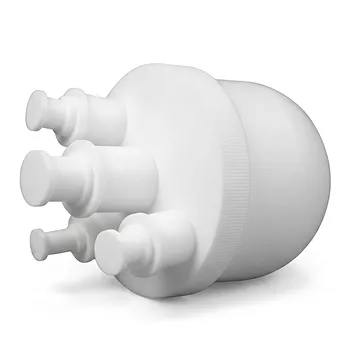
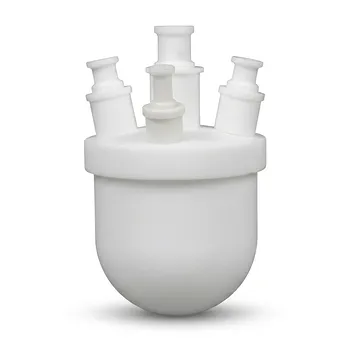
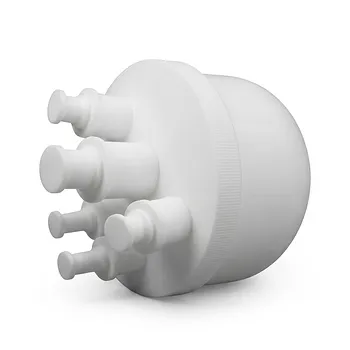
PTFE is well suited to custom-machined reaction vessels, electrochemical cells, blocks, covers, and other apparatus made from solid stock. CNC machining provides design flexibility for low-volume or highly specialized parts.
For a one-off component, machining PTFE may be simpler than developing dedicated tooling for a molded PFA design.
Applications emphasizing maximum thermal margin
Both materials provide broad thermal resistance, but the exact operating limits depend on grade, stress, pressure, geometry, and exposure time. PTFE may be preferred where the design places a premium on its established high-temperature performance.
The decision should use the supplier’s temperature and pressure data for the specific grade and component, not a generic polymer comparison.
Low-friction mechanical interfaces
PTFE offers an exceptionally low coefficient of friction. It can therefore be advantageous for sliding, sealing, and nonstick functions where optical clarity and melt-welded construction are not central requirements.
PFA also has low-friction fluoropolymer behavior, but PTFE may be favored when friction performance and machined flexibility dominate the design.
Understanding the Trade-offs
PFA processing does not eliminate design constraints
PFA’s melt flow makes complex manufacturing possible, but it requires appropriate equipment, tooling, thermal control, and process validation. Molded parts can still experience distortion, residual stress, weld defects, or dimensional variation if processing is poorly controlled.
For critical vessels and fluid paths, manufacturing quality is as important as the nominal material selection.
PTFE is not inherently unsuitable for high purity
PTFE remains highly chemically inert and can perform well in high-purity laboratory environments. Its limitation is primarily fabrication and assembly, not a general lack of chemical compatibility.
A well-made PTFE component may be preferable to a poorly processed PFA component, particularly for custom or high-temperature apparatus.
PFA may be less appropriate for simple, rugged parts
For a simple gasket, machined block, or mechanically robust vessel where transparency and welded construction provide little benefit, PFA’s processing advantages may not justify its use.
PTFE’s availability in molded stock shapes and its machining flexibility can make it the more practical option.
Seams and joints remain important in either material
A seamless molded PFA component can reduce joint-related risks, but not every PFA assembly is seamless. Tubing connections, welded regions, valves, and fittings still require inspection and validation.
Likewise, PTFE assemblies can be reliable when interfaces are designed correctly and the fabrication process is controlled.
Making the Right Choice for Your Goal
Material selection should consider chemical exposure, temperature, pressure, geometry, cleanliness requirements, inspection needs, and production volume together.
- If your primary focus is complex, high-purity fluid handling: Favor PFA when molded or welded construction, smooth internal surfaces, low dead volume, and leak-tight assemblies are important.
- If your primary focus is visual inspection: Favor optically clear PFA for vessels, tubing, and reagent containers where observing the contents supports process control.
- If your primary focus is custom low-volume apparatus: Favor PTFE when the component can be machined efficiently from stock and does not require integrated molded features.
- If your primary focus is maximum chemical inertness with low friction: Evaluate PTFE first, while confirming that its fabrication and assembly method meets the required purity standard.
- If your primary focus is ultra-trace contamination control: Compare validated resin grades and manufacturing processes, including extractables, trace-element leachables, surface finish, cleaning, and weld or joint quality.
The right choice is the material and manufacturing route that together deliver the required purity, geometry, thermal performance, and long-term reliability.
Summary Table:
| Feature | PFA | PTFE |
|---|---|---|
| Melt processability | Yes (injection molding, extrusion, thermoforming) | No (requires paste extrusion, compression molding, sintering) |
| Optical clarity | Excellent (transparent) | Opaque |
| Weldability | Heat-weldable, enabling sealed assemblies | Not conventionally weldable |
| Complexity of components | High (complex geometries, integrated features) | Limited (machined or molded shapes) |
| High-purity suitability | Excellent (smooth surfaces, low dead volume) | Good (requires careful fabrication) |
| Temperature resistance | High (similar to PTFE) | Very high |
| Friction coefficient | Low | Extremely low |
Elevate your lab's performance with KINTEK's high-purity PFA and PTFE labware, including beakers, tubing, fittings, valves, and custom CNC-machined parts. Our melt-processable PFA offers seamless, transparent, and low-dead-volume solutions ideal for trace analysis and fluid handling, while our PTFE components deliver robust performance for demanding applications. We provide end-to-end support, from design to high-volume manufacturing, ensuring purity, precision, and reliability. Contact us today to discuss your requirements and discover how KINTEK can enhance your lab's efficiency and contamination control. Contact us now to get started!
Related Products
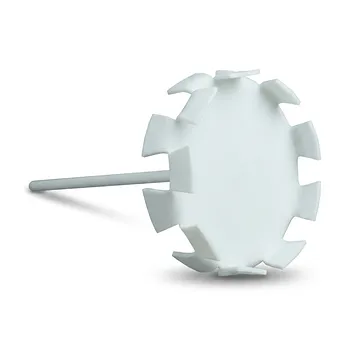
- High Purity PTFE Dispersion Disk for Food and Cosmetic Processing Non Stick Corrosion Resistant Large Stirring Paddle Customizable Fluoropolymer Impeller
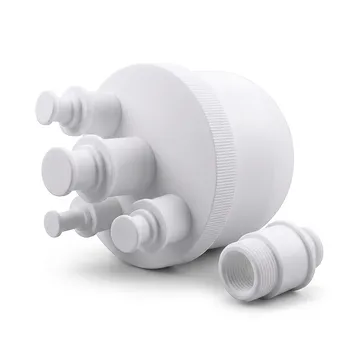
- Large Capacity PTFE Reaction Flask 20L Custom Multi Neck Laboratory Boiling Flask Fluoropolymer Chemical Processing Vessel
- Custom PTFE Reaction Tank Corrosion Resistant Fluoropolymer Chemical Processing Barrel 10L 20L 30L
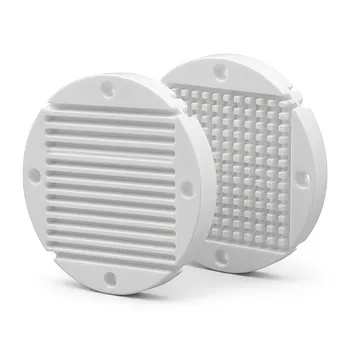
- Corrosion Resistant PTFE Reaction Trays and Custom Teflon Cassettes for Semiconductor Processing and High Purity Chemical Handling
- High Temperature Resistant Thickened PTFE Beaker 2000ml for Chemical Processing and Laboratory Trace Analysis
People Also Ask
- How many variations of PTFE disks are available and what parameters do they differ in? Choose the Right Material for Your Application
- What is the chemical formula and material of PTFE Disk? Unlock the Power of C₂F₄ Polymer
- What are the tolerance specifications for the thickness of PTFE disks? Why ±20% is the Industry Standard
- What is Dispersion PTFE used for? Creating Thin, High-Performance Coatings and Films
- What key properties are measured under ASTM D4441 to classify and evaluate PTFE dispersions?