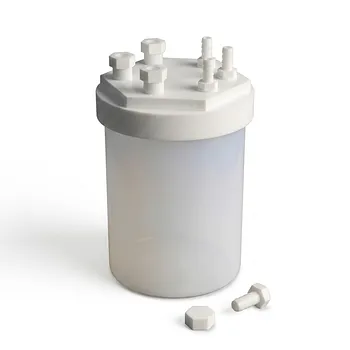
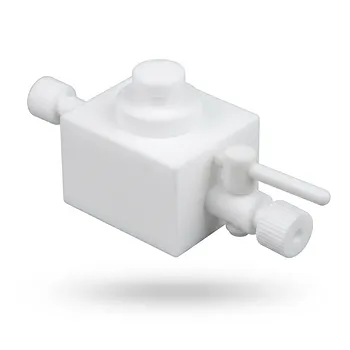
Fluoropolymers generally provide the strongest combination of chemical resistance and low permeation for fluid-transfer components. Compared with PA-12 and HDPE, materials such as PTFE, PFA, and FEP are less likely to swell, soften, lose strength, or allow aggressive chemicals to diffuse through the component. However, the actual performance depends on the specific fluoropolymer, fluid, temperature, pressure, wall thickness, and exposure duration.
For aggressive chemicals, high-purity fluids, and low-emission applications, fluoropolymers usually offer the greatest safety margin. PA-12 and HDPE can be effective and economical for less demanding service, but their higher absorption, swelling, and permeation can become limiting during long-term exposure or when handling volatile solvents and hydrocarbon mixtures.
Why Fluoropolymers Resist Chemical Attack
The protective role of fluorine
Fluoropolymers owe much of their stability to the strong carbon-fluorine bond. Fluorine atoms also form a protective sheath around the carbon backbone, making it more difficult for chemicals, heat, and reactive species to attack the polymer structure.
This chemistry helps PTFE, PFA, and FEP retain their integrity when exposed to corrosive reagents, aggressive solvents, and many hydrocarbon fuels.
Resistance to swelling and degradation
Chemical absorption can cause a polymer to swell, soften, lose dimensional accuracy, or develop stress cracks. Fluoropolymers typically show minimal swelling under demanding exposure, with the cited data indicating weight increases commonly below 3–5% in aggressive service.
PA-12 and HDPE may also resist many chemicals, but their non-fluorinated structures generally permit greater absorption and solvent interaction in particularly aggressive mixtures. The result can be reduced stiffness, dimensional change, and degradation of seals or fittings.
Retention of mechanical strength
For a fluid-transfer component, chemical resistance is not only about whether the material visibly dissolves. The material must also retain burst strength, flexibility, sealing force, and dimensional stability.
Fluoropolymers generally preserve a much higher proportion of their original mechanical performance after extended exposure. In contrast, swelling and plasticization in PA-12 or HDPE can reduce pressure capability and compromise leak-free connections.
How Permeation Differs
Permeation is a transport problem
Permeation occurs when small molecules dissolve into a polymer, diffuse through its free volume, and leave on the opposite side. It can cause fuel vapor loss, chemical emissions, contamination, odor transmission, or changes in the composition of high-purity fluids.
A material can therefore be chemically compatible in the short term while still having an unacceptable permeation rate over long-term service.
Fluoropolymers typically provide the lowest barrier rates
Highly fluorinated materials such as PFA, FEP, and PTFE generally offer better barrier performance than conventional polymers for many water vapor, solvent, and hydrocarbon applications. The reference data gives water-vapor permeation values of approximately:
- PFA and FEP: 13 × 10⁻¹³ cm³·cm/(cm²·s·Pa) at 25°C
- PTFE: 25 × 10⁻¹³ cm³·cm/(cm²·s·Pa) at 25°C
These values illustrate that fluoropolymer performance also varies within the fluoropolymer family. PFA and FEP can provide lower water-vapor permeation than PTFE in the cited comparison.
PA-12 and HDPE require application-specific evaluation
PA-12 and HDPE are not universally poor barrier materials. Both are widely used because they offer useful chemical resistance, manufacturability, and cost advantages.
Their limitation is that permeation can increase substantially with aggressive solvents, aromatic hydrocarbons, elevated temperature, pressure, and prolonged exposure. Reported permeation for conventional polymers in aggressive mixtures can reach hundreds of g·mm/m²/day, but such values should be treated as application-specific rather than as universal ratings for every PA-12 or HDPE formulation.
Wall thickness and temperature matter
Permeation decreases as the component wall becomes thicker, but increasing thickness may not be practical in compact tubing, valve seats, or molded fittings. Higher temperature generally accelerates molecular diffusion and can also increase polymer swelling.
Permeation testing should therefore use the actual fluid, temperature, pressure, component geometry, and expected service duration whenever the application has strict emissions or purity requirements.
Selecting Among Common Fluoropolymers
PTFE for low friction
PTFE has exceptionally low surface friction and strong chemical resistance. It is well suited to dynamic seals, stopcocks, valve components, and applications where non-stick behavior and low actuation force are important.
Its mechanical properties and dimensional behavior may require attention in high-pressure or tightly toleranced designs, so chemical compatibility alone should not determine the selection.
PFA for high-purity containment
PFA combines PTFE-like chemical resistance with better melt processability and precise fabrication capability. It is often selected for high-purity tubing, fittings, sample containers, and fluid-handling components where low contamination and controlled geometry matter.
The cited data also identifies PFA as having strong water-vapor barrier performance relative to PTFE.
FEP for chemical and dielectric performance
FEP provides high chemical resistance and excellent dielectric properties, with somewhat higher friction than PTFE. It can be appropriate when chemical inertness, electrical insulation, and processing characteristics are important together.
The correct choice still depends on pressure, temperature, flexibility, permeability, and fabrication requirements.
Understanding the Trade-offs
Fluoropolymers cost more
PTFE, PFA, and FEP generally carry higher material and processing costs than PA-12 or HDPE. For moderate fluids and short service lives, the additional barrier performance may not justify the expense.
The business case becomes stronger when failures would cause leakage, downtime, contamination, emissions, or frequent replacement.
Mechanical design can be more demanding
Many fluoropolymers have lower stiffness or different creep behavior than engineering plastics such as PA-12 and HDPE. Components exposed to sustained pressure, compression, or elevated temperature must be designed around the selected grade's mechanical limits.
A fluoropolymer may be chemically ideal but still require reinforcement, a support layer, or a different sealing geometry.
Compatibility is not universal
Fluoropolymers have broad chemical resistance, but no material should be treated as compatible with every fluid under every condition. Strong bases, high-temperature service, radiation, mechanical stress, and specific additives can change performance.
The formulation matters as well. Monomer composition and fluorine content influence solvent resistance, temperature capability, low-temperature behavior, and resistance to strong bases.
Permeation and leakage are different risks
Low permeation does not eliminate leakage through fittings, cracks, poor seals, or incorrect assembly. A system can have an excellent tubing material and still fail because of connection design or mechanical damage.
Material selection must therefore be combined with pressure testing, seal evaluation, and appropriate installation controls.
Making the Right Choice for Your Goal
Select the material according to the dominant failure risk and the actual service conditions.
- If your primary focus is maximum chemical resistance: Choose a suitably rated fluoropolymer such as PTFE, PFA, or FEP, then verify compatibility with the specific chemical mixture and operating temperature.
- If your primary focus is minimum permeation or emissions: Prioritize a low-permeation fluoropolymer, with PFA or FEP often providing strong barrier performance, and validate the complete component geometry.
- If your primary focus is high-purity fluid handling: Favor PFA or another qualified high-purity fluoropolymer because low surface interaction, low contamination risk, and stable chemistry are central requirements.
- If your primary focus is cost-effective transfer of less aggressive fluids: Evaluate HDPE or PA-12, provided testing confirms acceptable swelling, permeation, pressure retention, and service life.
- If your primary focus is low-friction valve or seal operation: Consider PTFE, while accounting for creep, load, pressure, and dimensional-control requirements.
For demanding fluid-transfer systems, the right material is the one that preserves both chemical integrity and functional performance for the full life of the component.
Summary Table:
| Material | Chemical Resistance | Permeation (Water Vapor) | Key Advantages | Key Limitations |
|---|---|---|---|---|
| PTFE | Exceptional | 25 × 10⁻¹³ cm³·cm/(cm²·s·Pa) | Low friction, high chemical resistance | Higher cost, mechanical design considerations |
| PFA | Exceptional | 13 × 10⁻¹³ cm³·cm/(cm²·s·Pa) | High purity, low permeation, melt processable | Higher cost |
| FEP | Exceptional | 13 × 10⁻¹³ cm³·cm/(cm²·s·Pa) | High chemical resistance, dielectric properties | Higher cost, higher friction than PTFE |
| PA-12 | Good for moderate fluids | Higher (application-specific) | Lower cost, good mechanical properties | Swelling, permeation with aggressive chemicals |
| HDPE | Good for moderate fluids | Higher (application-specific) | Lower cost, durable | Swelling, permeation with aggressive chemicals |
Optimize your fluid transfer systems with high-performance fluoropolymers from KINTEK. Our PTFE and PFA components are engineered for superior chemical resistance and low permeation, ensuring safety and reliability in demanding applications. Whether you need custom machined parts or standard labware, our expertise supports your success. Contact us today to discuss your requirements and receive a tailored solution. Get in touch now!
Related Products
- Custom PTFE Flask 250ml High Purity Fluoropolymer Laboratory Vessel for Chemical Research
- Custom PTFE Insulating Gaskets and Corrosion Resistant Fluoropolymer Seals for Industrial Electrical Applications
- Custom PFA Tubing 1/4 Inch High Purity Corrosion Resistant Fluoropolymer Tube with Welding and Machining Services
- High Temperature Resistant PTFE Thermal Insulation Board Corrosion Resistant Metal Free Fluoropolymer Stand for Ultra Clean Laboratories
- High Purity PFA Chromatography Columns and Collection Bottles Corrosion Resistant Fluoropolymer Filtration Systems for Trace Analysis
People Also Ask
- What are the key steps for structural integrity in molded PTFE lab reaction vessels? Master fine powder processing.
- What toxicological hazards and safe handling protocols must be established when PTFE fluoropolymer reaction vessels are subjected to pyrolysis temperatures? Learn essential safety measures now.
- When synthesizing TFVE monomers involving reactive organometallic reagents and aggressive polar solvents, what material performance characteristics are required? Ensure purity with PTFE/PFA.
- Why Are High-Purity Fluoropolymer Vessels and Tubing Critical for Trace Analysis? Prevent Contamination Reliably
- How does pressure management influence molar mass distribution and reaction rate in the iodine transfer emulsion polymerization of vinylidene fluoride, and how do custom fluoropolymer reaction vessels support this process?