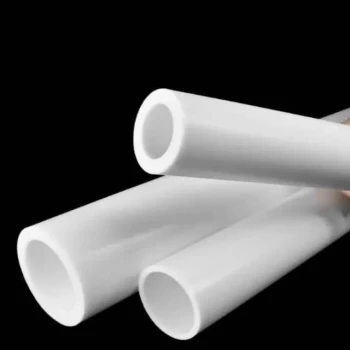
Extrusion variables determine which wall region becomes more porous by controlling material flow, interfacial structure, and the response of the concentric preforms during expansion. In dual-porosity ePTFE tubing, co-extruded inner and outer tubular billets are stretched and heat set to create different node-and-fibril structures. Moving the mandrel forward, reducing extrusion speed, or heating the mandrel generally decreases outer-surface porosity relative to inner-surface porosity. Lubricant concentration and PTFE particle size provide additional control over fibril spacing and pore size, typically across a range of approximately 10 to 40 µm.
Differential porosity is engineered before expansion and then fixed during stretching and heat setting. Mandrel position, extrusion speed, mandrel temperature, lubricant level, resin particle size, reduction ratio, and thermal history determine how densely each concentric layer consolidates and how its nodes and fibrils develop.
How the Concentric Wall Structure Is Created
Co-extrusion establishes the two material zones
Dual-porosity tubing begins with concentric tubular preforms: an inner billet forms the bore-side wall, while an outer billet forms the external wall. Each billet can use a different resin particle size or lubricant concentration.
This creates two independently tunable starting structures within one tube. Subsequent longitudinal stretching and heat setting transform those structures into distinct porous layers.
The wall is governed by node-and-fibril architecture
During expansion, PTFE particles separate into nodes connected by highly oriented fibrils. The distance between these features controls the effective pore size, permeability, and mechanical behavior of each wall region.
A more tightly spaced fibril network generally produces lower porosity and smaller effective flow paths. Larger intermodal distances create more open structures and higher permeability.
Which Extrusion Variables Change Differential Porosity
Mandrel position changes outer-wall consolidation
Positioning the mandrel forward during extrusion decreases the porosity of the outer tube surface relative to the inner surface. The mandrel position changes the geometry and flow conditions experienced by the concentric preforms as they pass through the die.
This provides a way to create an asymmetric wall without relying solely on post-extrusion processing. The resulting tubing can have a denser exterior with a more open inner region.
Lower extrusion speed increases thermal exposure
Reducing extrusion speed increases the time the material spends in the heated die or shaping zone. Greater thermal exposure promotes more complete particle coalescence and interfacial welding before expansion.
For the dual-porosity structure described in the reference, lower speed reduces the porosity of the outer surface relative to the inner surface. Excessively high speed can instead leave charge lines, residual voids, and incompletely welded regions that weaken the wall and make porosity less uniform.
Mandrel heating densifies the outer region
Heating the mandrel during extrusion also decreases outer-surface porosity relative to inner-surface porosity. The heated mandrel changes the thermal history of the material adjacent to the bore and affects how the concentric layers consolidate.
This variable must be coordinated with die temperature and downstream expansion conditions. A local change in temperature can alter both the density of the preform and the fibril structure produced during stretching.
Lubricant concentration controls pore openness
The extrusion lubricant reduces internal friction during paste extrusion and affects how the PTFE particles pack and deform. Higher lubricant concentrations generally produce higher surface porosity after extrusion and longitudinal stretching, while lower concentrations tend to produce lower porosity.
Using different lubricant levels in the inner and outer billets allows the two wall regions to be tuned separately. The concentration must remain balanced: too little lubricant can raise extrusion pressure and impair uniformity, while too much can make the preform excessively soft or create difficult pressure-control conditions.
Resin particle size adjusts fibril spacing
Changing PTFE resin particle size between the inner and outer billets changes the way particles pack, deform, and separate during expansion. This affects intermodal fibril distance and therefore the resulting pore size.
Particle-size selection is especially useful when the application requires different permeability or retention behavior on the two sides of the wall. In combination with lubricant concentration, it enables finer control than either variable provides alone.
How Expansion and Heat Setting Fix the Structure
Expansion ratio controls pore size
The extrusion variables establish the initial material condition, but stretching determines how far the nodes separate and how strongly the fibrils orient. Increasing the expansion ratio generally increases node-to-node spacing and produces a more open porous structure.
The cited processing range of approximately 2.7:1 to 4.8:1 can shift pore dimensions across a broader design window. The appropriate ratio depends on the desired balance among permeability, fluid retention, wall strength, and dimensional stability.
Stretch temperature changes fibril development
Thermal exposure during stretching affects PTFE mobility and the final node-and-fibril arrangement. Stretching conditions in the approximate range of 225°C to 300°C, followed by sintering near the PTFE sintering temperature, can substantially change pore size and porosity.
Heat setting then stabilizes the expanded architecture. If the thermal history differs between the inner and outer regions, the layers may retain different levels of shrinkage, fibril spacing, and permeability.
Sintering time affects wall integrity
Sufficient residence time at sintering temperature promotes particle coalescence and charge-to-charge welding. This improves mechanical integrity and reduces unwanted internal voids that could otherwise be mistaken for intentionally engineered porosity.
Residence time increases as extrusion speed decreases and also depends strongly on wall thickness. Insufficient time can leave weak, poorly welded regions, while excessive thermal exposure may reduce the intended openness of the porous structure.
Understanding the Trade-offs
Lower porosity improves containment but reduces permeability
A denser outer wall can improve fluid retention, pressure resistance, and protection against external contamination. The trade-off is lower gas or liquid transmission through that region.
A more porous inner wall may support fluid exchange or filtration, but it can also increase the risk of permeation or particle passage if pore size is not tightly controlled.
Higher lubricant levels improve flow but can reduce process stability
Increasing lubricant concentration lowers extrusion pressure and can support greater porosity after expansion. However, excessive lubricant can soften the preform and make dimensional control more difficult.
Lubricant selection must therefore account for both extrusion behavior and the final porous architecture. Pressure alone is not a sufficient process target.
Higher extrusion speed improves throughput but reduces consolidation time
Fast extrusion can increase production rate, but it reduces residence time in the heated region. If the material does not receive enough thermal exposure, incomplete welding and residual voids can reduce strength and wall uniformity.
Operating below the theoretical maximum speed provides greater opportunity for complete consolidation. Production speed should be selected together with die length, temperature, wall thickness, and required mechanical performance.
Greater expansion creates openness but can reduce robustness
Increasing the expansion ratio can increase permeability and pore size, but excessive stretching may reduce wall density or create nonuniform fibril structures. The two concentric layers may also respond differently if their resin and lubricant formulations are not compatible with the same expansion schedule.
The expansion process must preserve the intended contrast between inner and outer porosity rather than merely maximizing total porosity.
Geometry and die design affect repeatability
Reduction ratio, die cone angle, die land length, and mandrel geometry influence extrusion pressure, particle orientation, wall thickness, and flow balance between the two billets. Uneven flow can produce circumferential or axial variations in porosity.
These variables are therefore part of the porosity design, not merely equipment settings. A stable pressure profile and uniform concentric flow are necessary for repeatable differential porosity.
How to Apply This to Your Project
The correct parameter set depends on whether the tubing must prioritize filtration, permeability, fluid retention, or mechanical containment.
- If your primary focus is lower outer-wall porosity: Position the mandrel forward, reduce extrusion speed, or heat the mandrel while maintaining sufficient thermal control to consolidate the outer region more densely than the inner region.
- If your primary focus is higher permeability: Use a higher lubricant concentration or a resin formulation that promotes greater fibril spacing, then select an expansion ratio and stretch temperature that produce the required pore size.
- If your primary focus is precise inner-to-outer porosity contrast: Formulate the inner and outer billets independently by varying lubricant concentration and resin particle size, then validate both layers after the same expansion and heat-setting cycle.
- If your primary focus is wall strength and containment: Provide adequate heated-die residence time, avoid excessive extrusion speed, and use a reduction ratio and die geometry that minimize residual voids and uneven wall flow.
- If your primary focus is a defined pore-size range: Control particle size, lubricant level, expansion ratio, and stretch temperature together, because no single extrusion variable determines the final 10-to-40 µm pore structure.
Reliable dual-porosity ePTFE tubing comes from treating extrusion, expansion, and heat setting as one linked structure-design process.
Summary Table:
| Variable | Effect on Outer vs Inner Porosity | Notes |
|---|---|---|
| Mandrel position (forward) | Decreases outer porosity | Alters flow and consolidation |
| Extrusion speed (lower) | Decreases outer porosity | Longer thermal exposure |
| Mandrel heating | Decreases outer porosity | Changes thermal history |
| Lubricant concentration (higher) | Increases porosity (whole wall) | Adjust per layer for contrast |
| Resin particle size (larger) | Increases fibril spacing | Tunable per layer |
| Expansion ratio (higher) | Increases pore size (both) | Use 2.7:1 to 4.8:1 |
| Stretch temperature (higher) | Increases openness | 225-300°C range |
To achieve precise differential porosity in your ePTFE components, trust KINTEK's high-performance PTFE/PFA expertise. Our custom CNC machining and laboratory supplies ensure your dual-porosity tubing meets exact specifications. Contact us today to discuss your project and benefit from our tailored solutions!
Related Products
- Custom PTFE Digestion Tubes and High Purity Polytetrafluoroethylene Centrifuge Vessels 60ml for Trace Analysis
- Custom High Purity PTFE Digestion Tubes and Centrifuge Tubes for Trace Metal Analysis
- High Purity PTFE Digestion Tubes and Custom Centrifuge Tubes 100ml for Trace Analysis and Chemical Digestion
- Custom PTFE Condenser Tube 100ml Serpentine and Straight Fluoropolymer Laboratory Heat Exchanger with Flask Adapters
- Custom PTFE Digestion Tube Double Sided Openable High Temperature Corrosion Resistant Low Background
People Also Ask
- How do PTFE digestion tubes assist in pharmaceutical and biological sample preparation? Ensure High Recovery & Purity
- How do PTFE digestion tubes minimize contamination during ultra-trace elemental analysis? Achieve high-purity results.
- What is the primary function of PTFE digestion tubes in a laboratory setting? Essential for Pure Sample Mineralization
- What are the common capacities and physical configurations available for PTFE digestion tubes? Expert Selection Guide
- How do PTFE digestion tubes facilitate the analysis of food and agricultural products? Ensure High-Purity Mineralization