Reactor conditioning and reagent introduction are controlled as a sequence of leak testing, oxygen removal, and contamination-free charging. The reactor is first pressurized with nitrogen to approximately 30 bar to confirm leak-tightness, then evacuated to about 10⁻² mbar for 40 minutes to remove residual oxygen. Liquid reactants and dissolved initiators are added through inert funnels, while gaseous fluoroalkenes are introduced by differential weighing.
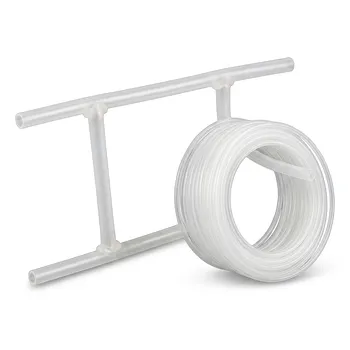
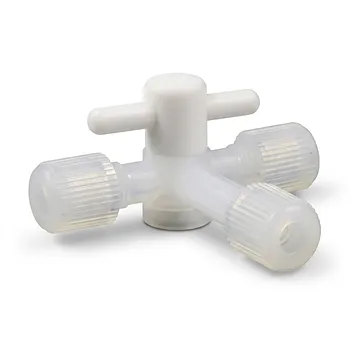
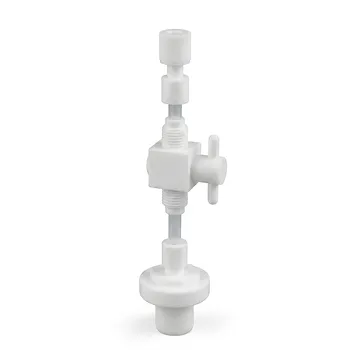
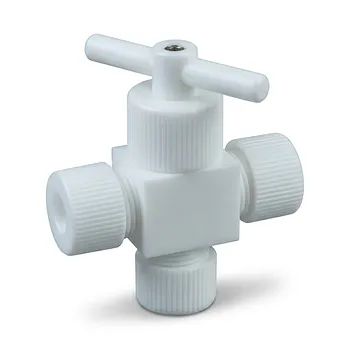
The process depends on both a clean, oxygen-free reactor and reliable high-pressure fluid handling. PTFE and PFA tubing, valves, and fittings help preserve vacuum integrity, resist aggressive fluorinated chemicals, and prevent metallic or ionic contamination from entering the polymerization.
How the Reactor Is Conditioned
Leak testing with nitrogen
Before charging reactants, the reactor is pressurized with inert nitrogen to roughly 30 bar. This verifies that the vessel, connections, valves, and transfer lines can retain pressure before reactive monomers are introduced.
A nitrogen pressure test also avoids using the fluorinated monomers themselves to diagnose leaks, reducing both safety risk and material loss.
High-vacuum evacuation
After the pressure test, the reactor is evacuated to approximately 10⁻² mbar for 40 minutes. This step removes oxygen and other residual gases from the reactor and connected transfer path.
Oxygen removal is critical because radical polymerizations are sensitive to oxygen, which can interfere with radical initiation and alter conversion or molecular-weight control.
Conditioning the complete fluid path
The conditioning operation must include more than the reaction vessel alone. Transfer tubing, valves, fittings, and inlet assemblies form part of the reaction environment and must also be evacuated and isolated without introducing leaks.
This is why seal quality and material compatibility are process requirements, not merely equipment preferences.
How Reactants Are Introduced
Charging liquid reactants
Liquid comonomers, solvents, and other liquid ingredients are introduced through inert funnels or equivalent closed charging arrangements. The use of inert transfer paths limits exposure to atmospheric oxygen and reduces the chance of contamination.
Dissolved initiators are introduced in the same controlled manner, allowing the initiator solution to enter the reactor without relying on open handling.
Introducing gaseous fluoroalkenes
Gaseous monomers such as chlorotrifluoroethylene, hexafluoropropylene, and perfluoromethylvinyl ether are added by differential weighing. The source vessel is weighed before and after transfer, and the mass difference determines how much gas has entered the reactor.
This method is useful for high-pressure gases because direct volumetric measurement can be affected by pressure, temperature, and gas compressibility.
Maintaining a closed, inert system
The sequence is designed to keep the reactor closed after evacuation and to minimize atmospheric exposure during charging. Once the liquid and gaseous components are loaded, the reactor can be sealed and brought to the required polymerization conditions.
For formulations that are susceptible to acid-catalyzed side reactions, a weak base such as potassium carbonate may also be included before heating. That addition is formulation-dependent rather than a universal requirement for every fluoroalkene copolymerization.
Why Fluoropolymer Fluid Transfer Components Matter
Chemical resistance under aggressive exposure
Fluorinated monomers, fluorinated solvents, and reactive gases can attack ordinary plastics, elastomers, and metals. PTFE and PFA provide high resistance to these environments, helping tubing, valves, and fittings retain their mechanical and chemical integrity.
This is particularly important during repeated evacuation, pressurization, and exposure to reactive fluorinated compounds.
Preserving vacuum and pressure integrity
The reactor must remain leak-tight during both the nitrogen pressure test and high-vacuum evacuation. Compatible fluoropolymer components and properly designed compression fittings help maintain the necessary seals across changing pressure conditions.
A small leak can admit oxygen during evacuation or release hazardous monomer during operation, compromising both reaction quality and safety.
Preventing contamination
Metallic components or unsuitable polymeric materials may contribute trace impurities through corrosion, surface degradation, or leaching. High-purity PTFE and PFA fluid paths reduce the risk of introducing metallic, ionic, or particulate contamination into the reaction mixture.
That purity is valuable because even low-level contamination can affect radical chemistry, polymer color, composition, or downstream material performance.
Supporting repeatable reagent delivery
Consistent tubing and valve surfaces provide a more predictable transfer path for liquid reagents and gaseous monomers. This improves reproducibility in the amount of material delivered and reduces variation between polymerization runs.
The benefit is not that fluoropolymer components replace process control; they make the controlled process technically achievable.
Understanding the Trade-offs
Chemical inertness does not eliminate mechanical limits
PTFE and PFA are highly chemically resistant, but component selection still has to account for pressure rating, temperature, wall thickness, fitting design, and creep. A chemically compatible material can still be unsuitable if the assembly is not rated for the operating conditions.
High-pressure service therefore requires a complete component-level assessment, not just a material-name check.
Compression fittings require careful installation
A fluoropolymer tube can be compatible with the chemistry while the fitting geometry, ferrule, or sealing method remains inadequate. Improper installation can cause leaks, tube deformation, or poor repeatability during evacuation and pressurization.
Fittings should be selected and assembled according to the supplier’s pressure and temperature specifications.
Fluoropolymer components are not a substitute for inert procedures
Using PTFE or PFA does not remove the need for nitrogen leak testing, high-vacuum evacuation, controlled weighing, and proper isolation. Equipment compatibility and operating discipline must work together.
The process is reliable only when both the materials and the procedure control oxygen ingress, leakage, and contamination.
Pressure changes must be interpreted carefully
During heating, pressure may initially rise because of thermal expansion. Later pressure changes can reflect monomer consumption, but pressure alone should not be treated as a complete measure of conversion without considering temperature and system behavior.
This distinction is important when monitoring a strongly exothermic high-pressure reaction.
Applying the Process to Your Setup
The practical sequence is to qualify the entire reactor and transfer system before introducing reactive monomers.
- If your primary focus is oxygen control: Pressure-test the assembled system with nitrogen, then evacuate the complete fluid path to approximately 10⁻² mbar for 40 minutes before charging.
- If your primary focus is accurate reagent dosing: Add liquids and dissolved initiators through inert funnels, and determine gaseous monomer delivery by differential weighing.
- If your primary focus is contamination prevention: Use high-purity PTFE or PFA tubing, valves, and fittings wherever they contact the reactants or evacuated volume.
- If your primary focus is pressure safety: Verify the pressure and temperature ratings of the complete assembly, including fittings and seals, rather than evaluating tubing material alone.
A well-conditioned reactor and chemically compatible transfer system provide the foundation for safe, reproducible fluoroalkene copolymerization.
Summary Table:
| Aspect | Details |
|---|---|
| Leak Testing | Pressurize with nitrogen to ~30 bar to ensure leak-tightness. |
| Evacuation | Evacuate to ~10⁻² mbar for 40 minutes to remove oxygen. |
| Liquid Reagents | Add via inert funnels; dissolved initiators included. |
| Gaseous Monomers | Introduce by differential weighing (mass difference). |
| Fluoropolymer Components | PTFE/PFA tubing, valves, fittings resist chemicals, maintain vacuum, prevent contamination. |
| Contamination Prevention | High-purity PTFE/PFA minimize metallic/ionic impurities. |
| Process Integrity | Inert procedures (N2 test, evacuation) are essential; materials are not a substitute. |
Ensure reliable, contamination-free fluoroalkene polymerization with our high-purity PTFE and PFA fluid transfer components. From tubing and valves to custom CNC-machined parts, KINTEK supports your lab's demanding high-pressure processes. Contact us today to optimize your system – Get in touch with our team!
Related Products
- Corrosion Resistant High Purity PFA Valve and Weldable Transparent Tubing for Semiconductor Fluid Transfer
- Corrosion Resistant PFA Tubing 1/4 Inch Custom Molded Welded Fluid Transfer Components
- High Purity PFA Valves and Weldable Corrosion Resistant Transparent Tubing for Semiconductor Sensor Manufacturing Fluid Transfer
- High Purity PFA PTFE Flare Stop Valves Customizable 2-Way 3-Way Reducing Fluoropolymer Fluid Control Solutions
- Custom PTFE Valve 2-Way 3-Way Corrosion Resistant Low Background Virgin Fluoropolymer Industrial Fluid Control
People Also Ask
- Why are high-purity PFA fluid transfer components required for OSDAs and silica? Ensure Precision in Zeolite Synthesis
- Why are high-purity PFA components for MOF-derived electrocatalysts essential? Achieve Absolute Chemical Purity
- Why are high-purity PFA fluid transfer components preferred for battery electrolytes? Ensure Purity & Data Accuracy
- How does high-purity PFA tubing maintain reagent purity? Achieve Ultra-Smooth, Zero-Contamination Fluid Transfer
- How do high-precision PFA fluid transfer components, such as tubing and fittings, affect the results of continuous-flow synthesis?