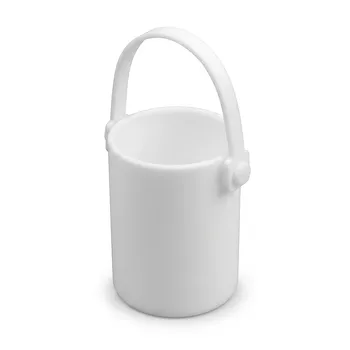
Selecting high-performance PTFE or PFA liners is critical because they provide the chemical inertness required to survive strong alkaline environments while ensuring the purity of the zeolite framework. These materials prevent metal ion leaching from the reaction vessel and feature low-surface-energy finishes that facilitate uniform ultrasonic energy distribution. Without these specific fluoropolymers, the synthesis process risks contamination and inefficient crystallization.
The use of PTFE or PFA liners in NaX zeolite synthesis is a strategic choice to isolate the reaction from metallic contamination and ensure that ultrasonic cavitation energy is directed entirely into the precursor solution rather than being absorbed by wall-adhered crystals.
Protecting Chemical Purity in Aggressive Environments
Resistance to Strong Alkaline Media
The synthesis of NaX zeolite typically occurs in highly alkaline environments, often involving concentrated sodium hydroxide (NaOH). High-performance fluoropolymers like PTFE and PFA are uniquely resistant to these caustic solutions, which would otherwise corrode standard laboratory glass or low-grade plastics.
Prevention of Ion Leaching
Corrosion of the reaction vessel can introduce unwanted metallic impurities, aluminum, or silicon into the solution. By acting as a total chemical barrier, these liners ensure that the final zeolite framework remains pure and its catalytic or adsorptive properties are not compromised by trace contaminants.
Integrity of the Zeolite Framework
Precise control over the framework structure requires an environment free from external chemical interference. PTFE and PFA maintain their stability at the synthesis temperature (70°C) and higher, ensuring no organic or inorganic fragments from the liner itself enter the reaction.
Enhancing Ultrasonic Efficiency and Product Recovery
Minimizing Crystal Adhesion
PTFE and PFA possess low surface energy, which creates a "non-stick" environment. This prevents NaX crystals from adhering to the vessel walls during the nucleation and growth phases, which is essential for maximizing the yield of the collected product.
Optimizing Ultrasonic Cavitation
In ultrasonic-assisted synthesis, cavitation energy must be distributed uniformly throughout the precursor solution to drive molecular reorientation. Smooth liner surfaces prevent the buildup of solid layers on the walls, ensuring that the ultrasonic waves are not dampened or unevenly reflected.
Facilitating Complete Sample Recovery
The non-stick nature of these fluoropolymers allows for the effortless detachment of the synthesized powder after the reaction is complete. This ensures the integrity of the morphology, such as nanoflowers or nanorod arrays, which can be delicate and easily damaged during aggressive manual recovery.
Understanding the Trade-offs
Mechanical Wear from Ultrasonics
While chemically inert, PTFE is relatively soft and can be subject to mechanical erosion over long periods of intense ultrasonic exposure. It is important to inspect liners for "pitting," which can create micro-pockets where impurities might eventually lodge.
Thermal Expansion Limitations
PTFE and PFA have high coefficients of thermal expansion compared to the stainless steel jackets of hydrothermal autoclaves. If the cooling process is too rapid, the liner can deform or lose its seal, potentially leading to leaks or "creeping" of the alkaline solution between the liner and the metal wall.
How to Apply This to Your Synthesis Project
When selecting a liner for your specific zeolite or nanoparticle synthesis, consider your primary performance requirements:
- If your primary focus is maximum purity: Use high-purity PFA liners, as they generally have lower trace-metal extractables and smoother surfaces than standard PTFE.
- If your primary focus is cost-effective routine synthesis: Standard PTFE liners are sufficient for most NaX zeolite applications at 70°C, providing excellent chemical resistance at a lower price point.
- If your primary focus is high-temperature hydrothermal synthesis (above 150°C): Ensure your liner is housed in a high-pressure stainless steel autoclave to prevent the fluoropolymer from deforming under its own thermal expansion.
Choosing the right fluoropolymer liner ensures that your NaX zeolite synthesis remains pure, efficient, and reproducible across multiple batches.
Summary Table:
| Feature | Benefit for NaX Zeolite Synthesis | Recommended Material |
|---|---|---|
| Chemical Resistance | Resists concentrated NaOH; prevents vessel corrosion. | PTFE / PFA |
| Non-Stick Surface | Prevents crystal adhesion and ensures easy sample recovery. | PFA (Smoother) |
| Purity Control | Eliminates metal leaching for a clean zeolite framework. | High-Purity PFA |
| Ultrasonic Optimization | Uniform cavitation energy distribution; prevents wave damping. | High-Density PTFE |
| Thermal Stability | Maintains integrity during synthesis at 70°C and above. | PTFE / PFA |
Elevate Your Synthesis Precision with KINTEK
Maximize the purity and yield of your NaX zeolite synthesis with KINTEK’s specialized fluoropolymer solutions. From everyday basic labware like beakers, crucibles, and reagent bottles to advanced hydrothermal synthesis liners and microwave digestion vessels, we provide the high-performance PTFE and PFA components your research demands.
Whether you need comprehensive fluid transfer components (tubing, fittings, valves), sample prep tools (filters, pipettes, tweezers), or bespoke laboratory setups tailored via our end-to-end custom CNC fabrication, KINTEK ensures an absolute focus on high-performance materials. Don't let metallic contamination or inefficient recovery compromise your framework—trust the experts in fluoropolymer labware.
Ready to optimize your lab's performance? Contact us today to discuss your standard or custom requirements!
References
- Susi Nurul Khalifah, Anton Prasetyo. Synthesis of NaX Zeolite from Blitar Kaolin via Hydrothermal and Sonication Methods with Alkali Fusion Pre-treatment. DOI: 10.14710/jksa.28.5.274-282
This article is also based on technical information from Kintek Knowledge Base .
Related Products
- High Purity PTFE Microwave Digestion Vessel Replacement Liner for Acid Sample Preparation and Trace Analysis
- High Purity PTFE Microwave Digestion Vessel for Soil and Food Analysis Acid Resistant Fluoropolymer Sample Preparation Liners
- Custom TFM Reaction Vessel with Stainless Steel Jacket and PTFE Inner Cup for High Corrosion Resistance
- Custom PTFE Sleeves and Hollow Rods for Advanced Applications
- Customizable PTFE Rods for Advanced Industrial Applications
People Also Ask
- How does the dielectric property of PTFE benefit microwave-assisted digestion? Unlock Rapid and Uniform Sample Heating
- What safety features are commonly integrated into microwave digestion vessels? Ensuring High-Pressure Laboratory Safety
- What are the advantages of using microwave digestion vessels for environmental analysis? Boost speed and sample accuracy.
- What are the advantages of using microwave digestion vessels? Optimize EG@MO synthesis with superior thermal control.
- How do microwave digestion vessels support pharmaceutical elemental impurity testing? Achieve Precise USP Compliance