Precision is the bedrock of mechanoluminescence data. High-precision CNC (Computer Numerical Control) fabrication is essential because the light emission intensity of $Cs_2NaScCl_6:Sb^{3+}$ is acutely sensitive to the magnitude and frequency of applied mechanical force. By utilizing CNC-machined fixtures, researchers ensure perfect mechanical alignment and a constant contact area, which are the only ways to guarantee that the resulting data reflects the material's properties rather than experimental error.
High-precision CNC machining eliminates mechanical instability, ensuring that the force applied to $Cs_2NaScCl_6:Sb^{3+}$ films is consistent and reproducible. This level of control is the only way to distinguish true material performance from environmental and mechanical noise.
The Physical Sensitivity of $Cs_2NaScCl_6:Sb^{3+}$
Sensitivity to Force Magnitude and Frequency
The mechanoluminescence (ML) of $Cs_2NaScCl_6:Sb^{3+}$ is not a static value; it fluctuates significantly based on how force is applied. Even minor deviations in the frequency of mechanical stimulus or the total applied force can lead to massive variations in light output.
The Role of Constant Contact Area
To obtain accurate data, the interface between the force applicator and the ML film must remain uniform. CNC fabrication produces components with micrometer-level tolerances, ensuring the contact area does not shift or deform during dynamic testing.
How CNC Fabrication Stabilizes the Testing Environment
Ensuring Perfect Mechanical Alignment
Custom brackets and fixtures act as the bridge between linear motors, force gauges, and the sample. CNC machining ensures these components are perfectly squared and aligned, preventing "off-axis" forces that would skew intensity readings.
Minimizing Mechanical Noise and Loosening
As seen in complex electroreduction experiments, mechanical stability is key to reducing experimental noise. High-precision parts fit together with extreme tightness, preventing the subtle loosening or vibrations that occur during high-frequency testing.
Improving Analytical Reliability
When the spatial orientation of the sample remains absolutely stable, the resulting data is much cleaner. This precision allows for more accurate scattering data fitting and ensures that analytical models are based on physical reality rather than mechanical artifacts.
Understanding the Trade-offs
Cost and Lead Times
While CNC machining offers unmatched precision, it is significantly more expensive and time-consuming than 3D printing or manual fabrication. Research teams must weigh the high upfront cost of custom fixtures against the necessity of high-fidelity data.
Material Rigidity vs. Flexibility
CNC-machined parts are typically made from rigid metals or high-performance plastics. While this rigidity is excellent for spatial stability, it can sometimes lead to stress concentrations if the fixture design does not account for the natural expansion or contraction of the testing rig.
Applying Precision Machining to Your Research
Selecting the Right Approach for Your Goal
To determine if high-precision CNC is necessary for your specific ML setup, consider the following objectives:
- If your primary focus is obtaining publication-quality repeatable data: Invest in CNC-machined fixtures to ensure that every test run occurs under identical mechanical conditions.
- If your primary focus is exploring new material compositions quickly: Use rapid prototyping for initial trials, but transition to CNC-fabricated components once you begin formal performance characterization.
- If your primary focus is high-frequency dynamic testing: Utilize CNC-machined steel or aluminum brackets to eliminate the vibrations and mechanical "play" that common fabrication methods cannot prevent.
By prioritizing mechanical integrity through high-precision fabrication, you transform a sensitive experiment into a robust and definitive scientific study.
Summary Table:
| Key Requirement | Role in ML Testing | Impact on Research Data |
|---|---|---|
| Mechanical Alignment | Prevents off-axis force application | Minimizes experimental noise and skew |
| Constant Contact Area | Maintains uniform interface with film | Ensures intensity reflects material properties |
| Micrometer Tolerances | Eliminates mechanical "play" and looseness | Guarantees high-frequency reproducibility |
| Material Rigidity | Provides extreme spatial stability | Facilitates accurate analytical data fitting |
Elevate Your Research Precision with KINTEK
Don’t let mechanical instability compromise your $Cs_2NaScCl_6:Sb^{3+}$ mechanoluminescence data. KINTEK specializes in high-performance fluoropolymer materials and precision engineering to support the most demanding laboratory environments.
From high-purity PFA/PTFE trace analysis labware and fluid transfer components (tubing, valves, fittings) to advanced custom reaction apparatus like microwave digestion vessels and electrochemical cells, we provide it all. Our end-to-end custom CNC fabrication capabilities allow us to deliver everything from complex, non-standard machined fixtures to high-volume orders of everyday consumables like beakers and centrifuge tubes.
Ready to secure publication-quality results? Contact KINTEK today to discuss your bespoke laboratory setup and experience the difference that absolute mechanical integrity brings to your scientific studies.
References
- Hao Suo, Feng Wang. Excitation-mode-selective emission through multiexcitonic states in a double perovskite single crystal. DOI: 10.1038/s41377-024-01689-7
This article is also based on technical information from Kintek Knowledge Base .
Related Products
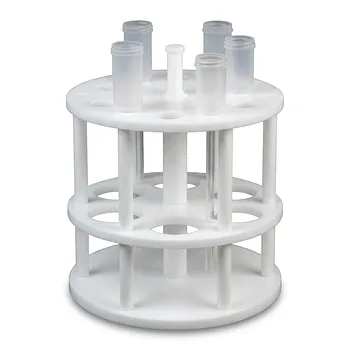
- Custom PFA Microcolumn Racks and PTFE Machined Low Background Corrosion Resistant Laboratory Fixtures
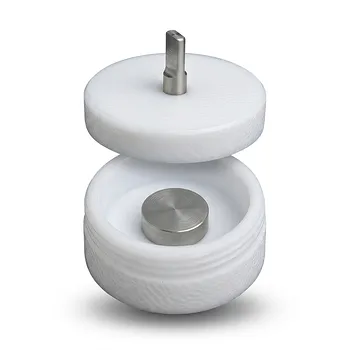
- Acid Resistant PTFE Button Cell Battery Test Fixture Customizable Machining High Purity Electrochemical Testing Clamp
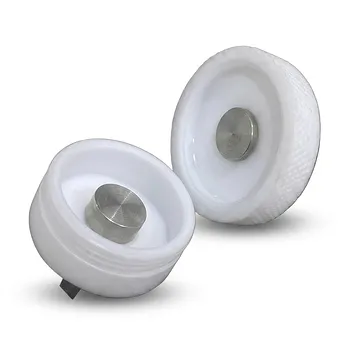
- Corrosion Resistant PTFE Coin Cell Battery Testing Clamps and Acid Proof Custom Fluoropolymer Battery Fixtures
People Also Ask
- What other PTFE lab accessories are commonly used? Essential Tools for Chemical Resistance & Purity
- How does high fluorination in perfluorinated polymers improve chemical resistance and thermal stability of lab apparatus? Discover the science behind PTFE and PFA's superior performance.
- What inherent material characteristics of non-melt-processable PTFE make it suitable for manufacturing high-purity laboratory containers and custom-machined apparatus?
- Why are PTFE and PFA preferred over other fluoropolymers for manufacturing specialized laboratory apparatus and custom machined components? Discover the key advantages and how to select the right material for your lab needs.
- What unique material properties make fluorinated polymers like PTFE and PFA essential for high-performance laboratory equipment and chemical containment? Key advantages explained