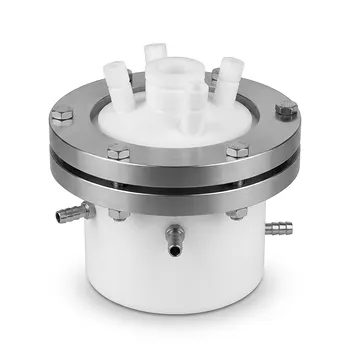
The PTFE-lined autoclave is essential because it provides a chemically inert, high-pressure environment that allows corrosive precursors to react safely at temperatures typically reaching 200°C to 250°C. It prevents the acidic or alkaline solutions used in MoS2 synthesis from destroying the stainless steel outer shell. This sealed setup ensures the high purity required for critical structural changes, such as the phase transition from 2H-MoS2 to the metallic 1T phase.
A PTFE (polytetrafluoroethylene) liner acts as both a protective barrier for the hardware and a controlled reaction chamber for the chemistry. It enables the high-pressure, subcritical conditions required for MoS2 nucleation while ensuring no metallic impurities from the autoclave wall contaminate the final product.
Preventing Reactor Corrosion and Chemical Attack
Resistance to Aggressive Precursors
The synthesis of MoS2 often involves molybdenum and sulfur sources that create highly acidic or strongly polar environments. At elevated temperatures, these chemicals become significantly more reactive and would quickly corrode a standard stainless steel vessel.
Protection of the Structural Shell
While stainless steel provides the mechanical strength to hold high pressure, it is susceptible to chemical pitting and leaching. The PTFE liner isolates the reactants, ensuring the structural integrity of the autoclave remains intact over hundreds of reaction cycles.
Longevity in Harsh Environments
Hydrothermal reactions for MoS2 can last 24 hours or longer. The chemical inertness of PTFE ensures that the liner does not degrade or react with the precursor solutions during these extended periods of thermal stress.
Facilitating Subcritical Conditions and Phase Transitions
Achieving High Autogenous Pressure
The sealed PTFE environment allows solvents to reach temperatures well above their atmospheric boiling points. This creates autogenous pressure, which increases the solubility and reactivity of the precursors, leading to a supersaturated state necessary for crystal growth.
Driving the 1T Phase Transition
Preparation of the metallic 1T-MoS2 phase requires specific subcritical conditions and often involves the intercalation of ions like ammonium. The high-pressure environment maintained by the PTFE liner is critical for driving these ions into the MoS2 layers to induce this metastable phase.
Enhancing Nucleation and Growth
By maintaining stable, high-pressure conditions, the autoclave facilitates the slow growth of high-quality crystals. This controlled environment is what allows for the self-assembly of complex structures, such as MoS2 nanosheets or nanospheres.
Ensuring Material Purity and Recovery
Eliminating Metal Ion Contamination
If the reaction solution were in direct contact with the steel walls, metal ions (like iron or nickel) would leach into the MoS2. The PTFE liner provides a metal-free environment, ensuring the electrical and catalytic properties of the MoS2 are not compromised by impurities.
Maximizing Material Yield
PTFE has an extremely smooth, non-stick surface that reduces the adhesion of nanosheets to the vessel walls. This property makes it much easier to recover the synthesized material and clean the liner for subsequent use.
Maintaining Structural Integrity
The liner ensures that the nucleation and growth processes are governed strictly by the precursor chemistry rather than interactions with the vessel wall. This results in more uniform particle sizes and consistent structural morphology.
Understanding the Trade-offs
Temperature Limitations
While PTFE is highly stable, it has a functional upper limit, typically between 200°C and 250°C. Exceeding these temperatures can cause the liner to soften or deform, potentially leading to a seal failure or "creeping" of the plastic.
Thermal Expansion Mismatch
PTFE and stainless steel expand at different rates when heated. If the autoclave is heated or cooled too rapidly, the differential expansion can damage the liner or make it difficult to remove from the stainless steel shell.
Pressure Sensitivity
Because the liner is not a pressure vessel itself, it relies entirely on the stainless steel shell for support. If the liner is not fitted correctly or if the internal pressure exceeds the shell's rating, the system poses a significant safety risk.
How to Apply This to Your Project
Selection Based on Synthesis Goals
The necessity of a PTFE liner depends on your specific performance requirements and the nature of your chemical precursors.
- If your primary focus is Phase Purity (1T phase): Use a high-quality PTFE liner to ensure the sealed, high-pressure environment required for ion intercalation remains stable throughout the 24-hour cycle.
- If your primary focus is Preventing Contamination: Ensure the liner is thoroughly cleaned with acid between uses, as the non-stick surface is your primary defense against cross-batch metal ion pollution.
- If your primary focus is High-Yield Recovery: Leverage the low-adhesion properties of PTFE by using a centrifuge to collect the product directly from the liner, minimizing material loss on the vessel walls.
Choosing the right PTFE-lined autoclave ensures that your MoS2 synthesis is safe, reproducible, and produces the high-purity crystalline phases required for advanced applications.
Summary Table:
| Key Feature | Advantage in MoS2 Synthesis | Research Benefit |
|---|---|---|
| Chemical Inertness | Resists aggressive acidic/polar precursors | Protects autoclave shell & ensures safety |
| Metal-Free Surface | Prevents leaching of iron or nickel ions | Guarantees high-purity crystalline phases |
| Pressure Retention | Supports high autogenous pressure | Drives MoS2 nucleation and 1T phase growth |
| Non-Stick Property | Minimizes material adhesion to walls | Increases recovery yield of nanosheets |
Achieve Superior Purity in Your Material Synthesis
Elevate your research with KINTEK’s high-performance fluoropolymer solutions. Whether you are performing delicate MoS2 phase transitions or high-pressure digestions, our equipment ensures an ultra-pure, chemically inert environment for every reaction.
From everyday lab basics like beakers, crucibles, and reagent bottles to specialized high-purity trace analysis instruments and comprehensive fluid transfer components (tubing, fittings, valves), KINTEK provides the reliability you need. Our expertise extends to advanced reaction apparatus, including custom PTFE-lined autoclaves, microwave digestion vessels, and electrochemical cells, all backed by our precision end-to-end custom CNC fabrication.
Why choose KINTEK?
- Absolute Material Focus: Specialized in high-performance PTFE and PFA for maximum chemical resistance.
- Bespoke Engineering: We deliver everything from complex non-standard machined parts to high-volume orders.
- Contamination Control: Designed for the most sensitive sample prep and filtration workflows.
Ensure your next breakthrough is free from impurities. Contact KINTEK today to discuss your custom laboratory setup!
References
- Shrouq H. Aleithan, Khan Alam. Enhancing the supercapacitor performance of MoS <sub>2</sub> nanostructures through metallic phase enrichment and morphology control. DOI: 10.2478/msp-2025-0047
This article is also based on technical information from Kintek Knowledge Base .
Related Products
- PTFE Lined High Pressure Digestion Vessel 50ml High Temperature Hydrothermal Synthesis Tank
- High Temperature Corrosion Resistant Hydrothermal Synthesis Reactor with TFM Inner Liner and Straight Cylinder Design
- Custom TFM Reaction Vessel with Stainless Steel Jacket and PTFE Inner Cup for High Corrosion Resistance
- High Pressure Custom TFM Reactor Stainless Steel Outer Vessel PTFE Inner Cup for Corrosive Synthesis
- PTFE Acid Steam Cleaning System HF Resistant Trace Analysis Beaker Digestion Tank Customizable
People Also Ask
- What are the benefits of using a PTFE-lined vessel for carbon-sulfur cathode treatment? Maximize Purity & Performance
- Why are PTFE-lined pressure digestion vessels required for the preparation of Ag/CeO2 catalysts? Purity & Performance
- What safety features are typically incorporated into high-pressure PTFE digestion vessel designs? Ensure Lab Safety
- What is the function of PTFE lined high-pressure vessels in g-C3N4 synthesis? Achieve High-Purity Material Growth
- Role of High-Pressure Digestion Tanks in Perovskite Synthesis: Achieve Superior Stability and Latent Heat