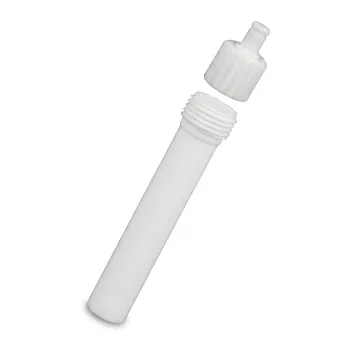
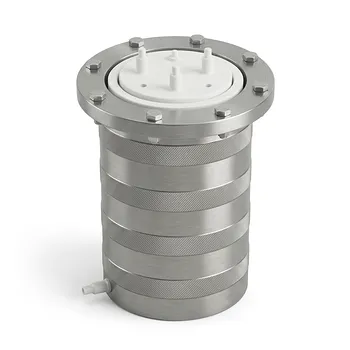
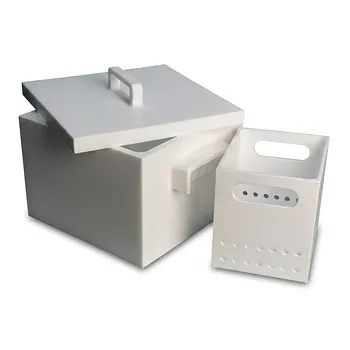
The primary reason for using a PTFE-lined autoclave in Nb2C MXene synthesis is the in situ generation of hydrofluoric acid (HF). The chemical reaction between NaBF4 and concentrated hydrochloric acid creates an extremely corrosive environment that would rapidly degrade standard stainless steel reactors.
A PTFE liner acts as an essential chemical barrier that protects the structural integrity of the autoclave while preventing metallic contamination from leaching into the synthesized Nb2C MXene.
Managing Corrosive Chemical Environments
The Danger of In Situ HF Generation
In the aluminum etching process, NaBF4 reacts with concentrated hydrochloric acid to produce hydrofluoric acid (HF) directly within the reaction vessel.
HF is one of the most aggressive chemicals used in material science, capable of etching glass and rapidly corroding most metals.
Without a protective barrier, the internal walls of a standard stainless steel autoclave would be dissolved, leading to reactor failure and safety hazards.
Exceptional Chemical Inertness
Polytetrafluoroethylene (PTFE), commonly known as Teflon, is chosen because it is nearly immune to chemical attack.
It provides a stable surface that does not react with the strong acids or the oxidizing precursors used during the hydrothermal process.
This inertness ensures that the chemical energy of the reaction is focused entirely on the aluminum etching of the precursor, rather than attacking the container.
Maintaining Material Purity and Integrity
Preventing Metal Ion Contamination
A critical requirement for MXenes like Nb2C is high electrochemical purity.
If the acidic reaction environment were to contact the stainless steel body, iron, chromium, and nickel ions would leach into the solution.
These metallic impurities can become embedded in the MXene layers, significantly impairing the final material's electrochemical performance and structural properties.
Ensuring Controlled Crystallization
The hydrothermal process relies on a sealed environment to create autogenous pressure and high temperatures, often exceeding 150°C.
The PTFE liner maintains its mechanical stability under these conditions, providing a consistent environment for directional crystallization.
By isolating the reactants, the liner ensures that the resulting Nb2C nanostructures are uniform and free from external chemical interference.
Understanding the Trade-offs and Limitations
Temperature Constraints
While PTFE is highly resistant to chemicals, it has a functional temperature ceiling, typically around 250°C.
Exceeding this limit can cause the liner to soften, deform, or undergo "creep," which may compromise the seal of the autoclave.
For reactions requiring even higher temperatures, specialized materials like PPL (polyphenylene polymers) must be used instead.
Thermal Expansion Gaps
PTFE has a much higher coefficient of thermal expansion than the stainless steel jacket surrounding it.
If the liner is not properly sized or cooled slowly, the differential expansion can cause the liner to crack or become stuck within the metal body.
Users must follow strict heating and cooling protocols to prevent mechanical fatigue of the liner over multiple synthesis cycles.
How to Apply This to Your Synthesis Project
Successful synthesis of Nb2C MXene depends on the careful selection and maintenance of your hydrothermal equipment.
- If your primary focus is material purity: Ensure your PTFE liner is thoroughly cleaned with dilute acid between runs to remove any residual ions or precursors.
- If your primary focus is safety and longevity: Regularly inspect the liner for discoloration or "pitting," which indicates that the material is nearing the end of its functional life.
- If your primary focus is high-temperature reactions: Verify that your target temperature is at least 20-30°C below the rated maximum of your PTFE liner to avoid deformation.
By prioritizing the integrity of the PTFE barrier, you ensure a safe reaction environment and the production of high-quality, high-performance MXenes.
Summary Table:
| Feature | Role in Nb2C MXene Synthesis |
|---|---|
| Chemical Inertness | Resists in situ HF and concentrated HCl during aluminum etching. |
| Purity Protection | Prevents iron, chromium, and nickel ions from leaching into the MXene layers. |
| Structural Integrity | Protects the stainless steel autoclave body from catastrophic acid corrosion. |
| Pressure Stability | Maintains a sealed environment for autogenous pressure and uniform crystallization. |
| Temp. Resistance | Reliable performance for hydrothermal reactions up to 250°C. |
Elevate Your Synthesis with KINTEK’s High-Performance Fluoropolymers
Precision in MXene synthesis demands equipment that can withstand the harshest corrosive environments. KINTEK specializes in providing an exhaustive range of high-performance laboratory supplies crafted exclusively from PTFE and PFA to ensure your research remains uncontaminated and safe.
From essential labware like beakers, crucibles, and reagent bottles to advanced apparatus such as PTFE-lined hydrothermal synthesis liners, microwave digestion vessels, and custom electrochemical cells, we provide the tools necessary for high-purity trace analysis. Whether you need standard consumables—like stirring bars, tubing, and filters—or bespoke non-standard machined parts via our end-to-end custom CNC fabrication, KINTEK is your dedicated partner for fluoropolymer excellence.
Ready to secure your laboratory’s performance? Contact KINTEK today to discuss your custom fabrication needs or high-volume orders.
References
- Octavian Dumitru Pavel, Hermenegildo Garcia. Nb <sub>2</sub> C Mxene as a bifunctional acid–base and oxidation/hydrogenation catalyst. DOI: 10.1039/d5ey00004a
This article is also based on technical information from Kintek Knowledge Base .
Related Products
- PTFE Lined High Pressure Digestion Vessel 50ml High Temperature Hydrothermal Synthesis Tank
- Custom TFM Reaction Vessel with Stainless Steel Jacket and PTFE Inner Cup for High Corrosion Resistance
- High Purity PTFE Microwave Digestion Vessel Replacement Liner for Acid Sample Preparation and Trace Analysis
- High Purity TFM Microwave Digestion Vessels PTFE Acid Evaporation Liners Domestic GT-400 Equivalent Laboratory Reaction Containers
- High Pressure Custom TFM Reactor Stainless Steel Outer Vessel PTFE Inner Cup for Corrosive Synthesis
People Also Ask
- What are the benefits of using a PTFE-lined vessel for carbon-sulfur cathode treatment? Maximize Purity & Performance
- Why are PTFE-lined pressure digestion vessels required for the preparation of Ag/CeO2 catalysts? Purity & Performance
- What is the function of high-pressure PTFE digestion vessels in mineral analysis? Optimize Sample Mineralization
- What safety features are typically incorporated into high-pressure PTFE digestion vessel designs? Ensure Lab Safety
- What is the function of PTFE lined high-pressure vessels in g-C3N4 synthesis? Achieve High-Purity Material Growth