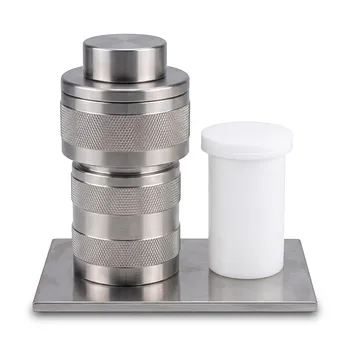
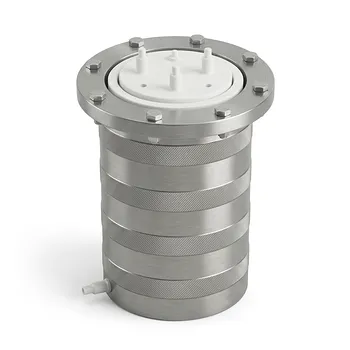
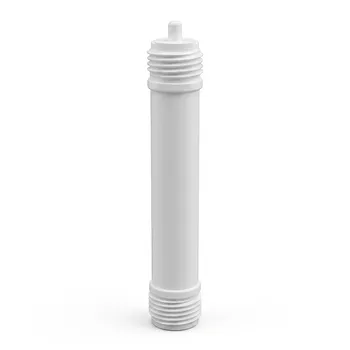
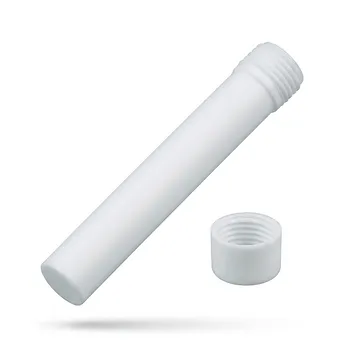
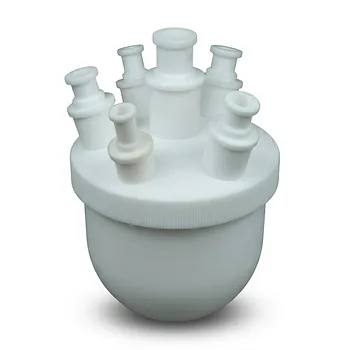
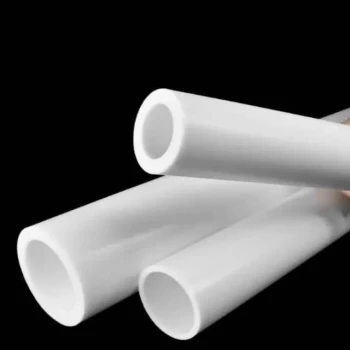
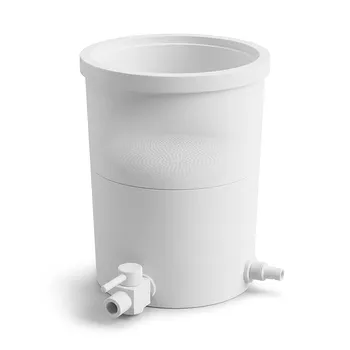
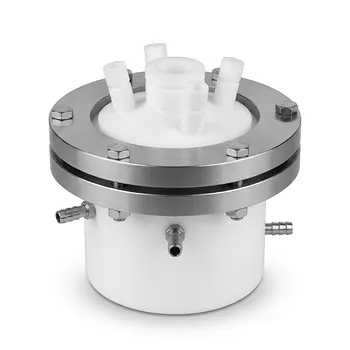
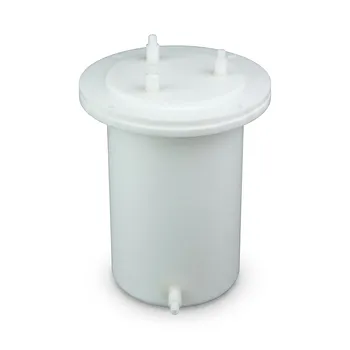
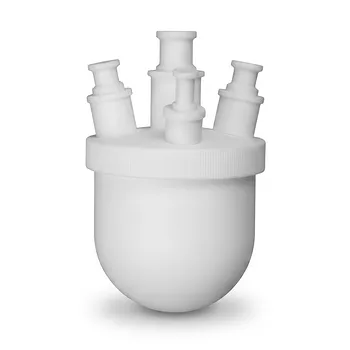
A PTFE liner is a fundamental requirement for hydrothermal synthesis because it creates a chemically inert barrier between the reaction and the metal autoclave. Specifically, it prevents metal ions from leaching into the polymer dots, which would otherwise quench their fluorescence and compromise the purity of their surface functional groups. This isolation ensures that the resulting nanomaterials maintain high optical performance and consistent chemical structures.
The PTFE liner serves as the "clean room" of the hydrothermal reactor, providing a chemically neutral and non-stick environment that protects both the purity of the polymer dots and the integrity of the stainless steel vessel. It is essential for preventing metallic contamination that would otherwise degrade the optoelectronic properties of the synthesized materials.
Protecting Optical and Chemical Purity
Eliminating Fluorescence Quenching
One of the most critical reasons for using a PTFE liner is to prevent the introduction of metal impurities. If reactants come into direct contact with the stainless steel walls of an autoclave, metal ions can leach into the solution, where they act as "quenchers" that significantly reduce the fluorescence intensity of the polymer dots.
Preserving Surface Functional Groups
Polymer dots rely on specific surface functional groups for their solubility and reactivity. The chemical inertness of PTFE ensures that these functional groups do not interact with the vessel walls, maintaining the precise chemical identity of the dots during the high-pressure synthesis.
Creating a Sealed Inert Environment
The liner provides a completely sealed environment that is isolated from external contaminants. This ensures that the crystal growth and polymerization processes occur in a controlled space, resulting in nanomaterials with uniform morphology and high purity.
Engineering for Extreme Chemical Environments
Resistance to Corrosive Solvents
Hydrothermal synthesis often involves the use of strong acids, bases, or organic solvents that would rapidly erode a stainless steel vessel. PTFE (Polytetrafluoroethylene) is virtually immune to chemical attack, allowing researchers to use aggressive reagents without damaging the hardware.
Managing High Temperatures and Pressures
The PTFE liner is designed to withstand the internal pressures generated during heating while maintaining its shape. Most standard liners are rated for temperatures up to 220°C, providing a stable reaction carrier for the majority of polymer dot synthesis protocols.
Protecting the External Autoclave
Beyond protecting the sample, the liner serves as a sacrificial barrier for the autoclave itself. By preventing corrosive media from touching the metal shell, it prevents pitting and structural weakening of the expensive stainless steel outer vessel.
Facilitating Efficient Sample Recovery
Utilizing Non-Stick Properties
PTFE is renowned for its anti-adhesion or "non-stick" characteristics. This property is vital for polymer dots, as it prevents the synthesized materials from sticking to the walls, ensuring a higher yield and easier collection of the final product.
Simplifying the Cleaning Process
Because residues do not easily bond to the PTFE surface, the liners are significantly easier to clean and decontaminate between experiments. This reduces the risk of cross-contamination between different batches of nanomaterials.
Facilitating Material Collection
The excellent mold-release properties of the liner allow for the complete recovery of nanopowders or single-crystal materials. This is especially important when working with small-scale experimental yields where every milligram of product is valuable.
Understanding the Trade-offs and Limitations
Temperature Ceiling Constraints
While PTFE is highly stable, it has a definite thermal limit, typically around 220°C to 250°C. Exceeding these temperatures can cause the liner to soften, deform, or release toxic vapors, which can compromise the experiment and safety.
Issues with Thermal Expansion
PTFE has a much higher coefficient of thermal expansion than the stainless steel that surrounds it. If the liner is filled too high or heated too rapidly, the expansion of the PTFE can cause it to deform or "creep," potentially making it difficult to remove from the autoclave after the reaction.
Porosity and Memory Effects
Over many uses, PTFE can become slightly porous, potentially trapping minute amounts of previous reactants. While superior to metal, users must still implement rigorous cleaning protocols or replace liners periodically to ensure the highest levels of purity for sensitive optoelectronic applications.
Optimizing Your Hydrothermal Synthesis Strategy
When preparing for the synthesis of polymer dots, the choice and handling of your liner should align with your specific research objectives.
- If your primary focus is maximum fluorescence yield: Always use a fresh or rigorously acid-washed PTFE liner to ensure zero metal ion interference.
- If your primary focus is synthesis at temperatures above 230°C: Consider alternative liner materials like PPL (Polyphenylene polymers) or PFA, which may offer higher thermal stability than standard PTFE.
- If your primary focus is high-throughput production: Maintain a dedicated set of liners for specific reaction types to prevent any risk of cross-contamination between different chemical precursors.
Selecting the right liner is not merely a matter of convenience, but a technical necessity for ensuring the optical integrity and structural purity of high-performance polymer dots.
Summary Table:
| Key Feature of PTFE Liner | Benefit for Synthesis | Impact on Polymer Dots |
|---|---|---|
| Chemical Inertness | Prevents metal ion leaching from autoclave | Maintains high fluorescence intensity and purity |
| Corrosion Resistance | Withstands strong acids, bases, and solvents | Protects the steel vessel and prevents contamination |
| Non-Stick Surface | Prevents material adhesion to vessel walls | Ensures higher yield and effortless sample recovery |
| Sealed Environment | Creates a controlled, isolated reaction space | Facilitates uniform morphology and crystal growth |
| Thermal Stability | Maintains integrity up to 220°C-250°C | Provides a safe carrier for high-pressure protocols |
Elevate Your Synthesis with KINTEK’s Precision Fluoropolymer Solutions
At KINTEK, we understand that the success of your research hinges on the purity of your environment. Whether you are synthesizing high-performance polymer dots or conducting complex trace analyses, our high-performance PTFE and PFA laboratory supplies are engineered to eliminate contamination and ensure material integrity.
From everyday basic labware like beakers, crucibles, and reagent bottles to advanced hydrothermal synthesis liners, microwave digestion vessels, and custom-machined electrochemical cells, KINTEK manufactures virtually every laboratory essential. Our expertise extends to comprehensive fluid transfer components, sample prep tools, and high-volume orders, all backed by end-to-end custom CNC fabrication.
Don't let impurities compromise your results. Contact us today to learn how our high-performance fluoropolymer products and bespoke fabrication services can support your next breakthrough.
Contact KINTEK for a Custom Quote
References
- Soumen Ghosh, Subrata Chattopadhyay. A fluorescent nonconjugated zwitterionic polymer dot: hydrothermal synthesis and application in the nano-molar sensing of 2,4,6-trinitrophenol. DOI: 10.1039/d5nr00455a
This article is also based on technical information from Kintek Knowledge Base .
Related Products
- PTFE Lined High Pressure Digestion Vessel 50ml High Temperature Hydrothermal Synthesis Tank
- High Pressure Custom TFM Reactor Stainless Steel Outer Vessel PTFE Inner Cup for Corrosive Synthesis
- Custom TFM Reaction Vessel with Stainless Steel Jacket and PTFE Inner Cup for High Corrosion Resistance
- High Purity PTFE Microwave Digestion Vessel for Soil and Food Analysis Acid Resistant Fluoropolymer Sample Preparation Liners
- High Purity TFM Microwave Digestion Vessels PTFE Acid Evaporation Liners Domestic GT-400 Equivalent Laboratory Reaction Containers
People Also Ask
- What are the benefits of using a PTFE-lined vessel for carbon-sulfur cathode treatment? Maximize Purity & Performance
- Why are PTFE-lined pressure digestion vessels required for the preparation of Ag/CeO2 catalysts? Purity & Performance
- What safety features are typically incorporated into high-pressure PTFE digestion vessel designs? Ensure Lab Safety
- What is the function of high-pressure PTFE digestion vessels in mineral analysis? Optimize Sample Mineralization
- What is the function of PTFE lined high-pressure vessels in g-C3N4 synthesis? Achieve High-Purity Material Growth