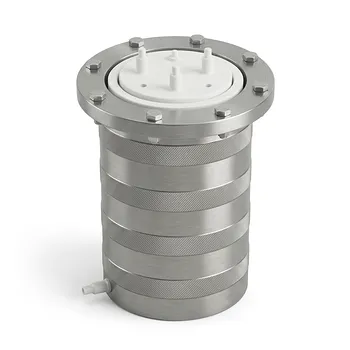
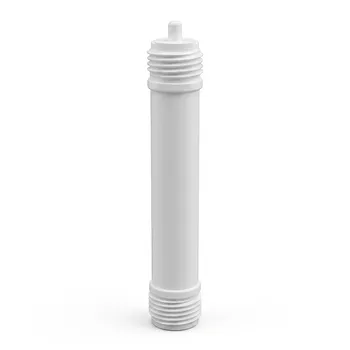
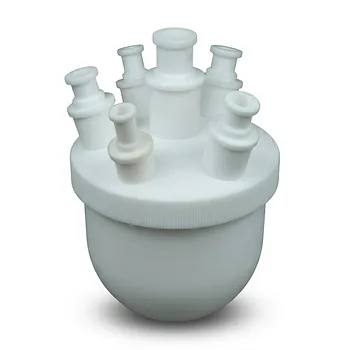
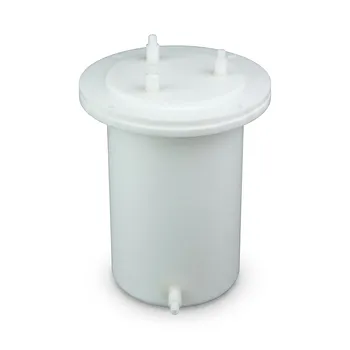
A Polytetrafluoroethylene (PTFE) liner is essential because it provides a chemically inert reaction environment that survives the aggressive solvents and temperatures required for MOF formation. Specifically, it withstands the 120°C heat and the corrosive nature of solvents like N,N-dimethylformamide (DMF), while preventing metal ions from the autoclave walls from contaminating the UiO-66-NH2(Zr) crystals.
The PTFE liner serves as a dual-purpose barrier: it protects the structural integrity of the stainless steel reactor from corrosive precursors and ensures the high chemical purity of the synthesized MOF by preventing metal ion leaching and product scaling.
Chemical Stability in Aggressive Environments
Resistance to Organic Solvents and Precursors
The synthesis of UiO-66-NH2(Zr) typically involves DMF and acidic precursors that can be highly reactive. PTFE is uniquely resistant to almost all chemicals, ensuring the liner does not degrade or react with the synthesis solution during the process.
Thermal Endurance at Synthesis Temperatures
Hydrothermal (or solvothermal) reactions for this MOF often occur at 120°C. PTFE maintains its mechanical properties and chemical resistance at these elevated temperatures, providing a stable vessel that does not soften or release impurities into the reaction mixture.
Sealing and Pressure Maintenance
The inherent properties of PTFE liners facilitate a tight seal within the stainless steel autoclave. This maintains the constant pressure and temperature environment necessary for the consistent nucleation and growth of the MOF framework.
Preservation of Framework Purity
Preventing Metal Ion Contamination
If the reaction solution directly touched the stainless steel walls of an autoclave, metal ions like iron or nickel could leach into the solution. These impurities would integrate into the UiO-66-NH2(Zr) lattice, potentially altering its porosity, catalytic activity, or fluorescence properties.
Ensuring Surface Functional Group Integrity
High-purity PTFE prevents external contaminants from interfering with the amino (-NH2) functional groups on the organic linkers. This ensures that the final nanocomposite retains the specific chemical signature and surface area required for its intended application.
High Product Recovery via Non-Stick Surfaces
The non-stick properties of PTFE prevent the MOF crystals from scaling or adhering to the reactor walls. This allows for nearly total recovery of the synthesized powder and simplifies the cleaning process, preventing cross-contamination between different synthesis batches.
Understanding the Trade-offs
Temperature Limitations
While PTFE is excellent for standard synthesis, it has a strict upper thermal limit, typically around 250°C. Exceeding this temperature can cause the liner to deform or "creep," which may lead to seal failure or the release of toxic fluorinated vapors.
Mechanical Deformation Under Pressure
PTFE is a relatively soft plastic that can undergo permanent deformation over many high-pressure cycles. Users must regularly inspect liners for thinning or "crowning" at the base to prevent catastrophic failure of the inner vessel.
Slow Heat Transfer
As a polymer, PTFE is an insulator and conducts heat much more slowly than the outer metal shell. This requires longer equilibration times to ensure the internal reaction temperature actually matches the set point of the oven or heating mantle.
How to Apply This to Your Project
Making the Right Choice for Your Goal
- If your primary focus is Maximum Sample Purity: Always use a high-purity, virgin PTFE liner to eliminate the risk of metal ion leaching from the autoclave body.
- If your primary focus is High-Yield Recovery: Leverage the non-stick nature of the liner by using ultrasonic cleaning or gentle scraping to recover all MOF particles from the walls.
- If your primary focus is Equipment Longevity: Ensure the liner is properly seated and not over-pressurized, as this protects the expensive stainless steel outer shell from irreversible corrosion.
- If your primary focus is Reaction Consistency: Pre-heat your autoclave for a longer duration to account for the thermal insulation provided by the thick PTFE walls.
The PTFE liner is the unsung hero of MOF synthesis, providing the sterile, stable environment necessary for the precise assembly of complex molecular frameworks.
Summary Table:
| Feature | Impact on UiO-66-NH2(Zr) Synthesis |
|---|---|
| Chemical Inertness | Resists aggressive DMF and acidic precursors without degradation. |
| Contamination Barrier | Prevents metal ions (Fe, Ni) from the autoclave leaching into the MOF lattice. |
| Non-Stick Surface | Maximizes crystal recovery and prevents product scaling on reactor walls. |
| Thermal Stability | Maintains structural integrity and sealing at standard 120°C reaction temps. |
Elevate Your MOF Research with KINTEK’s High-Performance Fluoropolymers
Precision in hydrothermal synthesis demands materials that never compromise your results. At KINTEK, we specialize in the absolute focus on high-performance fluoropolymers, providing the chemical inertness and thermal stability your lab requires.
Whether you need everyday basic labware (beakers, measuring cylinders, crucibles, reagent bottles) or advanced derivative apparatus like hydrothermal synthesis liners, microwave digestion vessels, and custom electrochemical cells, we deliver. From high-purity trace analysis instruments to comprehensive fluid transfer components (tubing, fittings, valves), our products are crafted from premium PTFE and PFA to ensure zero contamination.
Why choose KINTEK?
- End-to-End Customization: Our custom CNC fabrication can deliver everything from complex non-standard machined parts to high-volume bespoke setups.
- Complete Lab Solutions: We provide everything from sample prep tools (filters, pipettes, tweezers) to general consumables (O-rings, seal tapes, stirring bars).
- Unmatched Purity: Specifically designed for demanding applications like UiO-66-NH2(Zr) synthesis.
Ready to optimize your laboratory setup? Contact us today to discuss your custom requirements!
References
- Md Humayun Kabir, Meser M. Ali. Simultaneous Electrochemical Sensing of Ultra-Trace Multiple Heavy Metals Using Metal–Organic Frameworks-Graphene Oxide Nanocomposite-Modified Electrodes. DOI: 10.1021/acsomega.5c07592
This article is also based on technical information from Kintek Knowledge Base .
Related Products
- PTFE Lined High Pressure Digestion Vessel 50ml High Temperature Hydrothermal Synthesis Tank
- High Pressure Custom TFM Reactor Stainless Steel Outer Vessel PTFE Inner Cup for Corrosive Synthesis
- Custom TFM Reaction Vessel with Stainless Steel Jacket and PTFE Inner Cup for High Corrosion Resistance
- High Purity PTFE Microwave Digestion Vessel for Soil and Food Analysis Acid Resistant Fluoropolymer Sample Preparation Liners
- High Purity TFM Microwave Digestion Vessels PTFE Acid Evaporation Liners Domestic GT-400 Equivalent Laboratory Reaction Containers
People Also Ask
- What are the benefits of using a PTFE-lined vessel for carbon-sulfur cathode treatment? Maximize Purity & Performance
- Why are PTFE-lined pressure digestion vessels required for the preparation of Ag/CeO2 catalysts? Purity & Performance
- What is the function of high-pressure PTFE digestion vessels in mineral analysis? Optimize Sample Mineralization
- What safety features are typically incorporated into high-pressure PTFE digestion vessel designs? Ensure Lab Safety
- What is the function of PTFE lined high-pressure vessels in g-C3N4 synthesis? Achieve High-Purity Material Growth