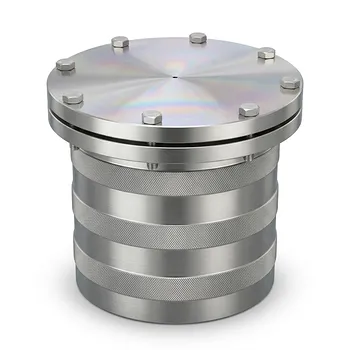
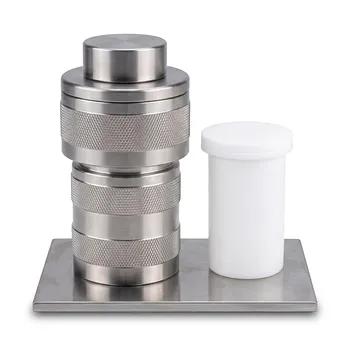
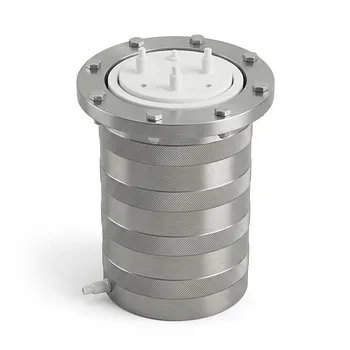
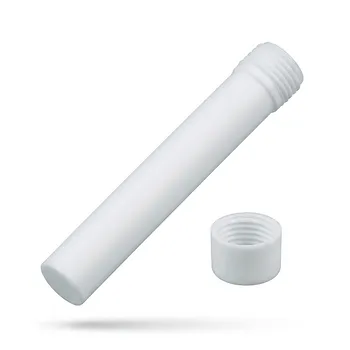
The hydrothermal synthesis of Magnetic Chitosan and Reduced Graphene Oxide (RGO) requires a PTFE-lined stainless steel autoclave to simultaneously manage extreme physical pressure and aggressive chemical environments. The stainless steel outer shell provides the mechanical strength necessary to contain high-pressure vapors, while the Polytetrafluoroethylene (PTFE) liner acts as a chemically inert barrier that prevents corrosive reagents from destroying the vessel or contaminating the product.
Core Takeaway: This dual-material design decouples the reactor's functions: the stainless steel handles the structural load of high-pressure synthesis, while the PTFE liner ensures chemical purity by resisting corrosion from the strong bases and oxidants required to form the composite material.
The Role of the Stainless Steel Outer Shell
Withstanding Autogenous Pressure
Hydrothermal synthesis occurs in a sealed environment where temperatures often exceed the boiling point of the solvents used. This creates autogenous pressure, a self-generated internal force that can be immense.
The stainless steel body is engineered to withstand these high-pressure conditions without deforming or rupturing. It ensures the reaction remains contained at temperatures typically ranging from 120°C to 200°C.
Maintaining Subcritical Fluid States
By providing a rigid, sealed environment, the autoclave maintains solvents in a subcritical state. This phase is essential for facilitating the growth of crystals and the uniform deposition of materials like Magnetic Chitosan onto the graphene framework.
The Necessity of the PTFE Liner
Exceptional Chemical Inertness
The synthesis of Reduced Graphene Oxide and Magnetic Chitosan often involves strong bases, oxidants, and organic solvents. These chemicals are highly corrosive to bare metal, especially at elevated temperatures.
PTFE is chosen because it is one of the most chemically stable materials available. It resists degradation from the aggressive precursors, ensuring that the vessel remains intact over multiple synthesis cycles.
Prevention of Metal Ion Contamination
If the reaction solution were to contact the stainless steel directly, the corrosive environment would cause metal ions (such as iron, chromium, or nickel) to leach into the mixture.
For magnetic materials and RGO, even trace amounts of leached metal can ruin the product’s purity. The PTFE liner acts as a physical shield, ensuring the structural integrity of the composite and its intended electrochemical or magnetic performance.
Facilitating Phase Transitions and Growth
The combination of a sealed pressure environment and a non-reactive surface is vital for material development. In similar processes, such as $MoS_2$ or $MnO_2$ synthesis, this environment promotes crystalline development and specific phase transitions that are impossible in open-air reactors.
Understanding the Trade-offs
Temperature Limitations
While PTFE is highly inert, it has a clear thermal ceiling. Most PTFE liners are rated for a maximum continuous operating temperature of around 200°C to 220°C.
Exceeding these limits can cause the liner to soften or deform, potentially leading to a seal failure. For reactions requiring higher temperatures, specialized materials like PPL (Para-polyphenylene) must be used.
Thermal Lag and Cooling Rates
The dual-layer design introduces a degree of thermal lag. Because PTFE is an insulator, the internal reaction temperature may take longer to reach the setpoint of the external heating source.
Furthermore, these autoclaves must be cooled slowly. Rapid cooling can cause the PTFE liner and the stainless steel shell to contract at different rates, leading to permanent warping of the liner.
How to Apply This to Your Project
Making the Right Choice for Your Goal
- If your primary focus is high purity: Always inspect the PTFE liner for scratches or discoloration before use, as surface defects can trap impurities from previous batches.
- If your primary focus is safety and longevity: Never fill the PTFE liner more than 80% of its total capacity to allow sufficient "headspace" for gas expansion during heating.
- If your primary focus is synthesizing RGO with strong acids: Ensure the autoclave seal is tightened according to the manufacturer’s torque specifications to prevent acidic vapors from escaping and corroding the outer steel threads.
By correctly balancing the mechanical strength of steel with the chemical resistance of PTFE, you create the stable, high-energy environment necessary for advanced material synthesis.
Summary Table:
| Component | Primary Function | Material Benefit | Critical Limitation |
|---|---|---|---|
| Stainless Steel Outer Shell | Structural Support | Withstands high autogenous pressure (120°C - 200°C) | Susceptible to corrosion from acids/bases |
| PTFE (Teflon) Liner | Chemical Barrier | Exceptional inertness; prevents metal ion contamination | Thermal ceiling of ~200°C-220°C |
| Combined System | Reaction Containment | Enables subcritical fluid states for crystal growth | Requires slow cooling to prevent warping |
Elevate Your Material Synthesis with KINTEK’s Precision Fluoropolymer Engineering
Achieving the perfect hydrothermal synthesis for Magnetic Chitosan or Reduced Graphene Oxide requires hardware that never compromises on purity or safety. KINTEK specializes in high-performance PTFE and PFA laboratory solutions designed to withstand the most aggressive chemical environments.
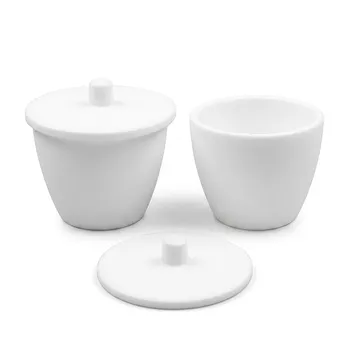
From everyday basic labware like beakers, crucibles, and reagent bottles to advanced hydrothermal synthesis liners, microwave digestion vessels, and custom electrochemical cells, we provide the tools necessary for precision research. Our expertise extends to comprehensive fluid transfer components, sample prep tools, and high-purity trace analysis instruments.
Why partner with KINTEK?
- End-to-End Customization: Our full CNC fabrication capabilities allow us to deliver everything from complex non-standard machined parts to bespoke laboratory setups.
- Unmatched Material Focus: We maintain an exclusive focus on high-performance fluoropolymers to ensure your samples remain free from contamination.
- Scalable Solutions: Whether you need a single custom liner or a high-volume order of consumables, we maintain the highest manufacturing standards.
Contact KINTEK today to discuss your specific project requirements and let our experts provide the high-performance fluoropolymer solutions your lab deserves!
References
- Mojtaba Abbasi, Fahimeh Abrinaei. Magnetic chitosan/reduced graphene oxide nanocomposites: Hydrothermal synthesis, structural analysis, and application in anthracene removal. DOI: 10.1063/5.0245293
This article is also based on technical information from Kintek Knowledge Base .
Related Products
- Custom TFM Reaction Vessel with Stainless Steel Jacket and PTFE Inner Cup for High Corrosion Resistance
- PTFE Lined High Pressure Digestion Vessel 50ml High Temperature Hydrothermal Synthesis Tank
- High Pressure Custom TFM Reactor Stainless Steel Outer Vessel PTFE Inner Cup for Corrosive Synthesis
- High Purity TFM Microwave Digestion Vessels PTFE Acid Evaporation Liners Domestic GT-400 Equivalent Laboratory Reaction Containers
- High Purity PTFE Microwave Digestion Vessel Replacement Liner for Acid Sample Preparation and Trace Analysis
People Also Ask
- Why are high-performance pressure-resistant reaction vessels required for oxygen-assisted hydrothermal conversion at 150 °C?
- Why are high-quality fluoropolymer-lined reaction vessels required for alk-Ti3C2Tx MXene? Ensure Purity & HF Resistance
- How do magnetic stirring and reaction vessels impact MOF-derived carbon quality? Optimize Your Composite Performance
- Why are PTFE-lined reaction vessels necessary for forced degradation studies? Ensure high-purity results and accuracy.
- Why is a high-purity PTFE lined reaction vessel required for the acidic etching of MXenes? Ensure Material Purity.