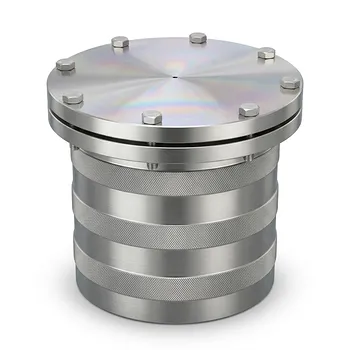
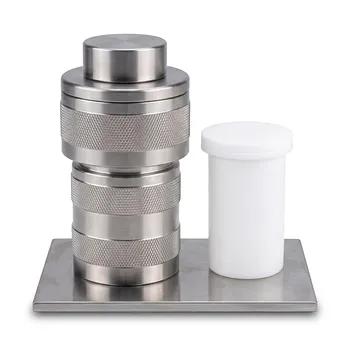
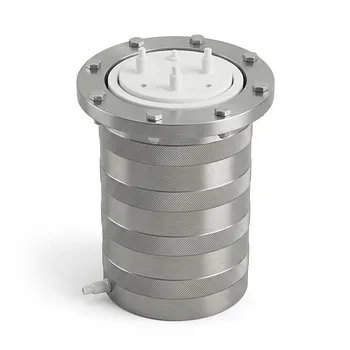
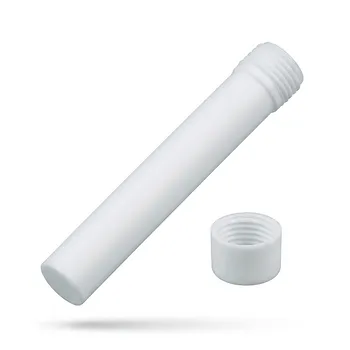
The necessity of a PTFE-lined stainless steel autoclave stems from the need to balance extreme chemical resistance with structural integrity. During the solvothermal synthesis of WS2, the reaction environment must contain corrosive precursors like tungsten hexachloride and sulfur sources at temperatures typically ranging from 200°C to 210°C. Without this dual-material system, the reaction would either breach the vessel due to high autogenous pressure or become contaminated by the corrosion of the container walls.
A PTFE-lined autoclave functions as a "nested" reaction environment where the outer steel shell provides the mechanical strength to withstand high pressure, while the inner PTFE liner ensures chemical purity. This specific configuration is required to facilitate the controlled growth and morphological evolution of tungsten disulfide nanostructures without interference from metallic impurities.
The Synergistic Design: Strength Meets Inertness
Managing Extreme Autogenous Pressure
The solvothermal process involves heating solvents beyond their boiling points within a sealed vessel, generating significant autogenous pressure. The external stainless steel shell acts as a pressure vessel, providing the mechanical strength necessary to safely contain these forces at temperatures up to 210°C.
Preventing Chemical Degradation and Corrosion
Reaction precursors, specifically high-concentration chlorides and sulfur-bearing compounds, are highly aggressive toward metal. The PTFE (polytetrafluoroethylene) liner is chosen for its exceptional chemical inertness, acting as a physical barrier that prevents these chemicals from eroding the internal steel walls.
Ensuring Thermal Stability
The synthesis of WS2 nanostructures requires a stable thermal environment to ensure consistent phase engineering. The autoclave assembly allows for a "closed-system" reaction, maintaining a constant temperature and pressure that would be impossible in an open-vessel configuration.
Maintaining Purity and Controlled Growth
Eliminating Metal Ion Contamination
If the reaction solution were to contact the stainless steel directly, metal ions (such as iron, nickel, or chromium) would leach into the solution. The PTFE liner prevents this cross-contamination, ensuring that the resulting WS2 nanostructures maintain high crystalline purity and optimal electrochemical properties.
Facilitating Morphological Evolution
The controlled, high-pressure environment inside the liner is critical for the ordered growth of WS2 nanosheets and complex superstructures. By maintaining a stable environment, the system allows for precise "morphological evolution," where the nanostructures grow into specific shapes required for their intended applications.
Optimizing Product Recovery
PTFE is characterized by an extremely smooth, non-stick surface. This property is vital for the subsequent recovery of solid precipitates, allowing researchers to collect synthesized powder sediments easily and completely without losing material to the vessel walls.
Understanding the Trade-offs and Constraints
Temperature Limitations of PTFE
While PTFE is highly inert, it has a functional temperature ceiling, typically around 250°C. Exceeding this limit can cause the liner to soften, deform, or release toxic vapors, which limits the solvothermal synthesis to specific temperature windows.
Thermal Expansion Mismatch
Stainless steel and PTFE expand at different rates when heated. This necessitates careful design of the autoclave to ensure the liner does not crack or become pinched, which could lead to precursor leakage and subsequent damage to the outer steel shell.
The "Filling Factor" Risk
The volume of the precursor solution (the filling factor) must be strictly controlled, usually between 60% and 80%. Under-filling can lead to insufficient pressure for nanostructure growth, while over-filling risks a dangerous pressure spike that could exceed the mechanical limits of the steel shell.
Applying This to Your Synthesis Goals
How to Select Your Operational Parameters
When configuring your solvothermal setup, your choice of autoclave use should be dictated by your specific material requirements and safety protocols.
- If your primary focus is high crystalline purity: Ensure the PTFE liner is pristine and free of scratches to prevent any trace metal leaching from the steel shell.
- If your primary focus is complex morphology (superstructures): Prioritize precise temperature control within the 200°C–210°C range to maintain the steady autogenous pressure required for ordered growth.
- If your primary focus is maximum yield recovery: Use the non-stick properties of the PTFE liner to your advantage by employing centrifugal recovery of the sediments directly from the liner.
The combination of a PTFE liner and a stainless steel shell remains the definitive standard for synthesizing high-quality WS2 nanostructures safely and reliably.
Summary Table:
| Component | Primary Function | Key Benefit for WS2 Synthesis |
|---|---|---|
| Stainless Steel Shell | Structural Integrity | Safely contains high autogenous pressure at 200°C–210°C. |
| PTFE Liner | Chemical Inertness | Prevents metal ion leaching and corrosion from chlorides/sulfur. |
| Non-stick Surface | Product Recovery | Ensures easy and complete collection of solid nanostructure precipitates. |
| Closed System | Thermal Stability | Maintains a constant environment for controlled morphological growth. |
Optimize Your Synthesis with KINTEK’s Precision Fluoropolymer Labware
Ensure the success of your WS2 synthesis with high-performance equipment designed for extreme environments. At KINTEK, we specialize in high-performance fluoropolymer materials, offering everything from everyday basic labware (beakers, measuring cylinders, and reagent bottles) to advanced reaction apparatus like PTFE-lined autoclaves, microwave digestion vessels, and custom electrochemical cells.
Our end-to-end custom CNC fabrication ensures we can deliver everything from high-purity trace analysis instruments and fluid transfer components (tubing, fittings, valves) to complex, non-standard machined parts tailored to your specific research needs. Whether you require high-volume orders or bespoke laboratory setups, KINTEK provides the chemical resistance and structural reliability necessary for cutting-edge material science.
Ready to elevate your lab's performance? Contact us today to discuss your custom requirements!
References
- Somveer Somveer, Jitendra Gangwar. Insights into phase engineering and morphological tailoring of WS<sub>2</sub> nanostructures via temperature controlled hydrothermal synthesis. DOI: 10.1088/2632-959x/addada
This article is also based on technical information from Kintek Knowledge Base .
Related Products
- Custom TFM Reaction Vessel with Stainless Steel Jacket and PTFE Inner Cup for High Corrosion Resistance
- PTFE Lined High Pressure Digestion Vessel 50ml High Temperature Hydrothermal Synthesis Tank
- High Pressure Custom TFM Reactor Stainless Steel Outer Vessel PTFE Inner Cup for Corrosive Synthesis
- High Purity TFM Microwave Digestion Vessels PTFE Acid Evaporation Liners Domestic GT-400 Equivalent Laboratory Reaction Containers
- High Purity PTFE Microwave Digestion Vessel Replacement Liner for Acid Sample Preparation and Trace Analysis
People Also Ask
- Why are high-performance pressure-resistant reaction vessels required for oxygen-assisted hydrothermal conversion at 150 °C?
- How do magnetic stirring and reaction vessels impact MOF-derived carbon quality? Optimize Your Composite Performance
- Why are high-quality fluoropolymer-lined reaction vessels required for alk-Ti3C2Tx MXene? Ensure Purity & HF Resistance
- Why are PTFE-lined reaction vessels necessary for forced degradation studies? Ensure high-purity results and accuracy.
- Why is a high-purity PTFE lined reaction vessel required for the acidic etching of MXenes? Ensure Material Purity.